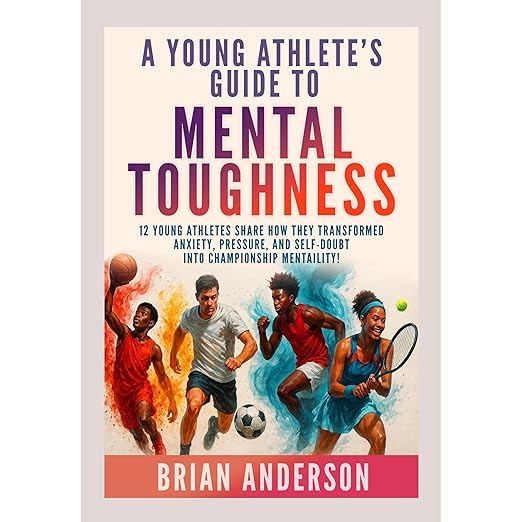
Before You Press Play
- Subjects: game-day anxiety, visualization, mental resets, twelve teenage case studies.
- Tone: Brisk and encouraging, built as short stories with one technique attached to each.
- Bottom line: A useful mental-skills primer for young athletes, sold with a workbook's worth of extras the audio cannot hand over.
Printable progress trackers, a cheat sheet and an emergency game-day checklist: the bonus section of this audiobook advertises four things nobody can print from a pair of earbuds. That is not a small quibble. The description sells a workbook, complete with templates to fill in, a checklist to keep in a kit bag and a technique sheet to consult before a match, while the edition actually on sale runs 4 hours and 35 minutes as an audio file. Whatever survives the change of format has to survive without the paper.
Machine Narration Meets a Promise of Teen Voices
Virtual Voice sits in the narrator field, which means the reading is machine-generated rather than performed by a person. That fact belongs at the top, because it collides with what the description promises. A book of first-person accounts from twelve teenagers, each one supposedly written in an authentic teen voice, is being delivered by a voice belonging to nobody. No line of the description explains how the synthesis handles the switch from one young narrator to the next, and the credit is the only information available.
Brian Anderson stands alone in the author field, while the description contradicts that in its very first line: written by young athletes, for young athletes. Further down, the book becomes a collection of real stories from twelve teen athletes who turned fear into focus. So who made this? An author who gathered and shaped a dozen accounts, a dozen teenagers with an editor behind them, or something between the two? The publisher line reads Independently Published, which settles nothing, and the page never returns to the question.
Maya's five-minute breathing reset, Jamal's mental movie method, Jordan's Teflon technique for handling trash talk, and Priya's zone formula are the four named in the copy, with eight more promised behind them. Each attaches to a named teenager and one specific problem: pre-game panic, converting practice success into clutch performance, staying steady under provocation, turning anxiety into flow. As a structure that is genuinely smart. A technique tied to a person and a bad afternoon is far easier to recall under pressure than a technique tied to a principle.
Kelvin's Account Clarifies What's Actually Inside
Confidence is the real subject, and sports psychology written for teenagers is a thin shelf, which gives this book an actual reason to exist. The responses support that in specific terms. One reader describes years of training hard while ignoring the mental side of the sport, and names game-day stress, panic and anxiety as the thing that had been holding them back. Another calls the strategies practical and actionable, and the tone natural and deeply relatable to young competitors. That is the value proposition, stated by the people it was aimed at.
Parents and coaches are who the description is really addressing, whatever the cover says about teen voices. It quotes them directly, under a heading announcing that parents and coaches are raving: a daughter who went from anxious to confident, a son who stopped freezing during games. It lists individual sports by name so that a search will surface it. It signs off by telling you to order your copy today and help your young athlete. This is a sales page that has been pasted into a description field, and it reads exactly like one.
Kelvin, one of the five voices in this column, gives the clearest account of the contents to be found here: twelve case studies of young athletes, written in their own voices, describing the psychological pressures they face and the specific techniques they use to get past them. Another response calls the writing conversational and credits that with making the situations easy to relate to. Between them the responses describe a consistent object, which is more than the description above them manages.
Reviews Predate December's Release by Months
Steph Curry and Chauncey Billups are the professional names the copy drops, alongside a claim that these techniques are being used by athletes right now. The reader who left the most enthusiastic response names a different athlete altogether, calling a visualization exercise attributed to Kobe the favorite part of the whole book. That name appears nowhere in the description. One of the two accounts is incomplete, and nobody reading this page can work out which one from the evidence provided.
Independently published titles often carry response columns older than their audio editions, and this one is an extreme case. Four of the five responses predate the December 12, 2025 release: three of them from August 2025, and a fourth dated December 2, ten days short of it. Only the final response, from February 2026, arrives afterward. Each of them was responding to some earlier form of the book. Their praise may well be sound on the content, and none of it can concern the recording, because the recording did not yet exist.
Sports psychology in audio has one structural advantage and one structural problem. The advantage is real: a breathing exercise is easier to follow spoken than read, and a young athlete can run one in a locker room with headphones on and nobody watching. The problem is everything the bonus section lists, from printable templates and a checklist to a cheat sheet and access to an online athlete community. None of that arrives through the file, and the page never explains how a listener is meant to reach any of it.
Case Studies Survive the Move Into Audio Well
Buy this for the household where a teenager trains hard and falls apart on game day, and where a four-hour listen stands a better chance of happening than a workbook does. The case-study format survives the move into audio better than most self-help structures, because a story with a name attached to it holds attention on its own terms. Coaches hunting for language they can borrow when talking to a nervous player will find plenty of it here, ready to use.
Hold off if your athlete actually needs the worksheets, if a synthetic reading will lose a teenager inside five minutes, or if you want the sourcing checked before handing over advice about anxiety. The page's own claims about authorship do not agree with one another, and its most enthusiastic reader remembers a name the description never prints. Hand it to a teenager who would rather listen than read, and it may well do what these readers say it did for them.
Before You Listen
Does this audiobook include the printable templates the description promises?
Not in any usable form. The bonus section advertises progress-tracking templates, an emergency game-day checklist, a cheat sheet and access to an online community, every one of which needs paper or a screen. The page never explains how a listener reaches them, so treat those extras as unavailable until you confirm otherwise.
Are the reviews on this audiobook about the audio edition?
Almost certainly not. Four of the five predate the December 2025 audio release, three of them by several months, and every single one of them talks about reading rather than listening. They are useful on the content and worthless on the recording, which is the distinction to hold on to.