A Wrinkle in Time has been in print for over sixty years, has a Newbery Medal, a spot on Time Magazine's list of the 100 best fantasy books of all time, a Disney film adaptation, and, per the cover copy on this listing, a mention on Stranger Things. Meg Cabot's blurb calls it "one of my favorite books of all time," adding, "I've read it so often, I know it by heart." This particular audiobook edition, released in 2012 through Listening Library, comes with more production layered around Madeleine L'Engle's original 1962 novel than a typical children's audio release: an introduction, a foreword, and an afterword, each read by a different person, before Meg Murry's own story even begins.
The Credited Narrator Doesn't Read the Novel
The novel itself needs little introduction at this point in its life. Late one night, three otherworldly beings sweep Meg Murry, her brother Charles Wallace, and their friend Calvin O'Keefe off on a mission to rescue Mr. Murry, who has vanished while doing secret government work. The trio travels by tesseract, a wrinkle that folds space and time, to the planet Camazotz, where a dark, controlling force holds Mr. Murry captive and threatens more than just one family. Reviewer Mike London, working through the whole Time Quartet for the first time as an adult, calls it "one of the most memorable and unusual books" read in years, despite a few reservations about how the later sequels in the series get labeled.
Here is where this particular listing gets genuinely strange: the narrator field names only Charlotte Jones Voiklis, L'Engle's granddaughter, but the synopsis is explicit that Voiklis reads the afterword specifically, not the novel itself. That same synopsis states the introduction is read by film director Ava DuVernay and the foreword by "the author," meaning L'Engle's own voice, presumably an archival recording. Who actually narrates the six-plus hours of Meg, Charles Wallace, and Camazotz, the actual story a listener is paying for, is not named anywhere in this listing's data. That is worth knowing before pressing play: the one credited name belongs to a supplementary piece, not the book itself.
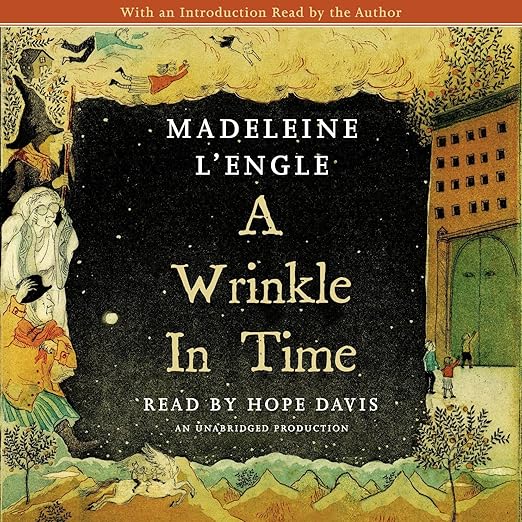
The cover art credit tucked at the bottom of the synopsis is its own small detail worth noting: 2007 artwork by Taeeun Yoo, used with permission of Pippin Properties, a literary agency rather than the publisher itself. Combined with the three separately credited voices for the introduction, foreword, and afterword, this listing reads like a production that cleared an unusual number of individual rights and contributors just to assemble its front and back matter, well before Meg Murry ever boards a tesseract. For a sixty-year-old title, that level of layered permissions and guest contributors says something about how much institutional weight now surrounds this specific book.
Three Perspectives Bookend a Sixty-Year-Old Story
Part of the appeal here is the sheer density of supplementary material bookending the story. A listener gets a director's perspective from Ava DuVernay, who adapted the novel for the 2018 Disney film, an archival reading from L'Engle introducing the novel, and a family perspective from Voiklis closing it out. That is a lot of context for a book that, per the synopsis, first published over sixty years ago and has spent that entire time being handed to new readers, including reviewer Marcel Dupasquier, who bought a fiftieth-anniversary print edition of the novel years before finally getting around to this audiobook.
Genre-blending premise, part science fiction, part fantasy, part family rescue mission, still reads as genuinely unusual for the genre, which is likely why it keeps earning new attention decades on: a Newbery Medal in its own era, a Disney adaptation more recently, and a reference on Stranger Things pulling in an audience raised on that show rather than the original novel. Reviewer Kat, revisiting the book after reading it as a child, singles out Meg and Charles Wallace by name as the reason the reread worked, calling the different worlds and the way the characters are tested through to the final battle worth returning to as an adult.
The central threat in Camazotz is also worth flagging for anyone expecting a lighter fantasy adventure: this is not a monster-of-the-week story but a planet-wide force that has already swallowed Mr. Murry, a scientist doing secret government work, and threatens to do the same to Meg, Charles Wallace, and Calvin before the book is through. That darker undercurrent, wrapped inside a story ostensibly aimed at younger listeners, is part of why the book has held up across generations rather than reading as a simple children's rescue fantasy, and it is worth knowing going in if you are choosing this for a sensitive young listener.
Untranslated Reviews Sit in Spanish and Italian
Beyond the narrator-credit puzzle above, this listing includes two non-English reviews sitting alongside the English ones, one in Spanish and one in Italian, both short and positive but left untranslated on the page. Anyone weighing foreign-language user feedback as part of a buying decision should know that two out of the five posted reviews will not be readable without translation, even though the audiobook itself and its synopsis are entirely in English.
It is also worth being clear-eyed about the runtime: six hours and twenty-seven minutes for a full novel plus an introduction, foreword, and afterword sits on the shorter side, which tracks with this being a middle-grade original rather than an adult-length production, but it means the bonus material likely eats a real chunk of that runtime rather than being a token few minutes tacked onto the end of the recording.
Supplementary Material Outweighs the Missing Credit
This audiobook edition is worth choosing over other available options if the supplementary material actually interests you, DuVernay's directorial perspective, L'Engle's own archival voice, Voiklis's family reflection, since that layered framing is what this specific release adds beyond the novel itself. Families introducing the book to a new reader, adult listeners revisiting a childhood favorite via the Time Quartet that Mike London describes working through, and anyone drawn in by the Stranger Things reference will all find plenty here. Listeners who specifically want to know who reads Meg's actual story before buying, rather than just the framing material around it, should look for a listing that names that narrator directly, since this one does not. Everyone else will likely find the missing credit a minor asterisk next to a genuinely well-assembled edition of a book that has earned its long shelf life.