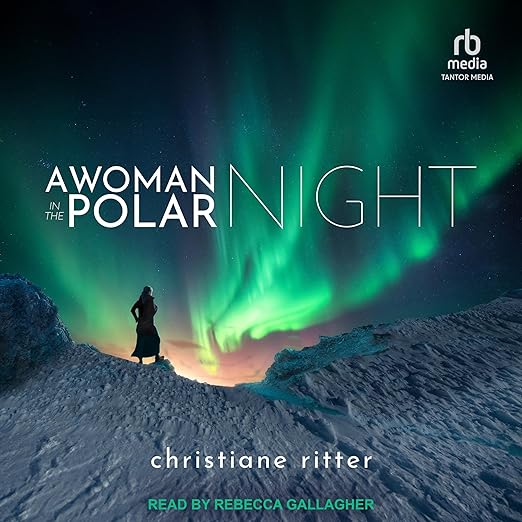
I finished A Woman in the Polar Night on a Sunday evening in early spring, when the light outside was doing something tentative and the apartment was very quiet, and I found that I had been sitting in the same chair for two hours without particularly noticing. Christiane Ritter has that effect. She is writing about an experience so far outside ordinary life that the prose should strain to communicate it, and instead it breathes with a naturalness that I kept stopping to admire. This is a book from 1938, originally written in German, that manages to feel entirely contemporary in a way that has nothing to do with modernity and everything to do with the quality of attention Ritter brings to what she is seeing.
The setup is almost impossibly dramatic on paper: an Austrian painter leaves her comfortable bourgeois life in 1934 to join her husband on a remote Arctic island called Spitsbergen, where they live in a tiny hut on a lonely fjord for a year. She expects something vaguely romantic, thick books and long sleeps. What she finds is a physical reality so demanding and a landscape so overwhelming that the first chapters are shot through with something close to despair. And then, slowly, something shifts. By the end of the year she is walking alone across sea ice in polar darkness and describing it with an equanimity that is more convincing than any ecstasy.
What Christiane Ritter Delivers
The book's most remarkable quality is the way Ritter uses exterior description to track interior transformation without ever making the symbolism heavy-handed. The Arctic in the depth of its polar night is not metaphorical in Ritter's telling; it is specific, physical, and strange in itself. And yet the progressive change in how she writes about it maps almost exactly onto the change in how she writes about herself. Early on the darkness is oppressive. By midwinter she is lying outside watching the northern lights with something approaching reverence. That movement from horror to love is the book's real subject, and Ritter is precise enough about both ends of the spectrum to make it feel earned rather than predetermined.
Reviewers have described the descriptive writing here as among the best they have ever encountered, and one noted that it never feels like filler, which is the right standard to hold it to. Ritter was a painter, and her eye for light, color, and the quality of silence in extreme cold is the kind of specificity that makes a reader feel genuinely located in a place they have never been and could not easily reach.
What Christiane Ritter Gets Right
Rebecca Gallagher's narration is the kind that becomes invisible in the best possible way. She does not impose a theatrical register on a memoir that is resolutely untheatrical. Ritter's prose is precise and understated, occasionally ironic about her own discomfort, and Gallagher finds the tone exactly: intelligent, observant, capable of humor without sentimentality. The moments of genuine emotion in the book, and there are several, arrive with more force precisely because Gallagher has not been building toward them all along. The seven-hour runtime is ideal for this material. Any shorter and the accumulation of the Arctic year would not register. Any longer and the prose's deliberate pace would become something harder to sustain.
Several reviewers note that Ritter's husband comes across as less sympathetic than she presents him, that his apparent imperviousness to her suffering early in the stay reads as indifference rather than stoicism. Ritter does not make this argument explicitly, but it surfaces in what she does not say as much as what she does. A reviewer observed that he seems not very nice, and others found in this an additional layer of the book: the story of a woman finding not just peace in the Arctic but a self that did not depend on anyone else's recognition of her.
Where Christiane Ritter Loses Some Ground
A Woman in the Polar Night was largely out of print for decades before a new English translation revived its reputation. Its inclusion in the Pushkin Press Classics series signals what the publishing world now recognizes: this is not a period curiosity but an enduring piece of writing about the relationship between extreme landscape and interior life. It belongs in conversation with books like Nan Shepherd's The Living Mountain or Peter Matthiessen's The Snow Leopard, works that use the encounter with overwhelming nature to ask questions about what consciousness is and what it requires.
The 4.6 rating across nearly 900 listeners reflects a title that found its ideal audience rather than a broad one. This is not adventure writing in the conventional sense. Nothing catastrophic happens. Nobody is heroically saved. But by the end of seven hours you have been somewhere real and come back changed by the going, which is what the best travel writing has always offered.
Who Should Pick Up A Woman in the Polar Night
Listen to this if you respond to nature writing that is more interested in consciousness than action, or if the literature of extreme solitude, from Thoreau to Kerouac's Desolation Angels, has ever moved you. It pairs beautifully with The Living Mountain for a listening sequence. Skip it if you want narrative momentum or dramatic incident. This is a book about sustained attention, and it requires a similar quality of attention from the listener.
Good to Know
Is A Woman in the Polar Night available in a translation, and does the translation affect the audiobook experience?
The Pushkin Press edition uses a contemporary English translation of Ritter's original German, and the prose reads with a freshness that suggests careful translating rather than period rendering. Rebecca Gallagher's narration treats it as living prose rather than a historical document, which is the right approach.
What is the listening experience like during the polar night sections, when Ritter describes months of darkness?
These are the book's most extraordinary passages. Ritter describes the quality of perpetual darkness with a precision that is visual rather than atmospheric, and the shift in her response to it over the course of the winter is the emotional heart of the memoir. Gallagher's measured pacing makes these sections feel immersive rather than claustrophobic.
Is this a book primarily for outdoor enthusiasts and adventure readers, or does it have a broader literary appeal?
The literary appeal is significant and arguably primary. Ritter is a more self-aware and philosophically interesting writer than the adventure genre label suggests. Her interests are in perception, solitude, and the relationship between the external world and inner life, which puts her closer to the essay tradition than to expedition writing. Readers who come for the Arctic often stay for the thinking.