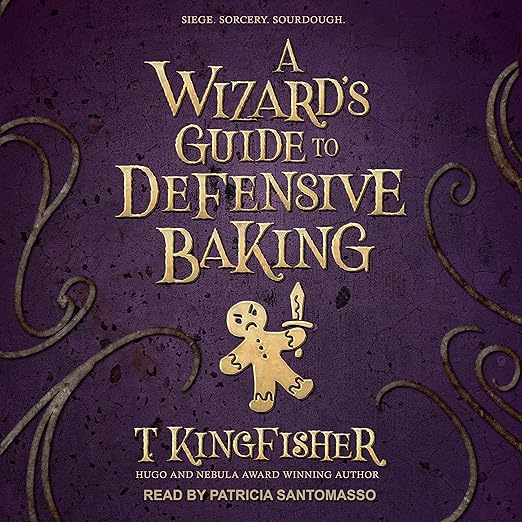
A dead body on the bakery floor is how this story starts, and the audiobook carrying it sits in the children's category with a Mystery and Suspense tag attached. Eight hours and thirty minutes, Patricia Santomasso reading, Tantor Audio publishing. One reviewer quotes the opening line back at us, and it is a fourteen-year-old announcing that a dead girl was lying in her aunt's shop. Whether that belongs on a children's shelf is the question this listing declines to answer, and the review column argues about it without ever quite noticing.
A Closer Look at A Wizard's Guide to Defensive Baking
Mona is fourteen and not the sort of wizard the city has been relying on. She cannot call lightning or speak to water. Her familiar is a sourdough starter, her magic works on bread and nothing else, and her ordinary life consists of making gingerbread men dance in the family bakery. Then she finds the body, an assassin turns out to be hunting magic folk through the streets, and Mona appears to be next on his list. The city has been emptied of wizards, which makes the assassin the smaller of her problems.
Charm is what the description sells. Reviewers describe something carrying considerably more weight than that. Citron opens by calling it light-hearted and then lists what actually arrives: layers about how fear and propaganda hurt innocent people for what they did not choose to be. Jenifer Francis summarizes a plot in which Mona is accused of the murder, becomes a target herself, and ends up in the middle of a war while wizards turn up dead across the kingdom. That is not a bakery comedy with a mystery attached to it, whatever the cover promises.
Shelf placement is the interesting problem. This page files the title for children and tags it Mystery and Suspense. Jenifer Francis headlines the response as a fun YA adventure novel. techyjack calls it a young adult story outright and places its edge above Harry Potter and below the Hunger Games, attributing that edge to the active participation of two young protagonists in death and war. Three separate readings, three different age brackets, and a listing that supplies no guidance of its own. The category label was applied by somebody who was not reading closely.
What Makes A Wizard's Guide to Defensive Baking Worth Hearing
Patricia Santomasso carries the recording alone across all eight and a half hours, and the tonal range required is the real assignment. A voice has to sell dancing gingerbread and sentient sourdough as funny in one chapter and a murdered child as serious in the next, in the first-person register of a teenager who is frightened and dry about it. Get that balance wrong in either direction and the book collapses into whimsy or into gloom. No second reader is credited and no full-cast production is claimed anywhere on the page.
Eight hours and thirty minutes turns out to be about the right size for what this does. Shal B read it in one sitting and recommends it flatly. At this length the story can develop the propaganda thread Citron responds to without losing the comic engine that makes it bearable, and a listener gets a complete arc in roughly two commutes or one long afternoon. Nothing on the page indicates a series, so what you buy resolves inside the runtime and leaves you owing nobody a sequel.
Affection in the column attaches to Mona specifically. C.Peter Albertson describes a protagonist who is practical, stubborn, kind in a way that sneaks up on you, and armed with an extremely specific magical ability, then admits to being far more moved than expected by a book about sourdough and homicidal gingerbread. Shal B mentions the supporting cast by name and finds all of them interesting. A first-person heroine whose narration has to be funny while she is frightened is exactly the sort of role a recording lives or dies on, and the column's warmth is no help at all in judging it, since none of that warmth is directed at the reading.
The Caveats
Parents shopping in the children's category should know what they are buying. The first line puts a dead girl on the floor. An assassin hunts a fourteen-year-old through a city. Wizards die throughout the kingdom, a war breaks out, and the emotional argument concerns crowds being turned against people for something they had no say in. Citron mentions tears alongside the laughter. None of that is unsuitable for a capable ten-year-old, and none of it is what the word children usually signals on a listing page.
Yardsticks the reviewers reach for repay careful reading, because they come from readers and not from the publisher. Harry Potter and the Hunger Games mark the edges of a range in techyjack's account, and Minor Mage gets named as the more disquieting book by the same author. Those references tell you about the reviewer's shelf as much as about this title. Anyone using them to make a decision should treat them as rough bearings, not as classifications anybody official has signed off on.
What the listing itself withholds is more of a problem than what the reviews disagree about. No recommended age band. No content note of any kind. No indication whether the title stands alone, though nothing suggests otherwise. Response dates run from August 2020 through to January 2026, which tells you the book has kept finding readers for years, and tells you nothing about whether any of them heard this recording. Every written response here stays on the story and skips past the performance entirely.
Who T. Kingfisher Is Writing For
Adults who like their fantasy funny and their stakes real are the natural fit here, along with confident readers of roughly eleven and up, which is where the reviewers who bothered to guess landed. The bread magic is a genuinely fresh constraint and the book takes it seriously enough to build a war around it. The category label is a poor reason to hand this to a younger child, and comfort fantasy without propaganda, murder and mass death is not what that opening line promises. Decide the age question yourself, because the filing will not do it for you.
A Few Questions About A Wizard's Guide to Defensive Baking
Is this audiobook really a children's title?
It is filed that way and tagged Mystery and Suspense, which is a strange pairing. The story opens with a dead girl on a bakery floor, involves an assassin hunting a teenager, and builds toward a war with a propaganda thread running through it. The category is doing very little work here.
How dark does the story get?
Dark enough that one reader attributes the edge to two young protagonists taking part in death and war. Wizards die across the kingdom, Mona is accused of murder and then hunted, and a reviewer describes layers about how fear turns crowds against innocent people. Laughter and tears both get mentioned.
Does one reader cover the whole audiobook?
Yes. Patricia Santomasso holds the entire eight hours and thirty minutes, with no second performer or full-cast credit listed. That puts the tonal balancing act on a single voice, since the same narration has to carry sentient sourdough comedy and a murdered child within the same chapters.