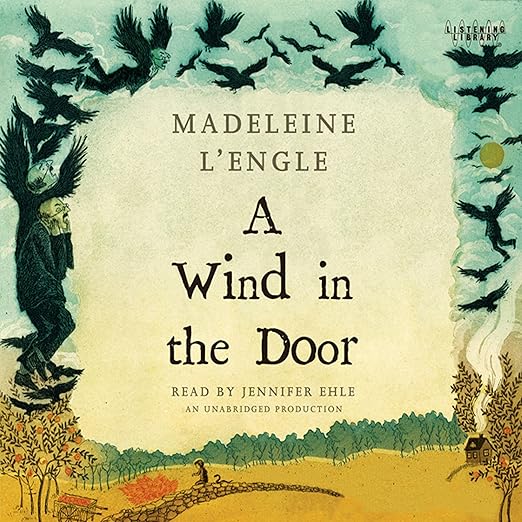
Charles Wallace sees dragons in the vegetable garden before this audiobook's plot even properly starts, and by the time anyone figures out those 'dragons' are actually a cherubim named Proginoskes, made of 'wings and eyes, wind and flame,' Meg Murry is already being pulled into a rescue mission that takes place, unusually, inside a brother's body rather than across the galaxy this series is known for.
Genuinely strange even by this series' own standards, the premise turns on Charles Wallace 'falling death ill,' and saving him means Meg, Calvin, and Proginoskes traveling 'deep within Charles Wallace' at a cellular scale rather than confronting an external villain across space. Charles J. Kravetz's review, written about the Kindle edition specifically, confirms the shift in scale directly, 'the story takes place inside his body,' with Charles Wallace himself sidelined from the action this time, unlike in the first Quintet book.
Abstract, philosophical stakes replace a purely physical threat here: the Echthroi are introduced as 'those who hate,' and the synopsis frames the goal as restoring 'brilliant harmony and joy to the rhythm of creation, the song of the universe' rather than simply defeating a monster. Kravetz's review credits the series broadly with including 'enough real science to keep the adult thinking' while still working for children, a difficult balance this particular book leans on especially hard given its biology-scale setting. The synopsis is also candid that the tone shifts alongside the scale: 'brilliant harmony and joy' sit right next to a cherubim's introduction as something out of a nightmare, and reconciling those two moods across five and a half hours is arguably the narrator's hardest job on this specific title.
What Madeleine L'Engle Gets Right
Jennifer Ehle narrates, and a story that moves between a family kitchen, a school principal's office, and the inside of a single human cell needs a reader who can shift registers without losing the thread connecting them, since the synopsis treats mitochondria and cosmic evil as part of one continuous scale. Not one of the five available reviews weighs in on Ehle's actual performance, so genre range alone, rather than a confirmed track record, has to carry the casting argument here.
This is also the second of five Quintet books, and reviewers treat the whole set as a unit worth collecting rather than sampling individually: KJ Samples's grandchild 'enjoyed it and has requested the others in the series' after this one specifically, a pattern suggesting audio works as a gateway into the remaining four Quintet titles just as easily as print editions do.
Where Madeleine L'Engle Loses Some Ground
Read the reviews on this listing with real caution, because most of them are not describing this audiobook at all. Charles J. Kravetz states directly, 'This review is for the Kindle edition ebook.' Gwen's five-star review is about 'this edition (Square Fish boxed set)' specifically, praising cover art and bonus interview material that obviously has no audio equivalent. Kindle Customer's three-star review complains about the text 'format' changing 'from book form to scroll' inside a Kindle app, and the anonymous four-star review describes a physical copy arriving with 'front and back covers' that 'are a bit creased.' Gwen's review goes further still, describing that boxed set's overall design as 'earthy, simple, and with just a splash of whimsy,' then adding a specific complaint about a bonus interview repeated across every book in the set, calling it 'a tedious disappointment to finish a novel' and find the same extra material waiting again. None of that packaging frustration has anything to do with what you would actually hear in this recording.
That leaves KJ Samples's review as the one account that could plausibly describe any format neutrally, meaning this listing's written reviews offer almost no direct evidence about the audio experience itself. The rating badge shows three ratings behind a 4.4 average, while five people actually left something in writing, one at four stars and one at three, so the visible record includes real, specific complaints, just not ones about anything you would actually hear. Weigh the star rating itself accordingly: it may say more about packaging and file formats across several different retail editions than about the story or its narration.
Should You Listen to A Wind in the Door?
Kids already partway through the Wrinkle in Time Quintet, comfortable with real science folded into fantasy stakes, are the clear audience; the synopsis's own closing list confirms this is book two of five, following A Wrinkle in Time and preceding A Swiftly Tilting Planet, Many Waters, and An Acceptable Time. Families collecting the whole set, the way KJ Samples's grandchild apparently is, get the most out of committing to audio across all five rather than switching formats partway through. Listeners who want their science fiction to actually engage with real biology and physics, rather than treating them as set dressing, are also well served, going by how consistently Kravetz's review credits the series with taking its science seriously even at a children's reading level.
Newcomers should start with A Wrinkle in Time itself rather than here; Kravetz's review confirms this book depends on already knowing Charles Wallace and Meg's established relationship. And if what actually drew you in was Gwen's review of a boxed set with striking cover art and bonus interviews, remember that none of that physical packaging or extra content transfers to this specific audio edition.
At a Glance
- Voice: Jennifer Ehle narrates; every available review discusses a print or Kindle edition instead, so this recording's actual performance is still an open question.
- Big ideas: science folded into fantasy stakes, sibling rescue at a cellular scale, cosmic forces of hatred versus harmony
- Atmosphere: Strange, philosophical, and tender
- Worth it?: A stranger, more interior sequel than the first Quintet book, best saved until after A Wrinkle in Time.
Questions Listeners Ask
Should listeners start with A Wrinkle in Time before this one?
Yes. This is the second book in the Wrinkle in Time Quintet, and one reviewer notes it depends on the established relationship between Meg and Charles Wallace from the first book. Starting here without that context means missing why the rescue at the center of this story matters so much.
Do the reviews on this audiobook's listing actually describe the audio experience?
Mostly not. One reviewer specifies writing about the Kindle ebook, another describes a print boxed set with bonus interviews, another complains about Kindle text formatting, and another mentions creased physical covers. Only one review is format-neutral, so treat most of the visible feedback as background rather than evidence about this recording.
Who narrates this Wind in the Door audiobook, and is there any feedback on the performance?
Jennifer Ehle narrates. Every review attached to this listing focuses on a print or ebook edition instead of evaluating the narration, leaving no direct evidence yet about how the audio performance itself actually sounds, or how Ehle handles the shifts between Meg, Calvin, and Proginoskes.
Does this audiobook stay focused on outer space adventure like the first Wrinkle in Time book?
No, and that is part of what makes it distinct. The rescue mission takes place inside Charles Wallace's own body at a cellular scale rather than across the galaxy, with a cherubim named Proginoskes guiding Meg through a much more interior, philosophical kind of danger.