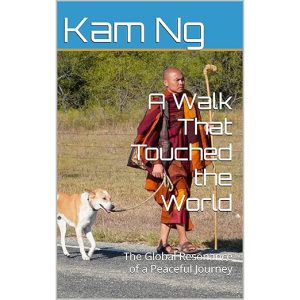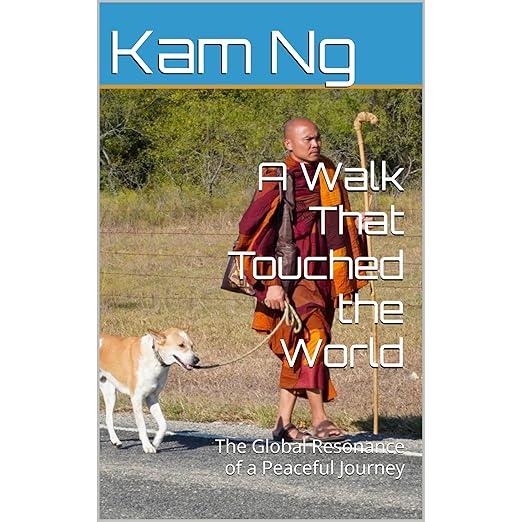
Ninety-six minutes of audio carry a movement that took months to organize, and that compression is the first thing worth saying about this audiobook. Kam Ng is not writing a chronicle of a peace walk so much as an argument about what walking together means, and the argument runs at a pace that never lets a single afternoon on the route slow it down. Whether that suits you depends entirely on what you came for. Anyone hoping for reportage will find something closer to a sermon delivered at a lectern, sincere and raised in register from the opening minute.
A Closer Look at A Walk That Touched the World
Kam Ng builds the book around a sequence of abstractions: origins, motivations, the social and moral context, the physical journey and the symbolic one running beside it. Students, families, elders, civic leaders and faith groups all step forward in the account, named as categories rather than as people. That choice gives the writing a certain dignity, and it also means the walk never quite acquires an address. You come away knowing what the participants believed and almost nothing about where they stood.
Nowhere on this page does a city, a year, or an organizing body appear. The shelf tag reads North America, the series is called Significant Events and this is billed as volume one, and none of that narrows the frame by much. For a title filed under travel writing, the absence of place is a genuine oddity. A walk is a route before it is anything else. This one is described almost entirely as an idea about a route.
Something stranger sits inside the description itself. It calls the work an eBook, twice, and it refers to the book throughout as The Walk for Peace rather than by the title printed on this listing. Whoever prepared the audio page pasted the text edition's copy across without adjusting a word, so the pitch you read promises that readers will finish with a clear sense of why the walk mattered. Readers, not listeners.
What Makes A Walk That Touched the World Worth Hearing
What the book does well is hold one idea steady. Peace, in Ng's account, is not an event but an obligation renewed daily, and the walk works as a demonstration of that rather than as a climax. The quiet conversations along the road matter more than any speech at the end of it. Anyone who has sat through the rhetoric of a public march will recognize the deliberate refusal to build toward a crescendo, and will probably be grateful for it.
Length is the book's best practical argument. An hour and thirty-six minutes is a lunch break and a walk home, and the material is never dense enough to punish an interrupted session. Nothing asks you to hold a cast of names in your head or to track a chronology across chapters. You can set it aside at the midpoint and return a week later without losing the thread, which is rarer in this category than the shelf would suggest.
Solidarity as a subject curdles into slogan easily, and the writing mostly avoids that fate. The framing that carries best is the one about answering silence with purposeful action, because it puts the burden on the participant instead of on the cause. Fear met with hope is the softer half of that formulation and the less interesting one. Ng holds the harder half for the full length of the book, which counts for a good deal.
Things to Know Before Starting A Walk That Touched the World
Exactly one person has written about this title, and the verdict is a single star attached to a one-line body: this is not written from the Monks from the Walk for Peace. Whatever the accuracy of that objection, it is an objection about provenance rather than about prose, and it is the only reader testimony on offer. Somebody arrived expecting an account from the people who organized the walk and did not find one.
Star arithmetic gives out here too. Three votes are counted, the badge reads 3.5, and three whole-star ratings cannot produce that figure. Even if both silent voters handed over five stars alongside the single one-star on record, the average lands at 3.7. Whatever is generating the displayed number, it is not a plain mean of three ratings, so treat the badge as decoration and read the one written objection instead.
Narration is credited to Virtual Voice rather than to a named reader, which matters more on this title than it would on a manual or a procedural. Writing built on pauses needs somebody deciding where the pauses go: reflection, quiet, the space between two people talking on a road. No human is making those calls on this recording, and the material asks for them constantly. Budget for supplying a certain amount of that yourself.
Who Kam Ng Is Writing For
Listeners who want a short, sincere statement about civic solidarity, and who do not need names and dates attached to it, will get roughly what they came for. The book sits closer to an essay than to a report and stops pretending otherwise within the first few minutes. If you read the kind of writing that treats an ordinary act as a moral practice, this belongs on the same shelf, at a fraction of the commitment.
Give it a pass if you want the history. Anyone researching a particular march, its organizers, its route or its aftermath will find nothing to hold on to, and the lone one-star response suggests at least one buyer arrived with precisely that expectation. Pass as well if abstraction wears on you: categories of participant stand in for individuals from the first minute to the last, and no participant is named anywhere on this page.
Volume one of a series called Significant Events sets up an expectation that later entries will do the same work for other moments, and on this evidence the format will live or die on how much specificity the writer is prepared to allow. Taken as an argument rather than as a record, it holds together. Taken as an account of something that happened in North America, it dissolves the moment you ask when.
- Subjects: civic solidarity, peace as daily maintenance, ordinary people answering division
- Tone: Earnest and unhurried, pitched between essay and address
- Bottom line: A sincere short argument about collective resolve, undercut by a description that names no place, no year and no organizer.
A Few Questions About A Walk That Touched the World
Does this audiobook assume you already know about the Walk for Peace?
It assumes nothing, and it also supplies nothing. The writing introduces its own terms and never leans on background you might be missing. The flip side is that you finish about as informed on the factual side as you started, because the account stays with motivation and meaning instead of chronology.
Is A Walk That Touched the World a religious book?
Not in any doctrinal sense. Faith groups appear among the participants alongside students, families, elders and civic leaders, but the framing is civic rather than theological, and the title is shelved under travel rather than religion. Expect moral language about solidarity, not scripture or devotional material.
What does the Significant Events series label tell you about this audiobook?
Very little at present. It is marked as the first volume of a series called Significant Events, and no companion titles are named anywhere on the listing. So the label reads as an intention rather than as a catalog, and nothing indicates when or whether a second entry follows.
Would this work for a classroom or a discussion group?
Better than for solo study. The short length means a group can hear the whole thing in one session, and the moral argument gives people something to push against. Any group wanting to research the actual event will need outside sources, because names, dates and locations are absent throughout.