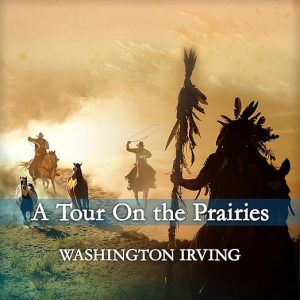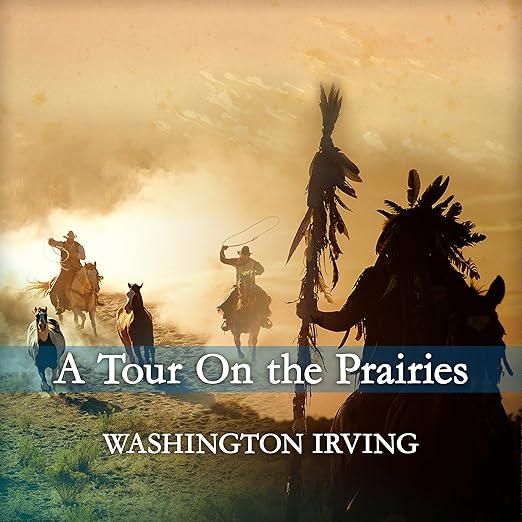
Washington Irving crossed what is now Oklahoma in 1832 as part of a government-commissioned tour of the western frontier, and the account he produced became one of the earliest works of American literary nonfiction to take the wild interior seriously as a subject. A Tour on the Prairies was published in 1835 and has never quite left print since: it documented a landscape and a way of life that were already changing rapidly, and it did so with the precise, image-hungry prose of someone who understood that what he was seeing would not be available to see much longer. As an audiobook narrated by Andre Stojka across just over six hours, it is a compact and consistently absorbing experience.
Irving arrived at the prairies as the most famous American writer alive, author of "Rip Van Winkle" and "The Legend of Sleepy Hollow," and a man who had spent the better part of seventeen years in Europe being celebrated by the literary establishment there. Returning to America in 1832 and joining the Ellsworth expedition into the Indian Territory was, for him, a deliberate act of literary repossession: he wanted to write something native, something that belonged to the American landscape rather than the European literary tradition he had been operating within. The resulting book carries that ambition in every paragraph.
The Verdict, Briefly
Irving's prose style in A Tour on the Prairies is what one reviewer called "unmistakably that of an accomplished author," and the journey framing is the vehicle through which he examines a collision of worlds he would not see again in the same configuration. He describes the prairie landscape with the specificity of someone trying to inventory it before it disappears: the movement of buffalo herds, the behavior of Osage hunters, the particular quality of light on the Great Plains at different times of day. A reader from present-day Oklahoma who reviewed the print edition described recognizing the physical landscape from Irving's descriptions nearly two centuries on, which is a remarkable testament to the precision of his observation.
The famous single-sentence synopsis Irving wrote for the book, "I found myself thus afloat, on the skin of a buffalo, in the midst of a wild river," captures the book's quality accurately. It is experiential writing rather than analytical writing, and the experience is physical in a way that surprises readers who come to Irving expecting the slightly Gothic, slightly whimsical quality of his New York stories. The prairies demanded something different, and Irving, to his credit, let them shape his prose rather than imposing his existing style on them.
Why Listen to A Tour on the Prairies
Stojka's narration handles Irving's period prose with skill. The sentence structures Irving uses are longer and more formally balanced than contemporary readers encounter in most travel writing, and a narrator who rushes them loses the quality of careful observation that distinguishes the book from a journal entry. Stojka does not rush. The result is a listening experience that rewards the kind of sustained attention the prairie landscape itself seems to have required of Irving: the patience to let the scene develop before reaching for a conclusion.
One reviewer described the book as "one of the early American publications that fashioned our ideas about the American West," and that historical significance is genuinely embedded in the text rather than just claimed by the book's reputation. Irving was writing in a moment before the American frontier had fully become mythology, when the mythologization was still in process, and his literary instincts both contributed to and occasionally resisted that process. The tension between his desire to document what he saw and his desire to render it heroic is present throughout, and it makes A Tour on the Prairies a more interesting document than its modest framing as a travel memoir might suggest.
Points to Consider
Listeners should approach Irving's depictions of Native Americans with the understanding that they are the product of a particular nineteenth-century Eastern literary perspective. Irving writes about the Osage and other peoples he encountered with more genuine curiosity than many of his contemporaries, but the framework remains one of a visitor observing people he experiences as categorically different from himself. The language and the structural assumptions of that observation are period artifacts, and they require the same kind of active contextualization that any nineteenth-century text about indigenous peoples requires from a contemporary audience.
The book is also a travelogue rather than a comprehensive historical account, which means its coverage of the political and legal context around the territory it describes is light. Irving was on the tour for roughly a month and was primarily interested in the sensory and experiential dimensions of the journey rather than the administrative machinery of westward expansion. Listeners who want a fuller account of what was happening in the Indian Territory in 1832 will need supplementary material, but those who want Irving's specific, literary, first-person encounter with the prairie landscape will find nothing has replaced it.
The Right Listener for A Tour on the Prairies
American literature readers who know Irving only through his New York stories will find this a revealing counterpart, demonstrating the range of a writer who could move between Gothic comedy and documentary travel writing without losing his prose control. Students of American frontier history will find it an invaluable primary source: not for its political analysis but for its granular, literary-quality observation of a landscape and a cultural moment at a specific point in their transformation.
General listeners interested in classic travel writing will find the six-hour runtime an accessible entry point into nineteenth-century American nonfiction. Stojka's narration makes the period style approachable rather than forbidding, and the physical vividness of Irving's best passages is fully available in the audio format. Those who prefer their audiobooks fast-paced or analytically dense should know this is a contemplative book, built for the same unhurried attention its author brought to the prairies themselves.
The Short Version
- Voice: Andre Stojka delivers Washington Irving's nineteenth-century prose with a period-appropriate formality that suits the material without creating distance.
- Big ideas: The American frontier as literary landscape, the encounter between eastern literary sensibility and wild territory, early documentary impulse in travel writing
- Atmosphere: Stately and evocative, with surprising bursts of physical urgency
- Worth it?: Irving's 1835 travelogue of the Oklahoma territory remains one of the foundational texts of American frontier literature, and Stojka's narration makes a compelling case for it in audiobook form.
A Few Questions About A Tour on the Prairies
Is this audiobook accessible to listeners unfamiliar with nineteenth-century prose style?
Yes. Irving's prose is formal by contemporary standards but not arcane, and Stojka's pacing makes the longer sentence structures easy to follow. Reviewers describe the writing as reading without too many archaic words, and the experiential nature of the content keeps the forward momentum strong.
How does the audiobook handle Irving's depictions of Native Americans in the text?
The narration presents Irving's text as written, which means listeners encounter a nineteenth-century Eastern literary perspective on the Osage and other peoples, with all the cultural assumptions that entails. The portrayal is more curious than hostile by the standards of Irving's time, but contemporary listeners will recognize the period framework and should approach it with appropriate context.
What makes this audiobook historically significant beyond being a travel memoir?
Irving was writing in 1832, before the American West became fully mythologized, and his account is one of the foundational texts in the process by which Eastern America began to construct an idea of the frontier. It is a primary document of cultural myth-formation as much as a travel record.
Is A Tour on the Prairies a standalone audiobook or part of a larger Washington Irving collection?
It stands entirely on its own. It was published as an independent work in 1835 and has no narrative connection to Irving's earlier fiction or his other Western writings. The six-hour runtime makes it a compact, self-contained listening experience.