Key Details
- Voice: One reader carries three young leads plus a zoo staff's worth of adults across two hours, so character separation is what a sample should be tested for.
- Big ideas: Zoo mystery, fair-play detection for young listeners, a long-running series growing up with its technology
- Atmosphere: Bright, brisk, low-stakes
- Worth it?: A tidy standalone case for six to nine year olds, provided you are not shopping for the 1990s version of this series.
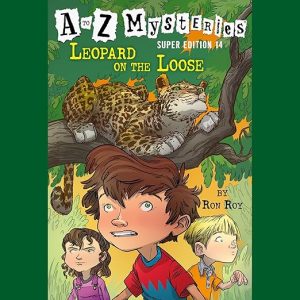
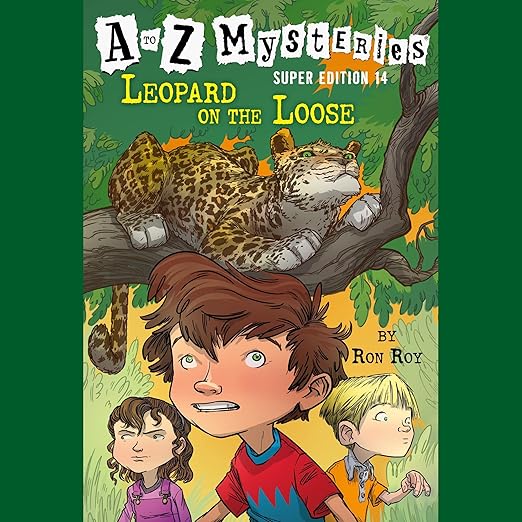
Dink, Josh and Ruth Rose have been solving alphabetical crimes since The Absent Author, and this super edition drops them into the San Diego Zoo with a rare amur leopard missing and, in the copy's cheerful formulation, everyone a suspect. Ron Roy has been running this series long enough that the shape is a known quantity: a contained setting, three friends with complementary temperaments, a puzzle a seven-year-old can follow and an eight-year-old can solve one beat ahead of the page. The audiobook runs two hours and five minutes in David Pittu's reading, which is roughly one long car journey or three bedtimes.
Two hours is the number that matters most for buyers of children's mysteries, because it determines what the book is for. This is not a bedtime serial you ration over two weeks. It is a single sitting, which is exactly why families keep buying these for road trips, and it is why the super editions, longer than the twenty-six alphabet entries, have their own following.
Modern Super Editions Get Blamed for Drones
Putting the case inside a zoo does most of the work here, and it does it well. A missing animal gives Roy a mystery where the stakes are high enough to matter and low enough to stay safe for the age group, since nobody is in danger of anything worse than a very bad afternoon, and a zoo supplies suspects with jobs, motives and access. The copy's joke about whether you can SPOT the mystery tells you the register: puns, momentum and a fair-play puzzle rather than atmosphere or dread.
What has changed since the early books is the technology, and this is where the column gets interesting. The earliest of the three votes on this listing, filed twelve days after the March 2022 release, is a one-star from a reader who came to it having loved the original run and left disappointed. The complaint is precise rather than grumpy: the story is shallow, the charm of the earlier books is gone, and the recent super editions are all about cellphones and drones and texting and internet research and shooting movies. That entry calls the book uninteresting at best, and adds that this is generous phrasing.
Whether that is a flaw depends entirely on which child you are buying for. A nine-year-old in 2026 does not experience a drone as an intrusion into a mystery; a parent who read the 1990s books does. Both reactions are legitimate, and the one-star is the only place on the page where anyone tells you which kind of book this actually is.
125 Minutes with a Single Reader, No Bookmark
Both remaining votes come from households where the series is already an institution, one describing a fourth grader who reads well above this level and comes back to these anyway, the other a shelf being filled volume by volume. That is the honest audience picture for any long-running middle grade series: the books are not being read for difficulty, they are being read for company. A familiar trio, a familiar structure, a new place to poke around in.
Audio suits that use case better than print does. A child who has outgrown the reading level can still enjoy the story at listening pace, younger siblings can ride along in the car, and Listening Library is the audio arm most experienced with exactly this kind of production. A hundred and twenty-five minutes with a single reader also means no interruption for chapter breaks, no bookmark, and no bedside light.
Alphabet framing gives the series a second use, too. Because the main run goes from The Absent Author to The Zombie Zone, families often collect toward completion, and the super editions sit alongside that project as longer standalone cases. This one requires nothing from the twenty-six, which makes it a reasonable place to test whether the series lands before committing to a shelf of it.
Silent Grades Must Average Four and Three-Quarters
Read the badge carefully. This listing shows 4.7 across a hundred and five ratings while the three written votes are a five, a five and a one, which average out well below the headline number. Run the arithmetic and the hundred and two silent grades have to average roughly four and three quarters between them for a 4.7 to hold. The lone dissent in the column is therefore not representative of what buyers actually thought, which is worth knowing before a single critical review talks you out of a purchase the crowd has quietly endorsed.
Watch the shelf metadata too. The listing files a zoo caper under Science and Technology, which looks like a misfiling until you read the one-star and realize the tags may be responding to the drones and internet research inside the plot rather than to the animals. It also means a parent browsing for a straightforward animal mystery may not find this where they expect it.
One last practical note: two hours is short enough that a sample settles the question of fit faster than any description can. With three lead children plus a zoo staff's worth of adults moving through the plot, character separation is the specific thing to listen for, because a young listener has to know who is speaking without being told.
Buying Nostalgia Means Modern Furniture Too
Buy it for six to nine year olds who want a mystery with a real solution, for reluctant readers who will happily listen to something below their reading level, and for families already invested in the series who want the longer format. It also works for a child who loves animals more than crime, since the zoo is the whole environment rather than a backdrop.
Approach with caution if you are buying nostalgia. Parents hoping to hand over the series they remember should know that the modern super editions have modern furniture in them, and that at least one longtime reader considers the trade a bad one. Handing this to a child who has never read the earlier books removes the problem entirely, which is the simplest way to make the purchase work.
A Few Questions About A to Z Mysteries Super Edition #14: Leopard on the Loose
What age is the Leopard on the Loose audiobook pitched at?
Roughly six to nine, and it travels upward comfortably. One response describes a fourth grader reading at high school level who still returns to these, which is the usual pattern for series loyalty. The puzzle is fair, the peril is minimal, and nothing in the copy suggests content a young listener would struggle with.
Do you need the earlier A to Z Mysteries before this audiobook?
No. Super editions are standalone cases, and this one introduces the three friends as it goes. Families often collect the main alphabet run toward completion, letter by letter, but the zoo mystery here assumes nothing whatsoever about what you have already heard or read.
Should the one-star review put you off?
Only if you share its specific complaint. It comes from a longtime reader of the original books who finds the recent super editions crowded with cellphones, drones and internet research, and who calls this one shallow. A child arriving fresh has no basis for that comparison and will simply get a zoo mystery.