Before You Press Play
- Narration: Crispin Redman brings patrician warmth to Fermor's prose, capturing its blend of youthful exuberance and retrospective elegance.
- Themes: Youth and wandering, pre-war Europe's vanishing world, the life of the literary traveler
- Mood: Elegiac and luminous, unhurried
- Verdict: Fermor's prose is among the finest English travel writing of the twentieth century, and Redman's narration does it genuine justice.
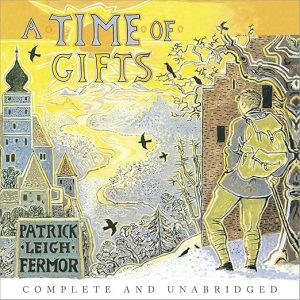
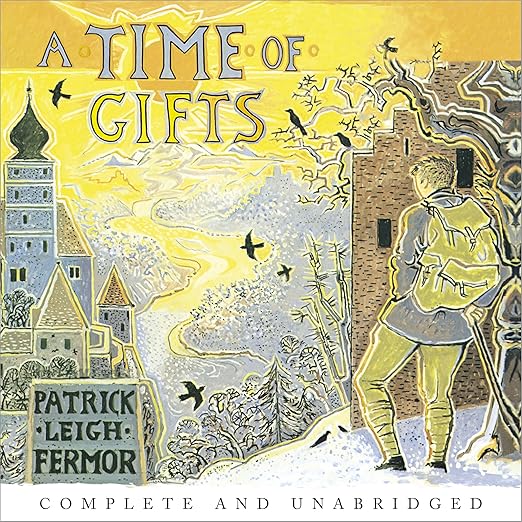
Patrick Leigh Fermor wrote A Time of Gifts decades after the journey it describes, and that temporal distance is audible in every sentence. This audiobook, the first volume of the Journey Across Europe trilogy narrated by Crispin Redman across just under thirteen hours, carries the quality of memory made luminous: precise in its details, generous in its associations, and suffused with the knowledge that the Europe the eighteen-year-old Fermor walked through in 1933 would be unrecognizable within a decade. Redman's narration carries that elegiac doubleness beautifully, a young voice and an old mind occupying the same sentences simultaneously, which is the central literary achievement of Fermor's prose and the central challenge for any narrator who takes it on.
The book follows Fermor from the Hook of Holland on foot toward Constantinople, and this opening volume takes him as far as Hungary. That geography matters enormously. The route cuts through the Rhine valley, Bavaria, Austria, and Central Europe at a specific and unrepeatable historical moment. Hitler has just been appointed Chancellor when Fermor sets out. The burgomasters who welcome him, the monasteries where he sleeps, the river towns and castle ruins he passes through are all drawn with the kind of attention that only comes from a writer who understood, looking back, that he was witnessing the end of something extraordinary and irreplaceable.
What Fermor achieves that most travel writing does not is a fusion of scholarship and sensation. He can describe the Romanesque carvings on a Bavarian church door with the precision of an art historian, then pivot to the smoky warmth of a riverside inn and the taste of cheap wine with the immediacy of a novelist. Redman's narration handles both registers without strain. The scholarly passages, and there are many, are given space rather than rushed. The sensory passages land with appropriate warmth. One reviewer described the book as "scholarly yet extremely readable," and that balance is what the narration is asked to sustain across the full runtime.
The structure of the book is episodic rather than linear in the conventional sense. Fermor does not simply report what happened each day. He uses a sight or a conversation as a launching point for excursions into history, legend, language, and literature. A glimpse of Bavarian architecture sends him into an account of the Holy Roman Empire. A glimpse of storks on a rooftop opens into a meditation on migration and seasonal cycles. This associative mode, so characteristic of English prose of the mid-twentieth century, can feel sprawling on the page. In audio, Redman's measured pace makes it feel like a guided drift rather than a digression, which is the exactly right transformation.
What Makes A Time of Gifts Worth Hearing
The political material is handled with restraint that itself tells a story. Fermor encounters Nazi rallies and brownshirts, processes the strangeness of a Germany in rapid and frightening transformation, but he does so from the perspective of a teenager who does not yet have the vocabulary for what he is witnessing. The retrospective narration acknowledges what the young Fermor could not know. That gap between the experience and the understanding is one of the most affecting literary devices in the book, and Redman communicates it without editorializing, trusting the listener to feel the weight of what is not said alongside what is.
This is first and foremost a book about the density of Europe's layered history as felt by a young man walking through it with not much more than a change of clothes and a volume of poetry. The landscapes of the Rhine and the Danube, the frozen fields of Bavaria, the great monasteries of Austria, all of it rendered in prose that rewards close attention rather than passive consumption. Audio is, in some ways, the ideal format for Fermor, because the book asks for the kind of slow, undistracted attention that reading on a screen rarely allows. It benefits from being heard rather than skimmed.
Things to Know Before Starting A Time of Gifts
Listeners who prefer narrative propulsion over prose richness will find certain chapters slow. This is not a book with dramatic plot developments. Fermor gets lost, is housed by strangers, finds a library, crosses a river, encounters a blizzard. The drama is primarily perceptual and intellectual rather than event-driven. One reviewer noted that the "scope is majestic," and that is both its appeal and its potential limitation, depending entirely on what you are looking for in a travel narrative. The book rewards patience and is indifferent to impatience.
The audio format also cannot fully replicate Fermor's integration of foreign-language phrases, which were a deliberate feature of the original text. Redman navigates the multilingual passages in German, Dutch, and Hungarian with reasonable confidence, but some of the texture of Fermor's polyglot world is inevitably smoothed in the transition to audio. These are modest complaints about a genuinely exceptional listening experience overall, and they do not significantly diminish what Redman and the production team have achieved.
Who It's For
This audiobook belongs to listeners with a genuine appetite for literary travel writing and pre-war European history. It rewards those who can surrender to a slow, associative pace and find pleasure in finely observed detail. Listeners who came of age reading Chatwin, Thesiger, or Ryszard Kapuscinski will find Fermor a natural companion. Those expecting the pace and incident of a thriller or even a conventional memoir should look elsewhere entirely. For the right listener, this is among the most rewarding travel audiobooks in the English language.
A Few Questions About A Time of Gifts
Do I need to read the other volumes of the Journey Across Europe trilogy before or after this audiobook?
A Time of Gifts stands entirely on its own and is the natural starting point for the trilogy. The subsequent volumes, Between the Woods and the Water and The Broken Road, continue the journey and can be listened to in sequence, but each is self-contained.
Is the A Time of Gifts audiobook accessible if I have no background in European history?
Fermor provides enough context within the prose that a specialist background is not required. The book naturally introduces the history and geography it describes, though listeners with some familiarity with Weimar Germany and Central European history will catch additional layers.
Is A Time of Gifts a good audiobook for long drives or does it require concentrated attention?
The richness of Fermor's prose benefits from focused listening. It is not background audio. Long, uninterrupted sessions are the better fit for a book this texturally dense, rather than short commute-length segments.