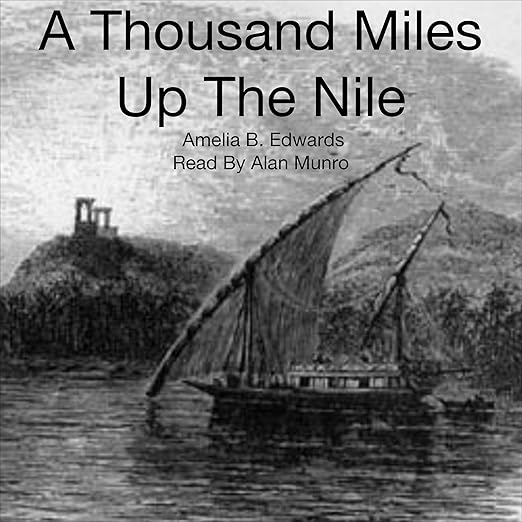
I came to A Thousand Miles Up the Nile through a side door. I had been reading about the Egypt Exploration Fund, the organization that helped professionalize British Egyptology in the 1880s, and kept encountering the name Amelia Blanford Edwards as its founder and "Godmother." I assumed I would find a standard Victorian travel account: paternalistic, descriptive, vaguely imperialist. What I found instead was one of the sharpest observers of her century, a woman who looked at the monuments of Abu Simbel and understood immediately that they were in danger, not from time but from tourism and modern indifference.
Edwards made her Nile journey in the winter of 1874, traveling south from Cairo in a houseboat with her companion Lucy Renshaw. Their expedition joined a flotilla that included another female English traveler, Marianne Brocklehurst. The company Edwards kept is itself part of the story: these were not wives accompanying husbands. They were independent women navigating a foreign country in an era when that required both resources and a particular kind of self-possession that Edwards wore without comment.
The book earns its reputation through the quality of Edwards' eye. She is not primarily interested in herself, which immediately sets her apart from a significant portion of Victorian travel writing. She is interested in what she is looking at, in the hieroglyphics she is beginning to learn to read, in the physics of light on ancient stone at different hours of the day, and in the human beings she encounters along the river. Her descriptions of arriving at Abu Simbel, where she and her group remained for six weeks, are among the most detailed accounts of those monuments written before modern archaeological standards transformed the site.
Her engagement with Egyptology was not idle curiosity. The experiences of this journey led directly to her 1882 co-founding of the Egypt Exploration Fund, because she returned from the Nile convinced that systematic preservation and documentation had to replace the looting and casual destruction she had witnessed. Reviewer K2's description of it as "a really wonderful travel log" captures the pleasure of the reading experience, but Edwards was also laying groundwork for a scientific institution that persists today.
Why It Works in Audio
Alan Munro's narration is well-matched to the material. Victorian prose has rhythms and cadences that require a narrator who can honor the sentence structure without making it feel archaic, and Munro finds that balance consistently. At over eighteen hours, this is a major time commitment, and a narrator who cannot sustain listener attention across that length would make the book inaccessible regardless of its literary merit. Munro manages the variety of Edwards' writing, her architectural description, her historical digression, her occasional dry comedy, with enough tonal flexibility to sustain engagement.
Listeners should be aware that the audiobook does not include the illustrations Edwards made during her journey, which were part of the original published volume and which several print reviewers describe as exceptional. That is simply a limitation of the format, not a failing of the production.
Things to Know Before Starting A Thousand Miles Up The Nile
Prospective listeners should do their homework on editions before purchasing, a point that print reviewers have raised repeatedly. Some versions of this text are incomplete, ending abruptly mid-journey. The Trout Lake Media audiobook version reviewed here covers the full text, but if you are looking at other editions, verifying completeness is worth the effort. Reviewer Sastenio noted the frustration of "teetering on the brink of a literary precipice" when the text cut off at Chapter XIII in another edition, and that is a genuinely poor experience for a book of this ambition and length.
Edwards' prose is Victorian in the full sense: leisurely, digressive, and laden with classical and biblical allusion. Listeners looking for tight pacing or narrative momentum in the modern sense will find this requires a different kind of attention than contemporary nonfiction. The rewards are proportionate to the patience the book asks for.
Who Will Get the Most From It
This is the audiobook for readers who want to understand Egypt through the eyes of one of the most perceptive Victorian travelers who visited it, and who are willing to spend eighteen hours in her company. It is particularly valuable for anyone interested in the history of Egyptology, in Victorian women's travel writing, or in how the monuments Edwards visited were experienced before twentieth-century tourism transformed them. Fans of Elizabeth Peters' Amelia Peabody mystery series will find the Edwards-Peabody connection illuminating, as one reviewer noted the direct influence. Listeners who want a brisk adventure narrative or modern travel writing will want something else. This is history experienced at the pace history actually unfolded.
- Narrator: Alan Munro's measured, Victorian-inflected delivery suits Edwards' prose era beautifully, carrying the reader across eighteen-plus hours with enough tonal variety to sustain attention.
- Subjects: Victorian female independence and travel, the ethics of Egyptology and preservation, a writer's relationship to the ancient world
- Tone: Contemplative and observant, with an antiquarian's precision and genuine wonder at every monument
- Bottom line: One of the great Victorian travel narratives, available in audio at its full length, essential for anyone with real interest in Egypt, Egyptology, or the history of women's travel writing.