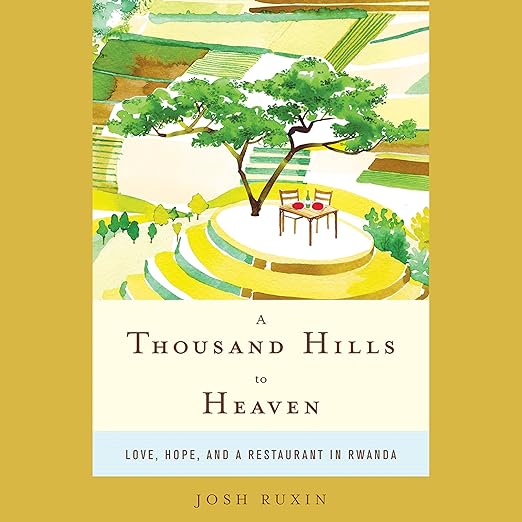
Josh Ruxin's A Thousand Hills to Heaven, narrated by Will Collyer, opens with a challenge that gives the book its moral engine: a question posed to Ruxin and his wife Alissa at a party, asking whether two young Americans could actually make a difference in a place like Rwanda, where the memory of genocide was less than a decade old and poverty was structural rather than incidental. Ruxin's answer, documented across 8 hours and 24 minutes of audio memoir, is both yes and no, which is part of what makes this audiobook more honest than most development narratives. He does not arrive with the right answers and execute them flawlessly. He arrives with resources, goodwill, and enormous gaps in his understanding, and the book traces what filling those gaps actually required.
The book operates in three registers simultaneously. It is a love story about two newlyweds building a life in Kigali. It is a professional memoir about Ruxin's work bringing health care and nutrition to rural Rwandan villages through the Millennium Villages Project. And it is the story of Heaven, the gourmet restaurant Alissa opened overlooking Kigali, which became a gathering place for an improbable mixture of genocide survivors, international aid workers, Rwandan professionals, and tourists. Will Collyer navigates all three registers with confidence, shifting between the warmth of domestic life and the weight of working in the shadow of mass violence without losing the thread of either.
The Review
What distinguishes this memoir from the standard foreign aid narrative is its candor about failure. Ruxin does not write as a hero who arrived with answers. He writes as someone who arrived with questions, made significant mistakes, and learned from the Rwandans he worked alongside. The health care work faced obstacles that conventional Western development models were poorly equipped to handle, and Ruxin is specific about what did not work, which gives the book its credibility and makes the eventual successes feel real rather than triumphant.
Reviewer Jennifer Lee noted Ruxin's skill in weaving together love, development work, and food into a warm and honest memoir, and that integration is the book's most distinctive achievement. The restaurant Heaven was not a side project. It was part of the argument about how economic development actually works: by creating employment, teaching marketable skills, mixing Rwandan ingredients with gourmet techniques, and demonstrating that the country's survivors could work side by side across ethnic lines. The best guacamole in Africa, as one review memorably phrases it, becomes a data point in an argument about what post-conflict recovery actually requires rather than what outside organizations typically provide.
What Makes A Thousand Hills to Heaven Worth Hearing
Will Collyer's narration earns the memoir its emotional weight. The chapters dealing directly with Rwanda's genocide history, the killing fields near where the Ruxins built their home, the survivors whose lives intertwine with the family's story, require a narrator who can hold the gravity of those moments without either rushing past them or overperforming them. Collyer does this consistently. He lets the facts carry their own weight, which is the right instinct for material this serious and this specific.
The book is also genuinely instructive about the mechanics of foreign aid. Reviewer Nancy Uslan described it as essential reading for international businesspeople and global entrepreneurs, noting the clearly defined best-practice principles drawn from trial and error on the ground. That is not hyperbole. Ruxin writes specifically enough about what worked and what failed that listeners with professional interest in development, global health, or social entrepreneurship will find concrete frameworks alongside the personal narrative. This is not a book that uses Rwanda as a backdrop for an American couple's self-discovery. The country and its people are at the center of what Ruxin is trying to understand throughout the eight hours.
A Few Reservations
Reviewer Joseph Bevan noted a chapter or two in the early section that felt slower than the rest, and that is a fair observation. The opening establishes the Ruxins' American context at some length before the Rwanda material takes hold. Listeners who find the setup slow should push through the first hour, because the book's momentum builds steadily once the Kigali chapters begin in earnest and the competing storylines of health work, restaurant building, and family life start to interweave.
The memoir also raises questions about the power dynamics of Western professionals working in post-conflict African settings that it does not fully resolve. Ruxin is self-aware about the limits of his perspective, but the book is ultimately written from his point of view, and the Rwandan voices are mediated through his memory and his framing. This is an honest limitation of the memoir form rather than a flaw unique to this book, but listeners should hold that in mind when evaluating the book's claims about what the Rwandan community wanted and needed during that period of recovery.
Should You Listen to A Thousand Hills to Heaven?
This audiobook is the right fit for listeners interested in the intersection of global health, food culture, and post-conflict recovery, or for anyone who has been frustrated by development memoirs that oversimplify what effective aid requires. It works well for listeners who want a personal narrative with real analytical content running underneath it. Those looking for a pure culinary travel memoir or a pure policy analysis will find neither in isolation here, but those who appreciate the braid of family, food, and development will find it a satisfying and substantive listen from beginning to end.
- Voice: Will Collyer handles the memoir's emotional range with care, moving between intimate family passages and the heavier weight of Rwanda's post-genocide context without flattening either.
- Big ideas: Post-genocide recovery, foreign aid reform, food as a tool for community building
- Atmosphere: Warm and clear-eyed, with real darkness given its due weight before hope earns its place
- Worth it?: Josh Ruxin's memoir of building a restaurant and a healthcare system in Rwanda is one of the more genuinely instructive accounts of what effective development work actually looks like on the ground.
Does A Thousand Hills to Heaven audiobook spend significant time on the Rwandan genocide, and is it graphic?
The genocide and its aftermath are present throughout as context for the Ruxins' work and the community they join. The treatment is serious and unflinching but not gratuitous. The book deals with the legacy of violence, including the proximity of the family's home to former killing fields, rather than depicting the violence itself in graphic detail.
Is this audiobook primarily a travel memoir or a development policy argument?
It is a personal memoir that contains a serious argument about foreign aid reform. The development policy perspective emerges from lived experience rather than academic analysis, which makes it more accessible and more persuasive for a general audience than a policy-focused text would be.
Do I need prior knowledge of Rwanda's history to appreciate this audiobook?
Basic familiarity with the 1994 genocide provides useful context, but the book explains what you need to know as the narrative unfolds. Listeners who want to go deeper into Rwandan history before or alongside listening might consider pairing this with Philip Gourevitch's reporting from the same period.
How does Will Collyer handle the emotional range of the memoir in the audiobook narration?
Collyer navigates the book's emotional range well, shifting between the warmth of the Ruxins' family story and the weight of working in post-genocide Rwanda without losing coherence. His restraint in the more difficult passages works in the book's favor, allowing the material to land without theatrical amplification.