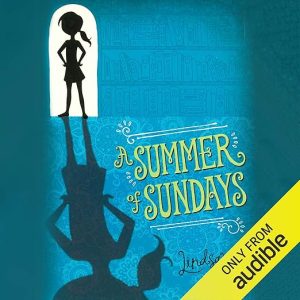
Lindsay Eland's sophomore novel earns its reputation as an audiobook in the tradition of middle-grade fiction that takes its audience seriously. The heroine is the third of six children in the Fowler family, the middle-of-the-middle-child who arrives at a summer library renovation convinced this will finally be the season she distinguishes herself from her siblings. That specific, age-accurate motivation, not a vague desire to matter but a concrete plan to become famous, is the kind of character engine that makes middle-grade fiction resonate across generations. Readers who were ever lost in a large family or simply tired of being overlooked will recognize her immediately.
Sunday Must Choose the Headline or the Friendship
The story's inciting discovery, a silver box in the basement of the library Sunday's family is renovating, containing letters and a manuscript addressed simply to 'The Librarian,' is a strong premise for the genre. Eland builds the mystery around questions that children genuinely find compelling: Who wrote this? Why was it hidden? Why do some people in town want it to stay hidden? The layering of personal ambition, the desire for fame and recognition, against the ethical demands of loyalty and trust gives the narrative a genuine moral arc. Sunday must choose between the headline and the friendship, and Eland does not make that choice cost nothing.
The neighbor-turned-friend dynamic with Jude is handled well. The transformation from 'annoying' to essential friend happens through shared stakes rather than forced bonding, which is the more honest version of how childhood friendships often form. Jude's investment in the mystery mirrors Sunday's without competing with her as the protagonist, a balance that middle-grade fiction sometimes misjudges.
Reviewers who approached this book expecting something ordinary found it 'better than you would think,' which is a form of praise that reflects genuine surprise from readers not primed to give it credit. That response pattern suggests Eland is working in a mode that looks conventional from the outside and delivers more than expected once you are inside it. The humor that appears in the opening, one review mentions 'something tragic yet funny happens immediately,' is characteristic of middle-grade fiction that understands its audience.
McInerney Voices a Household of Eight
Kathleen McInerney's narration is well-matched to the material. She navigates the ensemble cast of the Fowler family with clear voice differentiation, which matters considerably in a household of eight people. Sunday's voice in particular captures the particular register of a child who is both frustrated by her family circumstances and genuinely loves the family she belongs to, two feelings that coexist with more frequency in actual children than in fictional ones. McInerney finds that complexity and trusts it.
The seven-and-a-half-hour runtime makes this a comfortable middle-grade listen, long enough to build real investment in Sunday and Jude's partnership but short enough that younger listeners do not lose the thread across sessions. The pacing in the audio version benefits from McInerney's comedic timing in the early scenes, particularly the opening tragedy-and-humor that reviewers note as an immediate hook.
For adult listeners, A Summer of Sundays belongs in the category of middle-grade fiction that earns a broader audience through quality rather than through crossover marketing. The questions Sunday grapples with, what makes you visible, what do you owe the people you uncover secrets about, what is friendship worth when fame is on the table, are not exclusively children's questions. They are simply presented at the scale and stakes of a twelve-year-old's summer.
The Library Functions as a Location Here
The town-secrets element of the plot resolves in a way that privileges Sunday's moral growth over comprehensive mystery resolution. Readers who want full explanations of every buried secret may find the ending leaves some threads looser than they prefer. Eland is more interested in what Sunday learns from the process of uncovering the manuscript than in the manuscript itself, and the resolution reflects that priority.
The comparisons to Heather Vogel Frederick's Mother Daughter Book Club series and Coleen Paratore's Wedding Planner's Daughter are apt in register and audience but somewhat different in focus. Readers coming from those series expecting a similar community-of-girls structure will find A Summer of Sundays more solitary in its protagonist's journey, though Jude provides genuine partnership.
The library renovation setting is used primarily as atmosphere and plot device rather than as a sustained meditation on libraries and their meaning. Readers who were hoping for a book-about-books layer will find the library functions as a location rather than a subject.
Hidden Things Become Findable in This Library
Children aged eight through twelve who feel invisible in their own households, who have older or younger siblings who seem to get more attention, will find Sunday immediately legible and encouraging. Fans of middle-grade mystery with a light emotional core, rather than heavy suspense, will appreciate the book's balance. Parents looking for audiobooks that work for a range of sibling ages will find the family dynamics relatable across multiple listener ages simultaneously.
Adult readers who enjoy well-crafted middle-grade fiction, the kind that does not condescend to its audience or tack on lessons, will find Eland a reliable author. A Summer of Sundays is a sophomore novel that demonstrates genuine craft and a story worth seven and a half hours of listening time.
Eland's approach to the library setting rewards attention: the renovating-a-library premise gives the story a backdrop that middle-grade fiction rarely uses. Libraries in fiction are usually complete and functional, spaces of established order. A library under construction, with its basement contents unsettled and its institutional history temporarily exposed, is a different kind of space, one where hidden things become findable. The premise is elegant in its logic, and Eland makes the most of it without over-explaining why the basement yields its secrets precisely when it does.