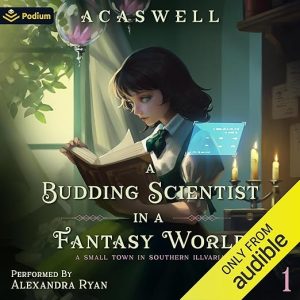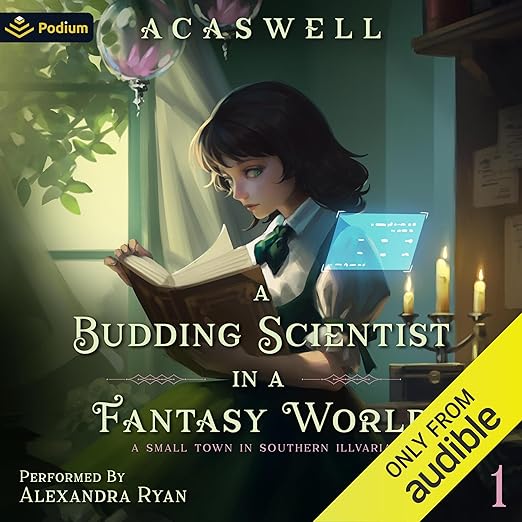
- Read by: Alexandra Ryan gives Alice a grounded, curious intelligence that anchors the scientific framing without making her sound detached or cold.
- At its heart: Scientific inquiry in a magical world, identity and adaptation, the danger of being an outsider with unique knowledge
- Vibe: Methodical and wonder-filled, with an undercurrent of genuine danger
- Short version: A standout isekai for readers tired of power-fantasy protagonists, Alice thinks her way through problems instead of fighting through them.
I came to A Small Town in Southern Illvaria skeptical. The isekai-LitRPG cross has produced a lot of formulaic work, teenager transported to fantasy world, gains overpowered abilities, defeats progressively larger threats. The genre has real pleasures, but it also has ruts worn deep from repetition. What caught my attention here was a review that described the book as a quote-charming non-parody critique of the genre. That framing made me put it on my list, and I am glad I did. I listened to the first half during a week of early morning walks, and the combination of Alice's methodical thinking and Alexandra Ryan's grounded narration made the commute feel shorter than it was.
The premise takes a familiar setup, Alice Verianna, a fifteen-year-old from the Denver suburbs, is transported to a magical alternate dimension governed by a mysterious System, and then asks a genuinely different question of it. Rather than accepting the System's gifts and charging forward, Alice wants to understand what the System actually is. She approaches mana the way a scientist approaches any unknown phenomenon: with observation, hypothesis, and stubborn refusal to accept what she cannot explain.
First, the Big Picture
Author Acaswell, whose work accumulated nearly two million views on Royal Road before reaching Audible, has built a protagonist whose intelligence is the story's engine. Alice is not a fighter and has no ambitions to become one. The [Survivor] class the System grants her is a reflection of her actual strengths: adaptability, careful observation, and a willingness to admit what she does not know. One reviewer put it precisely: the author understands that explaining a thing is not the same as making it boring. That is a principle that distinguishes this book from a lot of genre competition. The magic-science investigations Alice undertakes are genuinely interesting, not just narrative decoration.
The antagonist structure, the Society of Starry Eyes, a secretive organization hunting interdimensional travelers for their knowledge, provides tension without dominating the book. Acaswell seems more interested in the texture of Alice's daily life and intellectual growth than in escalating threat. That choice will divide readers, but for those who find the genre's constant escalation exhausting, it is a relief.
The Best Parts of A Small Town in Southern Illvaria: An Isekai LitRPG
Alexandra Ryan's narration is well-matched to the material. Alice is written with a specific voice, curious, occasionally frustrated, prone to scientific tangents, and Ryan delivers that interiority without tipping into either cuteness or self-importance. The twenty-seven-hour runtime is substantial for a first volume, and Ryan maintains engagement through the longer expository stretches where Alice is working through mana theory or mapping her new environment.
Podium Audio's production quality is reliable, and the audiobook benefits from Ryan's ability to distinguish the supporting cast, the local inhabitants of the world feel like individuals rather than a backdrop.
A Few Reservations
The first quarter of the book is slow by deliberate design. Alice's initial displacement and orientation in the wilderness are handled realistically rather than cinematically, she is genuinely frightened, genuinely uncertain, and genuinely limited. One reviewer who gave the book four stars specifically noted that the first 25% is rough and the story only shifts into the version promised by the synopsis after that. This is accurate. The payoff is real, but readers who need immediate momentum may struggle with the opening.
The book is also more interested in intellectual exploration than in combat or romance, which makes it unusual for the genre but means certain listener expectations will go unmet. Action sequences exist, but they are not the point. If you come to LitRPG primarily for battle progression and power fantasy, this is likely not the book for you.
Who Should Listen to A Small Town in Southern Illvaria: An Isekai LitRPG
Listeners who have grown frustrated with isekai protagonists who treat the genre's conventions as given should find Alice's approach refreshing. Readers who enjoy fantasy science fiction with genuine intellectual texture, think Brandon Sanderson's magic-system rigor applied to a coming-of-age narrative, will be rewarded. The twenty-seven-hour runtime suggests commitment, so this is best suited to listeners who want to settle into a world rather than pass through it.