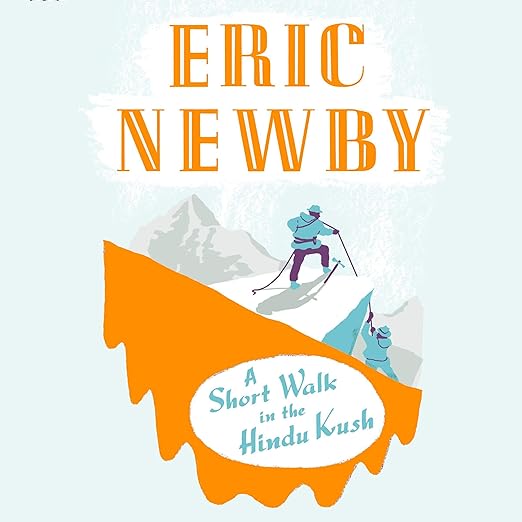
CAN YOU TRAVEL NURISTAN JUNE? Eric Newby sent that cable to his friend Hugh Carless in 1956, while making an improbable living inside the chaotic family business of London haute couture, and the audiobook that eventually came out of the answer runs ten hours and forty-one minutes with James Bryce reading. Their preparation for the mountains northeast of Kabul consisted, by the publisher's own admission, of some tips from a Welsh waitress. Everything charming and everything alarming about this book is contained in that sentence.
The comic engine is competence misapplied. Two well-mannered Britons with no relevant experience treat a serious range as a matter to be arranged, and the register never breaks: hardship is reported in the tone one would use for a delayed train. A June 2008 entry reaches for Monty Python to describe the effect and it is the right comparison, not because the book is silly but because the humor works by refusing to acknowledge that anything unusual is happening while the situation deteriorates around the sentence.
Underneath that runs a real journey. Nuristan in 1956 was, in the publisher's phrase, one of the most remote and beautiful wildernesses on earth, and Newby writes it for a reader who cannot be assumed to have any picture of it at all. The landscape work is what the copy means when it promises keen observation, and the walking itself is genuinely hard. Comedy is the delivery system here; the observation is what earned the standing the description claims for him.
What the audio adds and what it risks are the same thing. Deadpan is the most fragile comic register to read aloud, because the joke lives in the gap between what is happening and how flatly it is described, and a narrator who leans in even slightly closes that gap and kills it. James Bryce carries ten and a half hours of a voice that must never once appear to find itself funny. Start at a set piece where something has gone properly wrong rather than at the packing and the planning, since that is where the whole approach declares itself.
Why A Short Walk in the Hindu Kush Works as an Audiobook
An August 2013 four-star grounds the book's standing in something better than publisher enthusiasm, noting that it earned a place on National Geographic's hundred best adventure books and adding the more interesting compliment: that a reader learns something real about the region through two pairs of very inexpert eyes. Ignorance turns out to be a decent lens. Neither man knew what he was looking at, so both of them describe it, which is precisely what an expert would have left out.
It also works as an antidote to a whole modern genre. Contemporary adventure writing is largely about preparation, equipment and the management of risk, with the author's competence as the point. This is the opposite proposition: the point is that they should not have been there, that they went anyway, and that the mountains were entirely indifferent to how they felt about it. For a listener tired of expedition professionalism, ten hours in company this unqualified is a relief.
Weak Spots in A Short Walk in the Hindu Kush
One rating. Five people have written paragraphs beneath it, some of them at length and across nearly two decades, and the number at the top of the page rests on a single anonymous click that displays as 4.4. A lone voter cannot produce that figure, since a single choice among whole stars has no decimal in it, and the deeper problem is that the badge and the written responses are drawing on entirely different populations. The one you can read is the one worth reading.
This edition advertises things audio cannot obviously deliver. It promises new photographs, an epilogue from Hugh Carless and a prologue from Evelyn Waugh, and none of that is trivial: the description introduces Waugh as one of Newby's greatest proponents, which makes his prologue part of what this edition is selling. Nothing on the listing declares a companion file or confirms that the front and back matter were recorded, so a buyer who specifically wants Waugh's introduction should establish that before purchase rather than after.
Period attitudes are the other thing to prepare for. A June 2014 four-star found the account fun and instructive and still came away unsettled, observing that the position of women in the places described offers little comfort to anyone who thinks it should be otherwise. That is an accurate reading of what a mid-century British traveler recorded and did not much interrogate. The book is a document of 1956 in two directions at once, the country it crosses and the men crossing it.
Who Should Listen to A Short Walk in the Hindu Kush
Comic travel writing is a small and beloved category, and anyone who lives in it should have this already. Listeners drawn to Afghanistan and Central Asia before the wars will find a portrait recorded by somebody with no political stake and an unusually good ear for how people actually behave toward strangers. It also suits anyone who enjoys watching a book be funny for hours without ever raising its voice, which is a rarer skill than the shelf suggests.
Readers who want technical mountaineering, or a modern reckoning with what travel writing does to the places it visits, should be warned that neither is on offer here. Anyone allergic to British understatement will find the whole performance insufferable within an hour, and that reaction is legitimate rather than a failure of taste. Newby went to the Hindu Kush on a waitress's advice and came back with a classic, and the joke has held for seventy years.
Before You Press Play
- Read by: James Bryce inherits the hardest comic register in the language, deadpan held for a whole book without a single wink.
- At its heart: Amateur expedition, 1950s Afghanistan and Nuristan, British understatement, travel before the professionals.
- Vibe: Dry, buoyant, quietly punishing.
- Short version: A durable comic classic in audio, worth confirming first whether the Waugh prologue made it into the recording.