At a Glance
- Narrator: Richard Poe's measured, authoritative delivery suits Steinbeck's reportorial voice and the weight of what the pair witnessed in postwar Soviet Russia.
- Subjects: Postwar recovery, ordinary life under totalitarianism, the limits of what a reporter can see
- Tone: Quietly melancholic and historically resonant
- Bottom line: A unique document of immediate postwar Soviet life by two artists at peak powers, its value lying more in what it captured than in what it could fully explain.
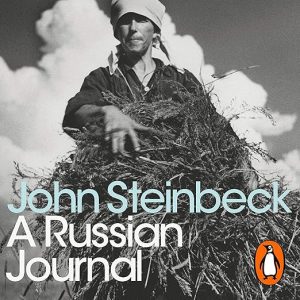
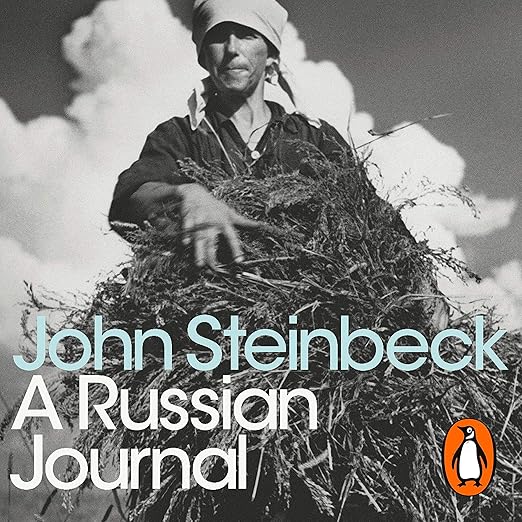
I came to A Russian Journal through the back door, having been reading about Steinbeck's nonfiction work after finishing a round of his novels, and found myself unexpectedly absorbed by this odd, particular book. It sits in a genuinely unusual place in the literary landscape: too journalistic to be memoir, too literary to be reportage in the standard sense, and too constrained by the conditions of its making to be the kind of documentary record that Steinbeck and Robert Capa clearly hoped it might become. What emerged from their 1947 journey into the Soviet Union is something rarer and more interesting than a standard war correspondent's report: an honest account of what two brilliant observers could and could not see through the limited aperture that Soviet authorities permitted them.
The timing is everything. Just after the iron curtain fell across Eastern Europe, just as the Cold War was solidifying into the shape it would hold for four decades, Steinbeck and Capa entered a country that was simultaneously performing its own reconstruction for Western observers and genuinely struggling to rebuild after the catastrophic losses of World War Two. They traveled not just to Moscow but to Stalingrad, then already renamed though the wound of the siege was barely two years old, and through the Ukrainian countryside and the Caucasus region. What they found, and what Steinbeck recorded, was a country of factory workers, government clerks, and peasants emerging from rubble, not the political machinery but the human texture of survival.
Richard Poe narrates for Penguin Classics, and his voice carries the appropriate weight for a document of this kind. Steinbeck's prose style in his nonfiction work is different from the novelistic voice most readers associate with his fiction, more restrained, more alert to what he does not know, and Poe handles that restraint well. The seven-hour runtime moves at a journalist's pace without feeling hurried through material that deserves time.
The pairing of Steinbeck and Capa is part of what makes this document exceptional. Both were artists who had defined modes of seeing: Steinbeck through a novelist's attention to individual human particularity, Capa through the camera's confrontation with physical reality. Their collaboration produced a book that is aware of its own limitations in ways that purely political reportage rarely is. Steinbeck writes honestly about what Soviet handlers allowed them to see and what they understood was being withheld. The result is a portrait that is more truthful for its acknowledged incompleteness than it would be if it claimed comprehensive access.
What John Steinbeck Gets Right
The Penguin Classics edition and production give this audiobook a legitimacy that some older public domain recordings lack. Poe is a professional narrator of considerable experience, and the production quality reflects the institutional weight of the Penguin imprint. For a document of this historical significance, production quality matters: you want to be able to trust the reading and give your full attention to the content rather than compensating for a weak narration.
No external reviews appear in the record for this specific audio edition, which is unusual for a Steinbeck title but not surprising for a relatively specialized audiobook release of a lesser-known nonfiction work. The general critical and reader response to A Russian Journal across its various editions has been consistently positive, with appreciation for exactly the quality Steinbeck himself understood he was creating: not a definitive account of Soviet Russia but a precise record of what two honest observers actually encountered. That quality of deliberate limitation is something that rewards rather than frustrates careful readers.
Where John Steinbeck Loses Some Ground
The historical context that makes the book most resonant is the gap between what Steinbeck and Capa saw and what was actually happening in Soviet society during the same period. They arrived in 1947, in the early stages of Stalin's postwar consolidation, and the human warmth and ordinary dignity they found in the people they met coexisted with a repressive political apparatus they were not positioned to see. Steinbeck does not pretend otherwise. The book's honesty about what access looked like during the Cold War era, and what a reporter could and could not say, is part of its value as a historical document.
The Ukrainian sections are particularly significant given subsequent history. Steinbeck's descriptions of a countryside still recovering from the devastation of the German occupation and the Soviet retreat carry a different weight now than they did in 1947 or even 1948 when the book was first published. The people he encountered are separated from contemporary events by three generations, but the land itself is unchanged, and the continuity between the agricultural heartland Steinbeck walked through and the landscape at the center of contemporary conflict gives the book an unexpected urgency.
Who Should Pick Up A Russian Journal
This is the right listen for Steinbeck readers who have not explored his nonfiction work, for students of Cold War history who want a literary primary source rather than a political analysis, and for anyone interested in what Russia and Ukraine looked like from the outside in the immediate aftermath of the Second World War. Skip it if you want dramatic narrative momentum: this is a journal, observational and reflective, not a thriller or a polemic. The value is in what Steinbeck noticed and how he rendered it, not in suspense or argument.
How does A Russian Journal compare to Steinbeck's fiction in terms of the listening experience?
Steinbeck's nonfiction voice is considerably more restrained than his novelistic prose. A Russian Journal is observational and honest about its own limitations in ways that his fiction, which often reaches for myth and archetype, does not need to be. Readers expecting the lyrical sweep of Grapes of Wrath will find something quieter and more deliberately bounded here.
What was Robert Capa's role in creating A Russian Journal, and does the audiobook reference his photographs?
Capa was Steinbeck's collaborator on the journey, traveling as the photographic partner who would document what they observed visually. The audiobook, like the text itself, describes the collaboration but cannot reproduce Capa's photographs, which in the original book provide a visual record alongside Steinbeck's prose. Interested listeners should seek out a print or digital edition to see the photographs.
Is A Russian Journal politically biased in either a pro-Soviet or anti-Soviet direction?
Steinbeck was notably honest about the constraints of what he was permitted to see, and the book is more interested in the human texture of ordinary Soviet life than in political argument in either direction. He acknowledges what he could not access. This honesty about limitation is part of what distinguishes the book from either Soviet-friendly Western reportage of the period or straightforward anti-Soviet propaganda.
Does the Ukrainian section of the book have particular significance given current events?
Yes, in a way that Steinbeck obviously could not have anticipated. His descriptions of the Ukrainian countryside and its people in the immediate aftermath of World War Two carry a different resonance now, and the agricultural heartland he walked through in 1947 is recognizable as the same landscape at the center of contemporary conflict. The book is not about the present, but the continuity is striking.