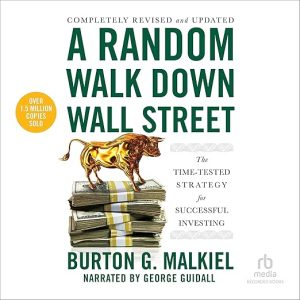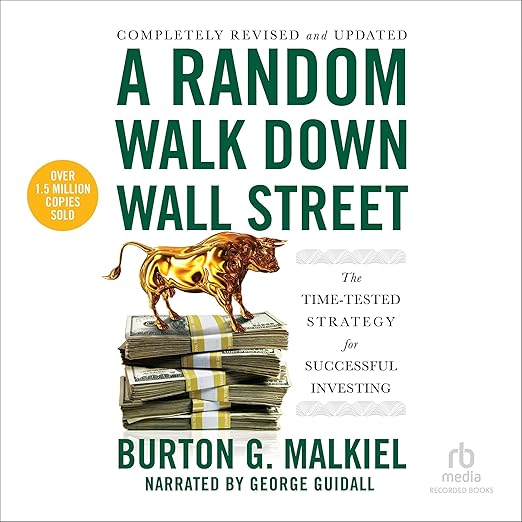
Burton Malkiel's A Random Walk Down Wall Street has been the anti-hype antidote for American investors since 1973, and reaching its 12th edition says something significant about its staying power. This audiobook version, narrated by George Guidall, clocks in at just under 12 hours - enough to cover not just the core random walk thesis but Malkiel's new material on tax-loss harvesting, automated investment advisers, the bitcoin bubble, and a full chapter on factor investing and risk parity. If you arrived here expecting a quick listen with a few actionable tips, calibrate differently: this is a thorough, argument-first book about why complexity in investing is usually your enemy, and it takes its time making that case.
Guidall is well matched to the material. His voice carries the patient gravity of someone who has narrated substantial nonfiction across decades - listeners will recognize him from audiobooks across the history and biography genres - and he manages Malkiel's more textbook-adjacent passages without letting them flatten into lecture. That matters here because the book moves between readable narrative, economic history, and something approaching introductory finance theory, and the transitions can be abrupt on the page. Guidall smooths them in audio.
What the Twelfth Edition Actually Adds
Malkiel's central argument has not changed across editions: stock market prices incorporate available information so efficiently that consistently outperforming the market through stock selection or market timing is, for the vast majority of investors, not achievable in the long run. This is not a new or controversial claim in academic finance. What keeps A Random Walk Down Wall Street relevant is Malkiel's gift for translating it into digestible language while confronting each new generation of market complexity on its own terms - day trading crazes, mortgage-backed security disasters, cryptocurrency speculation, and now the algorithmic adviser landscape.
The 12th edition additions are substantive. The tax-loss harvesting section is particularly useful: Malkiel walks through why timing the realization of losses to offset gains is among the most accessible tax management tools available to ordinary investors, and how automated advisers have made this easier than it was when human financial planners gatekept the strategy. The new factor investing chapter is the most technically demanding section of the book, engaging with the academic debate over whether size, value, momentum, and other factors represent genuine risk premia or data-mined artifacts. Even listeners without econometrics backgrounds will come away with a functional understanding of why the claims matter.
Armor Against Sellers of Guaranteed Systems
One reviewer, Michael J, made the point that A Random Walk Down Wall Street functions partly as inoculation against the perennial parade of market gurus. He describes the book as armor against people who sell you systems guaranteed to beat the market, noting that few of those sellers are still around after a decade. That is probably the most useful framing for new readers. This is not a book that will teach you to time the market or identify undervalued stocks. Its value is precisely in the argument that those activities, pursued by individuals without massive informational advantages, typically produce underperformance.
The life-cycle guide to investing - a recurring feature across editions, updated here for current conditions - breaks down asset allocation by age and risk tolerance in straightforward terms. For listeners who have spent time in the self-help financial genre and grown skeptical of complexity for complexity's sake, that section will feel like relief. Malkiel's consistent recommendation toward low-cost index funds has been validated so thoroughly by subsequent research that reading this edition feels less like receiving advice and more like watching someone who was right very early sit back and let the evidence speak.
Assuming Basics That Audio Cannot Flip Back To
Reviewer Gili flagged a real limitation: the book assumes some baseline familiarity with stocks, bonds, and basic investing concepts. True beginners will get through the early chapters fine - Malkiel is a skilled explainer - but the middle sections on technical and fundamental analysis, and certainly the factor investing chapter near the end, will move faster than beginners can process on first listen. The audio format does not help with this. Print allows you to flip back to a chart or re-read a definition; audio does not. Listeners without any investing vocabulary might do better starting with something like The Little Book of Common Sense Investing before arriving here.
The bitcoin treatment, which received attention in reviews when the 12th edition was published, is measured rather than dismissive. Malkiel is skeptical but engages with the arguments for cryptocurrency as an asset class rather than simply labeling it speculative noise. Whether his conclusions age well will depend on developments after this book went to press, but the analytical framework he applies to bitcoin is the same one he applies to gold, collectibles, and real estate - consistent at least if occasionally maddening to crypto advocates.
Guidall's Narration Earns the Twelve Hours
This audiobook sits in a narrow but important band: best suited for investors who have some basic vocabulary but have not yet committed to an investing philosophy, and for experienced passive investors who want their convictions reinforced with current data and examples. Complete beginners will benefit from at least a basic primer first. Active traders looking for validation of their approach will find only well-argued challenge. For anyone in the middle - skeptical of financial complexity, wary of being sold something, and looking for a calm, evidence-based framework - this remains one of the most reliable books in personal finance, and Guidall's narration makes the 12 hours genuinely worth the time.
- Narration: George Guidall brings Malkiel's argument-heavy prose to life with the measured authority of a seasoned financial narrator, keeping even the denser passages listenable.
- Themes: Passive investing and index funds, market efficiency, behavioral finance and investor psychology
- Mood: Calm, methodical, and reassuringly skeptical of financial complexity
- Verdict: Malkiel's enduring case for passive investing holds up in its 12th edition, and Guidall's narration makes the textbook stretches genuinely listenable.
Frequently Asked Questions
Is the A Random Walk Down Wall Street audiobook different enough from previous editions to justify a re-listen?
If you have read an edition from the past five years, the structural content will be familiar, but the 12th edition adds substantive new material: the tax-loss harvesting section, the factor investing chapter, updated material on automated advisers, and a reframed treatment of cryptocurrency. For listeners whose last encounter was the 10th edition or earlier, the additions are significant enough to warrant the full listen.
Does A Random Walk Down Wall Street require you to follow financial news to understand the examples?
No. Malkiel consistently contextualizes his examples with enough background that listeners unfamiliar with specific historical events or market episodes can follow the argument. The book is designed to be accessible to engaged general readers, not just finance professionals.
How does George Guidall handle the more technical financial content in this audiobook?
Guidall maintains a composed, authoritative delivery through the more technical passages, which helps considerably. He does not oversimplify or editorialize, and his pacing gives listeners time to process complex ideas. The factor investing chapter near the end is the most challenging to absorb on audio, but Guidall's narration makes it more accessible than the page equivalent.
Does this audiobook endorse any specific index funds or brokerage accounts?
No. Malkiel argues consistently for low-cost index funds as a category without recommending specific products or platforms. The advice is principle-based rather than prescriptive, which makes it more durable across the time between editions and across different countries' investment landscapes.