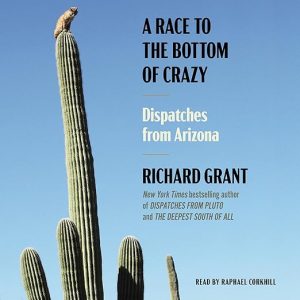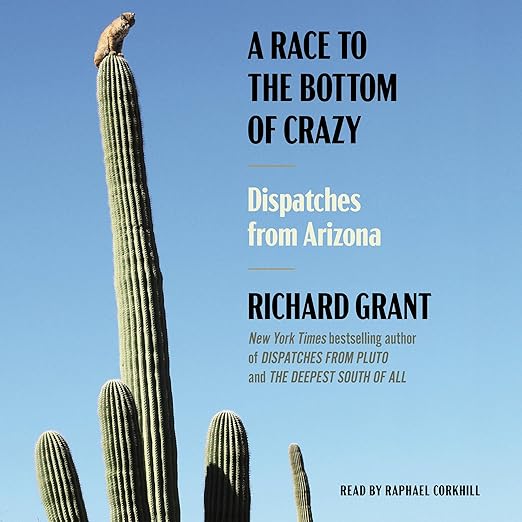
I spent a week with this one during a stretch of travel, which felt appropriate. Richard Grant is a writer who thinks in landscapes, and A Race to the Bottom of Crazy is as much about the physical Arizona, the Catalina mountains rising out of the desert like islands in the sky, as he puts it, as it is about the political and social upheaval he returned to find waiting for him in Tucson.
Grant and his wife moved back to Tucson, where they had first met, expecting to reconnect with a place they loved. Instead they found a housing market that had become irrational, election conspiracies proliferating in their neighborhood, right-wing political violence uncomfortably close to their four-year-old daughter, and a state on the front lines of climate change running out of long-term water supplies while simultaneously experiencing some of the nation's highest population growth. That combination of contradictions is what gives the book its title and its texture.
Grant's method is immersion journalism laced with memoir, and his access is genuinely varied. He visits the world's largest machine-gun shoot. He takes a sunset boat cruise with a US Congressman and a group of far-right patriots. He rides through the desert with a Border Patrol agent. He goes camping with his family in mountain ranges that feel like another world from the desert floor. Interspersed with these present-tense adventures are recollections of his previous time in the state, including a friendship with the cult writer Charles Bowden and years spent living off the grid with smugglers and dope farmers on the Mexican border. That backstory gives the book depth that a pure present-tense reporting exercise could not achieve. One reviewer who also lives in Tucson described the portraits of Arizona beauty and craziness as precisely accurate, which is the kind of local verification that good place writing produces. Another called Grant polished and specific, full of adventurous anecdotes about the decline of civilized behavior in the state. Both observations are correct and capture different dimensions of the same book.
The Best Parts of A Race to the Bottom of Crazy
Raphael Corkhill's narration carries Grant's prose with a measured observational quality that suits the material. Grant is British by origin, and Corkhill captures the sensibility of a knowledgeable outsider who has earned the right to have strong opinions about his adopted home. The political and environmental material could easily tip into either despair or advocacy, and Corkhill keeps the register even in a way that lets Grant's journalism breathe without editorial inflation. At just under ten hours, the book is well-paced for this kind of layered narrative. It is not a book that moves like a thriller, it moves like a good piece of magazine journalism expanded to full length, which means it rewards unhurried listening rather than aggressive pace.
Before You Commit to A Race to the Bottom of Crazy
One thoughtful reviewer raised a fair concern: the book occasionally feels scattered, and there is a sense that Grant's heart was not fully committed to the return move. That ambivalence surfaces in the writing at certain moments. Grant's previous memoir, Dispatches from Pluto about Mississippi, had a clearer through-line of discovery that this book sometimes lacks because he is returning to a place rather than discovering one for the first time. The Charles Bowden sections are among the strongest in the book, and readers who find themselves most engaged by that thread may want to seek out Bowden's own work directly, particularly his writing on the Catalinas, which several reviewers mention discovering through Grant's recommendation here.
Should You Listen to A Race to the Bottom of Crazy?
For readers interested in contemporary American political geography, climate change's immediate material impact on a specific region, or simply the genre of adventurous place writing that takes political context seriously, this is a strong choice. It is also a useful companion to Grant's earlier books if you already know his work. Skip it if you are specifically looking for policy analysis, this is journalism and memoir, not argument. And if you find immersive political writing that centers far-right culture exhausting regardless of framing, be aware that Grant spends significant time in those spaces, though always as observer rather than participant or advocate.
Do I need to have read Richard Grant's earlier books before this one?
No. A Race to the Bottom of Crazy works as a standalone. Some reviewers note that familiarity with Grant's Mississippi writing enriches the comparison, but it is not required context. His voice establishes itself quickly enough for new readers.
How does Raphael Corkhill's narration handle the book's mix of memoir and reportage?
Well. Corkhill maintains a consistent observational tone across both the personal memoir sections and the more journalistic reporting. He does not overdramatize the political content, which is the right instinct for material that already carries its own weight.
Is A Race to the Bottom of Crazy primarily political reporting or travel writing?
Both simultaneously, which is Grant's particular strength. The political and environmental reporting is embedded in specific places and specific encounters rather than presented as abstracted analysis. Think of it as place writing that takes its political context seriously throughout.
Who is Charles Bowden and why does he matter in this book?
Bowden was an Arizona writer known for his work on the borderlands, drug violence, and the desert Southwest. Grant's friendship with him and the years he spent in Bowden's orbit inform much of his outsider-insider relationship with Arizona. Several reviewers sought out Bowden's own writing after encountering him here.