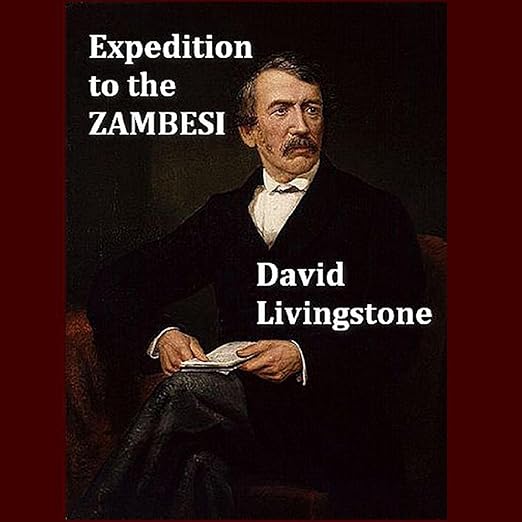
What draws someone to read an explorer's account knowing the world he saw no longer exists as he described it? Livingstone's second Zambesi expedition was, by most external measures, a failure. The British government withdrew support. Members of the party died. The territory proved far more resistant to navigation than his first journey had suggested. And yet the account that emerged, recorded with the particular combination of scientific precision and genuine poetic feeling that made Livingstone singular among Victorian explorers, went on to reshape how European readers understood southern Africa. The audiobook A Popular Account of Dr. Livingstone to the Zambesi and its Tributaries, narrated by Steven Crossley, runs just over 14 hours and brings that complexity to full attention.
Livingstone's text is a first-person record of his return to the Zambesi with his brother Charles and a larger, better-equipped party than his pioneering solo journey. The expedition faced hippopotami and crocodiles in the rivers, impossible terrain in the interior, and repeated outbreaks of disease. But the observation that his greatest enemies on this trip prove to be human is the most honest framing of what Livingstone documented: the friction within the expedition itself, and the deeper reckoning with what European presence in southern Africa was actually producing.
Livingstone was a more complicated figure than either his Victorian admirers or his modern critics have sometimes been willing to acknowledge. He wrote with genuine observational precision about the landscapes and peoples he encountered, and his opposition to the slave trade was sincere and costly to him personally. At the same time, the expedition he describes was one in a series of European incursions into the continent, and the foresight Livingstone is credited with was, in historical retrospect, the foresight of someone navigating a colonial apparatus he could not entirely see from inside.
Crossley's narration handles this material respectfully without pretending the historical complexity is not present. He reads Livingstone's own prose as Livingstone wrote it: attentive, often lyrical, occasionally frustrating in its European assumptions. The note that he does not romanticize, but he is often poetic, is accurate to the text. Livingstone's descriptions of the river at various seasons, of the landscape's particular quality of light, and of the communities he passed through carry genuine literary quality that distinguishes this from a straightforward expedition report.
What Dr. Stanley Livingstone Gets Right
The audiobook format is an appropriate delivery system for Victorian travel writing. These accounts were meant to be read aloud or consumed over many evenings rather than absorbed in a single sitting, and Crossley's narration respects that original rhythm. The episodic structure of the expedition, moving from the river mouth into the interior, encountering obstacles in sequence, managing the party dynamics, works well in chapters delivered orally. You move through the territory with Livingstone rather than reading across it.
For listeners with genuine interest in Victorian exploration literature, this audiobook sits alongside other canonical texts in the genre while being more demanding than more popular expedition accounts. Livingstone's combination of scientific report and personal reflection is unusual for the period, and his willingness to describe the internal tensions of the expedition, including conflicts with party members and the eventual collapse of British government support, gives the account a candor uncommon in exploration writing of the era.
Where Dr. Stanley Livingstone Loses Some Ground
The single available listener review describes the book as not at all spiritual and expresses disappointment, which tells you something important about audience calibration. Readers who encounter Livingstone's name through the lens of missionary history may expect a religious text and find instead a meticulous expedition record. The book is interested in the landscape, the peoples, the fauna, and the practical problems of river navigation; the spiritual dimension that animated Livingstone's personal life is not the primary subject of this particular account.
The 14-hour runtime is appropriate to the material but requires commitment from general listeners. Victorian prose has its own rhythms and assumptions, and the audiobook does not adapt those rhythms for a contemporary audience. Crossley reads the text as written, which is the right approach for a document of this historical significance, but it means listeners need to bring patience to the early chapters while they calibrate to Livingstone's voice and period style.
Readers who come to this audiobook through an interest in Victorian exploration literature will find Livingstone's voice different from many of his contemporaries in the genre. He writes without the imperial triumphalism that characterizes some Victorian Africa narratives, and his descriptions of the communities and landscapes he passed through have an observational quality that is sometimes genuinely respectful and sometimes limited by the assumptions of his era. The tension between those modes is itself historically interesting, and Crossley's narration lets it surface without editorial intervention. Reading primary sources is always partly an exercise in historical imagination, in holding the author's limitations alongside his real observations, and this audiobook rewards that kind of engaged listening.
The expedition's ultimate failure, the withdrawal of British government support and the deaths of several party members including Mary Livingstone, who died of fever at the Zambesi's mouth, gives the account a tragic undercurrent that Livingstone himself does not always name directly but that accumulates through the text. The audio format is particularly well suited to this kind of slow-building dimension, where the significance of details only becomes apparent in retrospect. Crossley's steady performance over 14 hours preserves the conditions for that retrospective understanding to develop.
Who Dr. Stanley Livingstone Is Writing For
Students of Victorian exploration literature, African colonial history, and the history of geographic discovery will find this audiobook a primary source of real value. Listeners who have worked through other Victorian expedition accounts and want to understand Livingstone's specific contribution to the genre will find the comparison rewarding. General history listeners who want a more accessible entry point to southern African colonial history should probably start with a secondary historical account before turning to this primary document. Those who dislike Victorian prose and want a modern narrative approach to the same material should look for a contemporary biography of Livingstone instead.
- Voice: Steven Crossley handles Livingstone's Victorian prose with a clarity that keeps the expedition narrative moving despite its considerable length.
- Big ideas: colonial-era exploration and its ambiguities, scientific and geographic discovery, the human costs of visionary persistence
- Atmosphere: Dense and episodic, with genuine moments of poetry in Livingstone's own descriptions
- Worth it?: A primary historical document in audio form; essential for serious students of Victorian exploration and African history, demanding for general listeners.
Questions Listeners Ask
Is this audiobook a primary source text or a modern retelling of the Zambesi expedition?
It is Livingstone's own account, written in the Victorian period. Steven Crossley narrates the original text as written, which means listeners get Livingstone's voice and perspective directly rather than a modern historian's synthesis. This is both the book's value and its demand on the listener.
Does A Popular Account of Dr. Livingstone to the Zambesi cover the same journey as his famous Missionary Travels book?
No. The Zambesi account documents Livingstone's second major expedition, undertaken with his brother Charles and a larger party. His Missionary Travels covered the earlier journeys. The two books describe different expeditions with different participants and different outcomes.
How does Steven Crossley's narration handle the Victorian prose style of the original text?
Crossley reads the text faithfully without modernizing it, which is appropriate for a historical document. He brings clarity to Livingstone's sentence structures, which can be complex by contemporary standards, and maintains a pace that keeps the episodic expedition narrative moving across 14 hours.
Is this audiobook appropriate for listeners who don't know much about southern African geography?
The geographic detail Livingstone provides is extensive and specific, and some familiarity with southern African geography will help listeners track the expedition's movement. A basic map of the Zambesi River and its tributaries is a useful companion resource, especially for the sections dealing with river navigation.