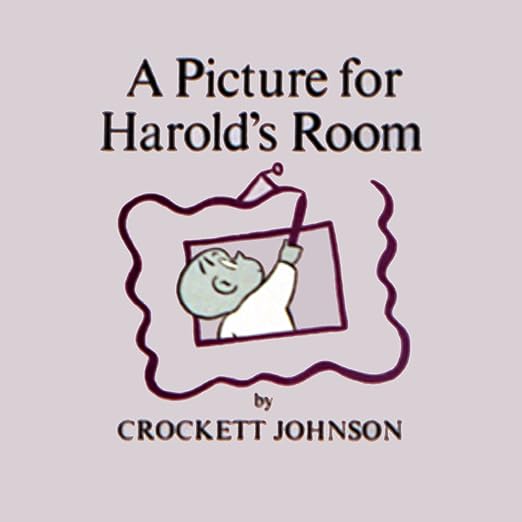
Crockett Johnson's genius with Harold and his purple crayon has always been a lesson in how children's picture books can accomplish something philosophically precise without anyone noticing. The purple crayon is a tool for world-making: Harold draws his reality into existence, and the boundary between imagination and the real never fully stabilizes. In A Picture for Harold's Room, that premise gets extended into something even more recursive. Harold draws a picture for his room. Inside that picture, the perspective keeps shifting. He is both artist and inhabitant of his creation. This audiobook version, narrated by Charles Cioffi, manages to capture the quiet strangeness of that loop in a format that runs just six minutes.
Six minutes is short even by picture book audiobook standards. But Johnson's text was always spare: he worked in simple sentences and line drawings, and the brevity was the point. Cioffi's narration respects that economy without rushing it. The pacing gives young listeners time to follow Harold's spatial logic as he draws himself smaller within his own picture, then readjusts, then revises his world again. For parents who grew up with the Harold books in print, this audiobook is less a discovery than a reunion, and Cioffi's measured voice gives it the warmth the format requires.
What makes this particular Harold book worth returning to, even among the stronger entries in the series, is its engagement with perspective as a concept. Harold's problem in this story is that his drawing keeps making him feel too small. He solves it the way he solves everything: by drawing his way into a better relationship with his space. Johnson is teaching visual perspective through a child's creative logic, and the lesson is playful enough that it never announces itself as a lesson. Young listeners will follow Harold's adjustments without framing it as instruction, which is exactly how the best children's material works.
The audiobook format adds one thing the print version cannot: a voice that models the gentle confidence Harold himself projects. Cioffi narrates without condescension, without the exaggerated energy that often marks children's audio performances. He reads the way you would read to a child before bed: present, unhurried, trusting the material to do its work. For families who use audiobooks as a wind-down ritual rather than as entertainment during commutes, the short runtime and calm delivery make this a reliable choice. Multiple listeners note that their children returned to the Harold books repeatedly, and the audio format makes that repetition more accessible.
Listen First, Then Attempt It Independently
The case for this audiobook over the print version is not absolute: Johnson's drawings are an integral part of how Harold works, and a pure audio experience strips that dimension away. But for young listeners who already know the book, hearing Cioffi's narration while following along with a physical copy creates a different kind of engagement. The listening-while-looking format works especially well for children who are beginning to connect print to spoken language, since Cioffi's pacing helps them follow the text at a readable speed.
Parents who review this title consistently mention that the Harold books function as a gateway to reading. The combination of simple vocabulary, clear sentence structure, and high imaginative investment gives children a text they can begin to decode on their own. Listening to the audiobook first and then attempting the book independently is a proven sequence with early readers. At six minutes, it is short enough to repeat several times in a single sitting without parental fatigue, which is a feature rather than a limitation.
Making Art About Making Art Grows With Listens
This audiobook is categorized as part of the I Can Read Level 1 series, which sets accurate expectations for its vocabulary level and plot complexity. Listeners who come to it expecting the narrative depth of longer chapter book audio productions will be underwhelmed. The six-minute runtime is not a compressed version of a longer text: it is the whole text. Johnson's Harold books have always been short, and this one sits at the shorter end of the series.
Children who are new to Harold entirely may find the concept slightly abstract without the visual anchor of the purple crayon drawings. The audiobook works best when paired with the physical book or when children already have some familiarity with Johnson's world. For children who know Harold and his crayon from prior books or from the film adaptation that has made the series newly visible, this entry adds a specifically creative layer to the existing mythology. Harold is not just adventuring here. He is making art about making art, and that self-referential quality is subtle enough that it grows with the child over repeated listens.
Brief, Warm, and Quietly Philosophical
Children ages four through seven who enjoy the Harold series will find this audiobook a comfortable, low-stakes listen. The calm narration and short runtime make it appropriate for rest time, pre-sleep routines, or the brief windows between other activities where longer audiobooks cannot fit. Parents who read the original books to their own children will appreciate Cioffi's interpretation, which honors the quiet originality of Johnson's voice without turning it into performance.
Skip this as a standalone audiobook experience for children who have never encountered Harold in any form. The character and his purple crayon deserve a visual introduction first, whether through the picture books or through screen adaptations. As a companion to the existing books, or as an audio repeat of a story the child already loves, this audiobook is exactly what it needs to be: brief, warm, and true to one of children's literature's most quietly philosophical characters.
Quick Take
- Read by: Charles Cioffi reads with measured warmth, never condescending, never performing; the pace gives young listeners space to follow Harold's spatial logic.
- At its heart: Imagination as world-building, perspective and scale, creativity as problem-solving.
- Vibe: Calm and slightly dreamlike, ideal for quiet listening rituals with young children.
- Short version: Best used alongside the physical book; as a companion to the print edition it adds a genuinely lovely dimension to Johnson's already-beloved character.
A Few Questions About A Picture for Harold's Room
Is this audiobook complete or abridged compared to the original picture book?
Complete. Johnson's text was always short, and the six-minute runtime reflects the full content of the book. Nothing has been cut or condensed.
At what age is this audiobook most appropriate for young listeners?
The I Can Read Level 1 designation places it squarely in the four-to-seven range. Younger children can enjoy it with a caregiver, and it is accessible enough for early independent readers around ages six to seven to follow the text while listening.
Does the audiobook work without the pictures, or is the visual element too central to the Harold books?
It works, but the visual element is genuinely part of how Johnson tells the story. Families tend to get the most from this audiobook when the child can see the drawings while listening, either following in the physical book or via a read-along format.
Is this audiobook part of a larger Harold series, and does it stand alone?
Harold and his purple crayon appear across multiple books, and this is one entry in that series. It can be enjoyed without reading others first, but children who already know Harold will connect more immediately with the premise and the character's creative logic.