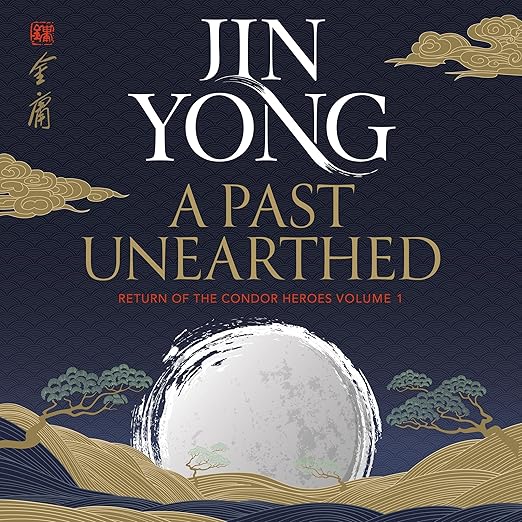
Genghis Khan is dead when this volume opens and the Mongol assault on the Central Plains has not slowed, which is the situation Guo Jing and Lotus Huang inherit along with Penance, the son of the sworn brother who betrayed them. Jin Yong wrote it, Gigi Chang translated it, Daniel Loh York reads the sixteen-hour-and-twenty-two-minute audiobook, and the listing files the entire thing under travel and tourism with a tag reading Asia. What it actually is, is a thirteenth-century martial arts epic.
Jin Yong's structure here is generational. A new cohort of martial artists has come up to meet the Mongol threat, with Guo Jing and Lotus Huang at its front, and the plot turns on an encounter with Blithe Li, the Red Serpent Celestial, that puts Guo Jing back in the path of a boy he has reason to feel responsible for. Penance is the son of Yang Kang, and lifting him out of vagrancy into the martial world is a kindness and an inheritance of trouble at once.
Buried history is what the title points at. Penance is placed with the Quanzhen Sect at their temple in the Zhongnan Mountains and stumbles into the buried history of that school, which sends him toward a reckoning with his father's past and with his own heart. Wuxia has always run on lineage, on who taught whom and which debts attach to which name, and this volume makes that machinery its actual subject instead of its scenery.
A four-star from January 2026 describes the entry as the hard part: the first chapter or so offered no obvious connection to the earlier Condor Heroes run, then the connection and the continuity surfaced and the rest went briskly. That is a fair warning and a fair reassurance in one. The opening asks a listener to hold names and affiliations for a while before explaining why any of them matter.
Why A Past Unearthed Works as an Audiobook
Names are why this format either works beautifully or comes apart. Chang's translation mixes systems deliberately: Guo Jing and Yang Kang keep Chinese order, Lotus Huang and Blithe Li are half-rendered into English, Penance is a bare English word, and the Quanzhen Sect and the Zhongnan Mountains arrive in pinyin. Every one of those needs a consistent decision held steady for sixteen hours, because a listener cannot flick back to a name list mid-fight.
Prose of this kind rewards the format too. A five-star from October 2024 calls it highly entertaining and imaginative adventure, full of kung fu and the taste of the best wuxia literature, and wuxia choreographs its set pieces in sentences rather than pictures. Combat written that precisely benefits from being paced by somebody else, since the temptation in print is to skim the technique names and jump to the outcome.
Length is less of an obstacle than it looks. Sixteen hours and twenty-two minutes reads as daunting for a first encounter with a tradition, but the copy sets several strands running side by side, the Mongol campaign, the new enemy, the boy's education and a sect's hidden history, and the book introduces its world while moving through it. The Lord of the Rings comparison at the top of the description is marketing rather than criticism, though the scale it implies is honest.
Weak Spots in A Past Unearthed
Series placement is genuinely muddled. The listing names the series Legends of the Condor Heroes and numbers this volume one, while the description sets its events after that story and the response pool treats it as a continuation. The United Kingdom five-star of November 2023 lays out the real shelf: all four volumes of Legends of the Condor Heroes, and then this newly published Return of the Condor Heroes, which follows them. Two different works have been folded into one series field.
The banner needs the same caution. Now in English for the first time sits at the head of the description, while that same United Kingdom response describes owning almost all the English editions of Jin Yong's books and a son, sixteen next month, who has been reading the series since he was ten. The claim covers this sequence rather than the author, and a buyer who takes it the other way will start in the wrong place.
Credits are thin in one specific spot. Gigi Chang translated this and is named at the foot of the description, which is more than many listings manage, and yet the translator appears in none of the credit fields. On a book whose English exists entirely because of that work, and whose recording is a performance of that English, the name belongs beside the author and the narrator rather than in the small print.
Then the category, which is simply wrong. A travel and tourism shelf with an Asia tag will deliver this to people planning trips and hide it from the people who read fantasy. The two endorsements at the top, from Shelley Parker-Chan and Fonda Lee, are also about Jin Yong's influence on a genre rather than about this volume, so read them as reputation rather than as a review of what you are buying.
The Right Listener for A Past Unearthed
Readers who have finished the four Legends volumes and want what comes next should simply take this. It works as an entry point too, for listeners who know wuxia through screen adaptations and are willing to accept sixteen hours of texture that no broadcast has room for. The reward is a martial world shown from within rather than summarized.
Approach with care if you need the earlier volumes first. The opening does not hold anybody's hand, the links to the previous run take a while to surface, and the martial world expects its rules about masters, sects and sworn brotherhood to be accepted rather than argued with.
Four of the five written responses end by reaching for the next book, and that is the clearest recommendation on this page as well as its clearest warning. Two of them ask outright when the following volumes will appear in English. Come to it expecting a portion of something much larger, and expect to finish wanting a release date that nobody here is able to supply.
Key Details
- Voice: Daniel Loh York holds sixteen hours of a translation that switches naming systems mid-sentence, from Guo Jing to Lotus Huang to the Quanzhen Sect.
- Big ideas: Martial lineage and inherited debt, a boy raised by his father's enemies, resistance under Mongol invasion
- Atmosphere: Expansive, ceremonious and quick on its feet
- Worth it?: A generous sixteen hours of wuxia, badly served by a listing that calls it travel writing.
Who published this recording, and when?
MacLehose Press is the name in the listing's publisher field, while the description closes with a 2023 production credit for Quercus Editions Limited, against an October 2023 release date. Two imprint names on one product is ordinary enough in publishing, though it is worth knowing if you are matching this edition against a catalogue record.
Does the A Past Unearthed audiobook work if you know the story from television?
A five-star from January 2024 says it beats watching the serial, singling out the descriptive detail the prose carries. Sixteen hours and twenty-two minutes leaves room for the sect politics and the technique names that a screen version has to compress, so expect more texture, and a slower start than an episode would give you.
Sixteen hours is a commitment, so what does the audiobook spend it on?
Four strands run in parallel: the Mongol campaign, the arrival of Blithe Li, Penance's move into the martial world, and the buried history of the Quanzhen Sect. The opening stretch is the densest of them, and it is the part most likely to need a second pass before the names settle into place.
Who translated it, and why does that matter for a recording?
Gigi Chang, whose name appears once in the description and in none of the credit fields. It matters because a reading performs a translation: the Chinese name order kept for Guo Jing and Yang Kang against English renderings like Lotus Huang and Blithe Li is Chang's decision, and holding it consistent is the narrator's whole job.