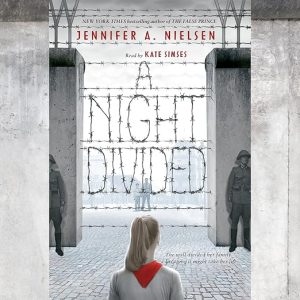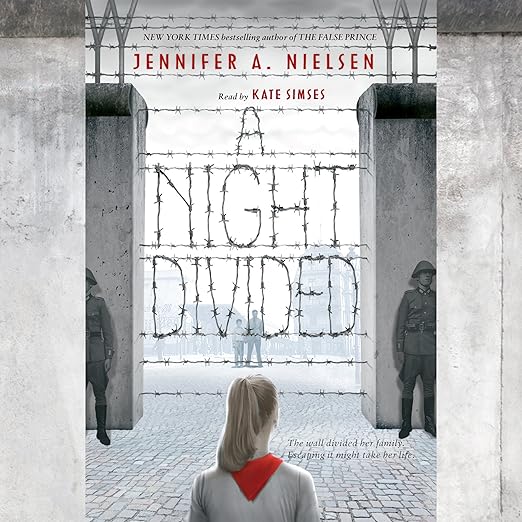
Gerta spots her father across the newly built Berlin Wall, pantomiming a strange, deliberate dance meant only for her to understand, and that single wordless scene sets Jennifer Nielsen's escape thriller fully in motion. Twelve years old and suddenly trapped on the eastern side of a city split overnight, Gerta watches Soviet-controlled soldiers train their guns on their own citizens while she quietly commits to the one dangerous idea her father's pantomime seems to be pointing toward: tunneling beneath the wall itself. I came to this audiobook already fond of Nielsen's other historical thrillers, and this one moves with exactly the urgency her reputation promises.
This edition carries the Scholastic Gold designation, the publisher's line for recognized standout titles from its backlist, a reasonable signal of the book's staying power for a story about the Berlin Wall's earliest, most chaotic days.
How A Night Divided (Scholastic Gold) Holds Up
Nielsen wastes little time getting Gerta into danger, a pacing choice one reviewer specifically credited as a real strength for holding young readers' attention, since a slow opening risks losing exactly the middle-grade audience this book is built for. Once Gerta connects her father's platform pantomime to a smuggled drawing, the tunnel plan becomes the book's driving engine, and every subsequent chapter carries the real, stated threat of deadly consequences if the family is caught.
What makes the book work beyond its thriller mechanics is how specifically it handles a less commonly dramatized chapter of twentieth-century history for younger readers. One reviewer, well-read in WWII fiction and nonfiction, noted they had encountered comparatively little material about this exact period of Cold War Germany, and came away wanting to independently research how much of Nielsen's account tracks real events, a strong sign the book earns curiosity rather than just delivering plot.
The Berlin Wall went up virtually overnight in August 1961, dividing families exactly the way Gerta's is divided here with almost no warning and no legal recourse, a real historical detail Nielsen's fiction captures accurately even as the specific tunnel plot itself is invented. Readers drawn in by the novel's urgency have real, well-documented history to research afterward if the setting sparks the kind of curiosity one reviewer specifically described.
Gerta's brother Fritz shares her exile on the eastern side of the wall, and the two siblings' partnership, arguing over risk, protecting each other from suspicious neighbors, ultimately trusting each other enough to dig a tunnel by hand, gives the book a second emotional axis beyond the parent-child separation the setup establishes first. That sibling relationship carries much of the story's tension once the digging itself begins.
The tunnel-digging sequences specifically demand careful pacing from a narrator, since so much of the tension depends on small sounds, a shovel against dirt, distant footsteps, that need to register as genuinely threatening without narration tipping into melodrama, a balance Simses' steady delivery is well suited to holding across the book's tensest stretches.
The mysterious drawing Gerta receives, which she has to puzzle out before realizing it points toward a specific tunnel plan, gives the book a genuine mystery-solving element layered on top of its escape-thriller structure, one more reason the pacing stays brisk even during scenes that are technically about planning rather than action.
Kate Simses narrates, carrying a story told from a twelve-year-old's perspective under constant, credible threat: armed soldiers, a divided family, and a tunnel dug in secret beneath a heavily guarded border. The register this demands is young enough to stay true to Gerta's age without softening the real danger she and her brother Fritz face throughout, a balance middle-grade thrillers frequently get wrong in one direction or the other.
This is part of the wider Scholastic Gold catalog, a curation line for the publisher's most enduring titles, which is a reasonable signal for parents and teachers looking for vetted historical fiction with real staying power. The book's focus on a single, tightly contained family crisis, rather than a sprawling war narrative, also makes it accessible to listeners who might find a broader WWII epic overwhelming.
Nielsen is also known for The False Prince and the wider Ascendance trilogy, and listeners who enjoyed her fast pacing and resourceful young protagonists there will recognize the same instincts at work here, applied to real historical stakes instead of invented fantasy political intrigue. That established track record for tightly plotted, high-stakes middle-grade fiction is a reasonable predictor of what to expect from this standalone historical thriller.
Weak Spots in A Night Divided (Scholastic Gold)
This is squarely middle-grade material, and adult listeners going in expecting a more complex, morally ambiguous treatment of Cold War politics should recalibrate toward a tighter, more personal family-escape story instead. That said, multiple reviewers explicitly noted enjoying it as adults, so the age category should not be read as a ceiling on the book's appeal.
The book depicts guns trained on civilians, real fear of imprisonment or worse, and a tunnel escape attempt with genuine life-or-death stakes, age-appropriate for the target range but still tense enough that especially sensitive younger listeners, or their parents previewing beforehand, should know real danger runs through the entire back half of the story.
This kind of tightly focused historical thriller also works well in classroom or family-education contexts, giving Cold War history an emotionally immediate entry point that a textbook timeline usually cannot match for younger listeners. Teachers and parents looking for supplementary material alongside broader twentieth-century history units will find this pairs naturally with that kind of use, not just independent recreational listening.
The Right Listener for A Night Divided (Scholastic Gold)
This suits middle-grade listeners and their families looking for accessible, well-paced historical fiction, plus adult listeners who want a tightly focused, emotionally direct entry point into Cold War Berlin Wall history rather than a sprawling historical epic. Fans of Nielsen's other work, and of family-separation-under-political-crisis stories generally, will find a lot to like here.
Listeners wanting extensive historical context or a broader treatment of the Berlin Wall's full history should supplement with nonfiction, since this stays tightly focused on one family's escape. For the intended middle-grade audience and curious adults alike, this is a fast, well-constructed way into a genuinely under-told chapter of history.
Quick Take
- Performance: Kate Simses keeps Gerta's twelve-year-old voice credible under real, sustained danger without softening the story's genuine stakes.
- What it covers: Berlin Wall family separation, a secret tunnel escape, trust and betrayal under surveillance
- Feel: Tense, urgent, and emotionally direct
- Our call: A fast-moving, well-researched middle-grade thriller that works for adult listeners too, especially those less familiar with this specific slice of Cold War history.
Frequently Asked Questions
Is this audiobook appropriate for younger listeners given the historical subject matter?
It is written for a middle-grade audience and handles the danger of armed soldiers and a life-or-death tunnel escape in an age-appropriate way, though the tension is real and sustained, so more sensitive younger listeners may want a parent to preview it first.
What does the Scholastic Gold label mean for this audiobook?
Scholastic Gold is the publisher's line recognizing standout backlist titles, which signals this book has earned lasting popularity rather than indicating any special content or edition differences.
Is this audiobook based on a true story?
It is historical fiction set against the real construction of the Berlin Wall, and while Gerta's specific family and tunnel plan are invented, the surrounding historical setting is grounded in real events from that period.
Can adult listeners enjoy this audiobook even though it's written for kids?
Yes, multiple reviewers specifically noted enjoying it as adults, drawn in by the fast pacing and a lesser-covered chapter of Cold War history, even after realizing partway through that it was written for younger readers.