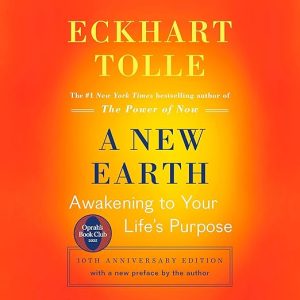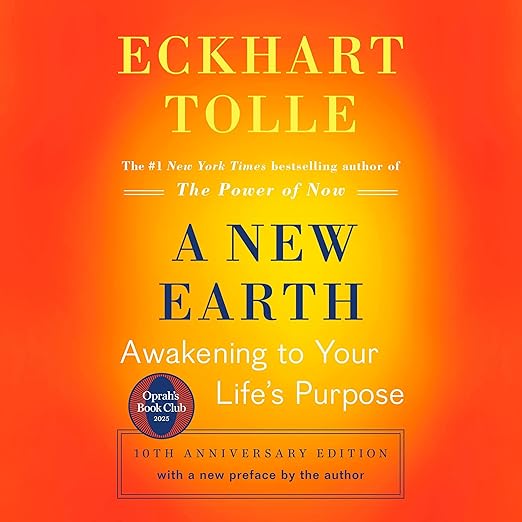
Oprah's name sits above everything else on this page, attached to a 2025 book club selection and a quote about revisiting the book that shaped one reader's sense of connection to the world more than any other living author had. The recording underneath that banner is older than most buyers will assume. Penguin Audio published this audiobook in October 2005 with Eckhart Tolle reading his own work, and it has been circulating for two decades while the marketing around it keeps getting refreshed.
A Closer Look at A New Earth
Ego is the whole subject, and the argument is easy to state and hard to live. Tolle holds that attachment to ego produces the dysfunction underneath anger, jealousy and everyday unhappiness, and that moving past that ego-based state is not only the route to personal happiness but the condition for ending conflict on a much larger scale. His earlier book taught readers to inhabit the present moment. This one turns the attention on whoever is doing the inhabiting, and treats the ego as the obstacle rather than the operator.
Tolle reads it himself, which changes the proposition. A spiritual manual voiced by a professional is a text being performed; the same manual voiced by its author is closer to instruction, and that difference is structural rather than a question of skill. Nine hours in one person's company is the largest variable in whether this edition works for you, so the sample is not a formality here. The delivery is part of the method, not a wrapper around it.
The most substantial response here, five stars from December 2015, calls this book perhaps even more descriptive of the truth Tolle points to in the earlier one, and both of them revolutionary transmissions of truth. Then it does something odd. It pastes in that writer's separate review of The Power of Now, praising simple sentences, a direct tone and practical modern language. Useful reading, though much of the fullest response on the page is grading a different title.
What Makes A New Earth Worth Hearing
Five stars in August 2011 supply the most useful frame anybody here offers. That response observes that Tolle draws on the teaching of many religious leaders while focusing less on traditions than on what William James called religious personalities, and that Tolle is plainly one himself. That reading explains the reach of the book. It does not argue from inside a tradition, so a listener from any of them, or from none at all, can follow the case without converting to anything.
Repetition is how a book like this earns its keep, and audio is built for repetition. The chapters keep circling the same few moves, tracking how attachment to ego turns into anger, jealousy and unhappiness, and hearing that again in a different week catches what a single pass will not. Nine hours split into short sessions serves the material better than one long push, since the book is designed to be revisited rather than completed and filed away.
Bigger than the self-help frame is the political claim, and it gets less attention than it deserves. The description presents this as a manifesto for building a better world rather than only for feeling better inside your own head, and the book means it: individual awakening is offered as the mechanism for ending conflict and suffering at scale. Whether that strikes you as visionary or naive, it explains why the title outsold its shelf. Self-help usually stops at the self, and this one refuses to.
Things to Know Before Starting A New Earth
Start with the dates. This recording came out in October 2005. The banner across the description announces a 2025 book club selection and quotes an endorsement written in January 2025. Nothing on the page suggests the audio was re-recorded, updated or re-edited for the occasion, which means a buyer arriving from a recent broadcast or newsletter is being sold a twenty-year-old file in new packaging. That is entirely legitimate, and it should still be said out loud.
Then the shelving. This listing carries a tag reading Occult, a poor description of a book about ego, attention and ordinary unhappiness, and a good way to attract the wrong buyer while missing the right one. The series slot is stranger still: it reads The Power of Now, which is the title of the earlier book, with no number attached. Nothing in the catalog tells you which to hear first, and the copy quietly assumes you already know.
The pool needs reading with care too. Five responses sit under an average of 4.7 across 20 ratings, all five graded at the maximum, which means the fifteen ratings arriving without text average out below the five that did. Three responses were filed from storefronts outside the United States, and one of those, five stars from October 2024, praises the delivery service in Spanish and says of the book only that it is a jewel.
Who Eckhart Tolle Is Writing For
Anyone who found The Power of Now useful and wants the longer argument is the obvious audience, and so is a listener who has read neither and would rather begin with the fuller statement. A five-star response from February 2026 describes the ideal use case: already inside what it calls an awakening process, wanting a guide to explain what is happening. Used that way, as a companion to something already underway, the book does the job it promises.
Skeptics of the vocabulary should be honest with themselves before buying. Consciousness, awakening and presence are load-bearing terms here, and the book does not define them the way an argument would; it asks you to recognize them. Listeners who need propositions they can test will spend the whole recording arguing with the frame, which is a poor use of an evening. The same goes for anyone hoping for exercises, worksheets or a numbered program.
What survives twenty years is the test any spiritual title has to pass, and this one passes it on the strength of its plainness. Tolle writes without jargon or hierarchy, he reads the book himself, and the audience it gathered was never confined to a single tradition. Judge it on whether the vocabulary suits you, because everything else about the work has held steady while the packaging around it has changed several times over.
A Few Questions About A New Earth
Should I hear The Power of Now before this audiobook?
It is not required. The description positions this title as an expansion of the earlier book's ideas rather than a sequel to a story, and the argument is restated from the ground up. Nothing in the listing sequences them either: the series line names the earlier title without giving either book a number.
Does Eckhart Tolle narrate the audiobook himself?
Yes. The author is the credited reader, which is why this edition functions as instruction from the source rather than a performance of somebody else's text. Worth noting alongside that: the recording is dated October 2005, and nothing on the listing indicates it was re-recorded for the recent book club selection.
Is nine hours and twelve minutes the complete text or an abridgement?
The listing carries no abridgement marker at all, so the reasonable assumption is the full text. The page never states it in words, though. If completeness matters to you, check the format line on the product page before buying rather than inferring it from the running time.
Does the audiobook require any religious commitment?
No. The description calls it a spiritual manifesto and frames ego as the obstacle to happiness and to peace at a larger scale, without asking for a doctrine, a congregation or a practice. The vocabulary sits closer to psychology than to theology, though the claims are not testable the way a psychology book's would be.