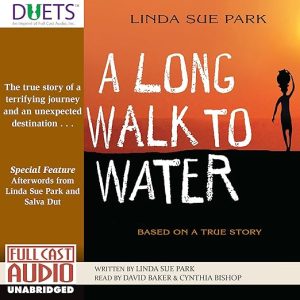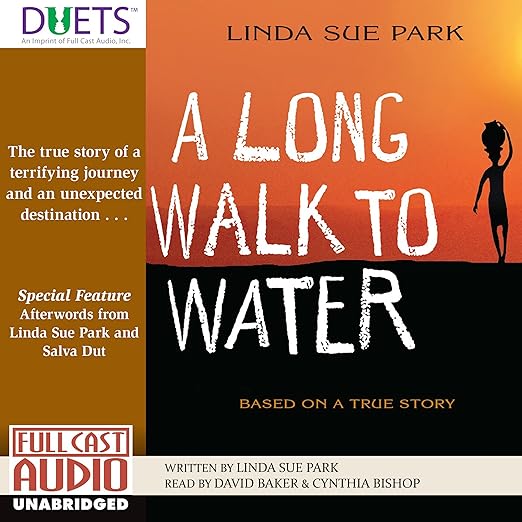
- Narrator: Credited to David Baker alone in this listing, though the synopsis names David Baker, Cynthia Bishop, and dialect coach James Achueil together.
- Subjects: survival and displacement, everyday hardship, hope found across distance
- Tone: Gentle but weighty
- Bottom line: A short, well-regarded family listen, elevated by a dialect coach with genuine lived experience of the story it tells.
A Long Walk to Water runs just two hours and forty-one minutes, a lean length for an audiobook carrying two full storylines at once, and that brevity turns out to be one of its real strengths rather than a limitation.
A Dialect Coach Who Made the Same Journey
Two threads unfold decades apart, per the synopsis. In 1985, southern Sudan is ravaged by war between rebels and government forces, and a boy named Salva Dut is caught in the middle when his village is attacked, forcing him into a harrowing journey across a harsh desert into a strange new life. Years later, in contemporary South Sudan, a girl named Nya walks eight hours a day just to fetch water, a grueling routine the synopsis describes as carrying unexpected hope once the two stories intersect. That intersection is the book's whole engine, and the synopsis is careful not to give away exactly how the two threads meet, only that the meeting point carries real narrative weight once it finally arrives near the end.
Production credit here is worth spelling out clearly, since the narrator field on this listing names only David Baker, while the synopsis itself credits the dual narrative as performed by both David Baker and Cynthia Bishop, with the assistance of dialect coach James Achueil, who the synopsis notes actually made the same journey across Africa himself as one of the Lost Boys of the Sudan. That is about as direct a claim to lived authenticity as a children's audiobook credit gets, and it is worth knowing before you press play, since it shapes how much trust you extend to the Sudanese half of this story from the very first chapter. The listing also carries an Audie Award Finalist nod in the Children's Titles category for ages eight to twelve, dated 2014. For a book covering war, displacement, and daily physical hardship, the short runtime is a deliberate choice rather than a limitation, keeping both threads tight enough that neither storyline overstays its welcome before the two finally meet.
Moments That Felt Like Real Time
Seeker's five-star review, titled Beautiful Story about Hope, Perseverance and Compassion, describes the two lives at the center of the book as intertwined in a genuinely heartwarming way, with one character persevering patiently through great difficulty and the other benefiting from and appreciating that endurance. That review recommends the book for listeners from middle school through adulthood, calling it well written and easy to follow. Diane E.'s four-star review echoes that immersive quality, describing moments that felt like they were happening in real time and admitting a wish that the story continued into another book once it ended.
Lauren Smith's five-star review brings a personal angle: a husband who travels to Africa yearly for mission work made the account of the main character's survival land differently, described as interesting in a way tied directly to that real-world connection. That kind of review, grounded in a listener's own outside experience, is worth weighing alongside the more general praise above. Jennifer's shorter five-star review adds a blunter data point: a tough story overall, but well written enough to hold attention despite the difficult subject matter it covers.
Two Reviews, Both Cut Off Mid-Word
Jazzy M's five-star review, titled Eye opening easy read, describes using this as a family listen, working through two to four chapters a night with children at home. That review notes a real age gap in engagement: it took longer for a seven and nine year old to get pulled into the story than it did for a thirteen year old in the same household, useful context for parents planning to share this one across a range of ages. Exactly what happened around chapter twelve stays a mystery, since the account breaks off mid-word right as that family's experience is being described.
Seeker's review runs into a similar issue, cutting off mid-word just as it moves toward a fuller explanation of what made the compassion theme land so strongly. Given the short runtime, the story necessarily moves briskly between its two threads, which is worth knowing if you prefer books that linger longer in one setting before shifting.
Twenty-seven counted votes sit behind the 4.7 average here, and nothing about that figure looks flagged or inconsistent, so it can be taken close to face value.
A Strong Fit for a Family's Shared Listen
This is a strong fit for families doing a shared listen, especially given Jazzy M's account of working through it chapter by chapter over multiple nights, and for classrooms or educators given its place among Audie Award finalists in the children's category. Anyone drawn to the dialect coaching detail, with James Achueil bringing lived experience of the same journey depicted in Salva's half of the story, has good reason to trust the production took its subject matter seriously rather than treating it as a generic backdrop.
Parents of younger children, based on Jazzy M's review, should expect the seven-to-nine range to need more time to settle into the story than older kids will, so pacing expectations should adjust accordingly rather than assuming uniform engagement across a wide age range in one household. Diane E.'s review is worth returning to here as well: the feeling that the story could easily support a sequel is a useful signal for parents wondering whether to plan a follow-up listen once this one wraps.
Does this audiobook use more than one narrator for its two storylines?
Yes. While the listing's narrator field names only David Baker, the synopsis credits the dual narrative as performed by both Baker and Cynthia Bishop, with dialect coach James Achueil assisting on the Sudanese setting, so listeners should expect more than a single voice across the runtime.
Is this audiobook better suited for young children to listen to alone or with an adult?
One review describes reading it as a family, two to four chapters a night, and found that a seven and nine year old needed more time to get pulled in than a thirteen year old did, suggesting shared listening works better for younger kids.