Before You Press Play
- Performance: Sean Runnette delivers the material with calm authority, a steady, clear voice that suits narrative history without theatrics.
- What it covers: Civilization and commodity, trade routes and cultural exchange, technology disguised as refreshment
- Feel: Curious and conversational, the best kind of popular history
- Our call: A compact, well-constructed argument that reframes world history through an angle most listeners will not have considered.
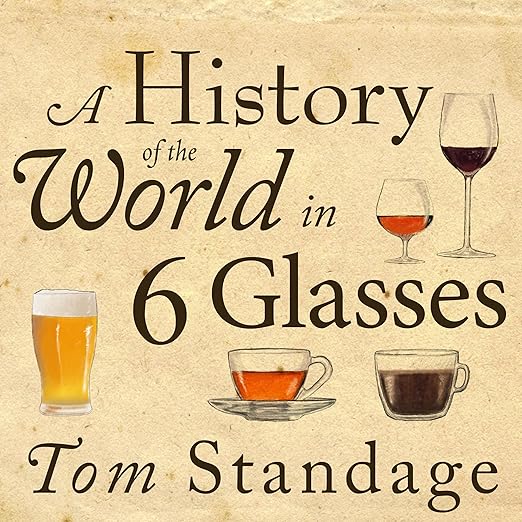
I picked up A History of the World in 6 Glasses on something of a dare to myself, the premise struck me as one of those pop-history conceits that sounds clever in a pitch meeting and collapses under the weight of actual execution. I was wrong. Tom Standage, the science correspondent behind the book, actually makes the thesis work, not because he forces history into a predetermined shape, but because he has chosen six beverages that genuinely were catalysts for larger transformations. The argument does not feel rigged. It feels observed.
The structure is clean: beer, wine, spirits, coffee, tea, cola. Each gets its own section of roughly two chapters, covering a pivotal historical period and the role the drink played in shaping it. Beer and the Fertile Crescent. Wine and the expansion of Greek trade. Rum and the Atlantic slave trade. Coffeehouses and the European Enlightenment. Tea and British imperial policy. Coca-Cola and twentieth-century globalization. The movement through time is linear, which helps listeners who are not already historians keep their bearings, and Standage is disciplined about staying on topic, each chapter argues its thesis rather than drifting into general period history.
A Closer Look at A History of the World in 6 Glasses
The strongest sections are the middle ones, particularly the chapter on coffeehouses. Standage's argument that coffeehouses functioned as proto-public spheres, places where merchants, writers, and intellectuals mixed in ways that private homes and taverns did not permit, is not original, but he makes it accessible without oversimplifying it. He draws a direct line from the coffee debate in seventeenth-century England to the ideas that would eventually produce the insurance market (Lloyd's of London began as a coffeehouse), the stock exchange, and the periodical press. That kind of intellectual genealogy, done clearly and without condescension, is exactly what popular history should do.
The book is brisk at just over seven hours, and that brevity is mostly a virtue. Standage is writing a provocation, not a survey; he wants to change the lens through which listeners see the past, not provide comprehensive coverage of any particular era. One reviewer called it "history light," and that description is not unfair, but history light, done well, is still history done well. Listeners who want the full scholarly apparatus and primary source arguments will need to go further; listeners who want to arrive at the end with a new way of thinking about how civilization develops will find exactly that here.
What Makes A History of the World in 6 Glasses Worth Hearing
Sean Runnette is a narrator who gets out of the way of the material, which is the right instinct for this kind of discursive nonfiction. The voice is clear and measured, pacing well suited to a listener who wants to follow an argument without being rushed. Runnette does not dramatize; he explains, which is what Standage's prose requires. Over seven hours, the consistency is an asset, there are no passages where the performance becomes distracting or where the listener is pulled out of the content.
Things to Know Before Starting A History of the World in 6 Glasses
The final section, on cola and Coca-Cola, is arguably the weakest. Standage makes the point that Coke became a symbol of American cultural reach across the twentieth century, but the argument feels thinner here than in earlier sections, perhaps because the historical distance is smaller and the connections less surprising. Listeners may also notice that the book's framing leans toward a broadly optimistic account of trade and exchange; the darker dimensions of some of these commodity histories, particularly spirits and the slave trade, are acknowledged but not dwelt on. This is not dishonest, but it is a choice about tone that shapes the listening experience.
Who Tom Standage Is Writing For
This is a natural fit for history podcast listeners who want something with a bit more depth than an episode but considerably less commitment than a full academic history. It works well as a commute listen, the chapters are self-contained enough that you can stop and resume without losing the thread, and it pairs nicely with related titles like Mark Kurlansky's Salt or Michael Pollan's food histories. Listeners who dislike popular history's tendency to simplify may find the brisk pace frustrating. Everyone else should find it exactly as much fun as it sounds.