In Brief
- Read by: Christopher Grove delivers Scott Nations's financial narratives with the measured authority the subject demands, clear through complex mechanics and comfortable with the human drama that animates each crash.
- At its heart: Financial contagion, regulatory failure and adaptation, the human psychology behind systemic collapse
- Vibe: Intellectually absorbing with a cumulative unease, the better you understand each crash, the more recognizable the patterns become
- Short version: Rigorous enough for financially literate listeners and accessible enough for generalists, a well-balanced piece of financial history that earns its comparisons to Michael Lewis.
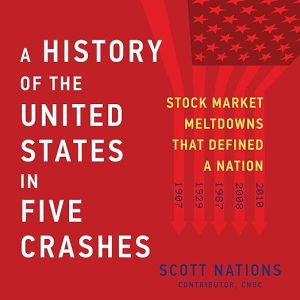
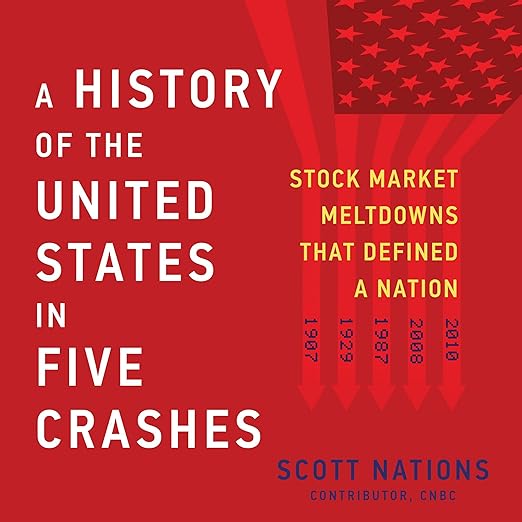
I finished A History of the United States in Five Crashes on a Saturday afternoon after spending several hours with it over the preceding week, and I had the particular sensation that good financial history produces at its best: the feeling that the world you live in has become slightly more legible. Not necessarily more reassuring, in this case decidedly not more reassuring, but more legible. Nations's project is to show how five specific market dislocations, from the Panic of 1907 through the Flash Crash of 2010, are connected not just chronologically but causally, each one creating conditions that the next one exploits.
That is an ambitious framing device, and it mostly holds. The book's central argument, that these crashes are not separate disasters but chapters in an ongoing story about how America's financial system repeatedly outpaces its regulatory infrastructure, is presented with enough specific evidence to be convincing without requiring the listener to already believe it. Nations is a CNBC contributor and financial executive, which means he has the practitioner's intimacy with the material and the communicator's habit of making complex mechanisms accessible. Whether that combination always serves the prose is a question worth returning to.
Each Crash Sets Up the Next One
Nations is not simply writing five financial histories in sequence. His central claim is that each crash creates the regulatory and psychological conditions for the next one, that America's financial system runs a recurring pattern in which innovation outpaces oversight, risk concentrates in ways that regulators do not yet have language for, and the resulting collapse produces rules designed to prevent the last disaster rather than the next one. That argument gives the book its spine and distinguishes it from a collection of set pieces. Whether you find the argument fully persuasive will depend on how much explanatory weight you think can reasonably be placed on five data points across a century, but the argument is argued rather than asserted, which is the minimum standard serious nonfiction should meet.
From Morgan's 1907 Panic to the Flash Crash
Nations structures each crash as a narrative rather than a case study, which is the right decision for a book aiming at the Michael Lewis readership. The Panic of 1907 centers on J.P. Morgan's role in preventing a full systemic collapse, and Nations uses it to establish the pattern: private actors filling regulatory vacuums, with consequences that ripple beyond their control. Black Tuesday 1929 focuses on investment trusts, and Nations's explanation of how a financial innovation imported from post-World War I Britain became a catastrophic amplifier of market excess is one of the book's clearest and most compelling sections.
The 1987 Black Monday section benefits from the specificity of portfolio insurance as a mechanism, the idea that a financial product designed to protect against loss could, through market dynamics, accelerate the very collapse it was meant to hedge against is genuinely counterintuitive, and Nations explains it without condescension. The 2008 chapter covers familiar ground, but the framing through Nations's five-crash thesis gives it enough new context to stay interesting even for listeners who have already read extensively on the crisis. The 2010 Flash Crash is the most technically demanding section and the most chronologically recent, and Nations's account of algorithmic trading's role in a trillion-dollar evaporation in minutes is both alarming and, by the book's logic, entirely consistent with everything that came before.
Individual Actors Risk Flattening Structural Forces
At least one reviewer noted that Nations trails off into irrelevant detail at points, breaking the flow of the story with material that would have been better cut. That observation is fair in places. The book's structural ambition, individual narratives plus connecting thesis plus sufficient technical explanation, creates moments where the prose is doing too many things simultaneously and none of them with full concentration. A tighter editorial hand in specific sections would have improved the listening experience without diminishing the book's substance.
The humanizing of financial forces through individual actors is a deliberate choice that some reviewers appreciated and others found reductive. Nations identifies specific people, bankers, regulators, traders, as representative of larger systemic pressures, which creates narrative momentum but risks overpersonalizing what are fundamentally structural problems. This is a tension that all financial narrative history faces, and Nations navigates it better than many, though not without the occasional moment where a biographical vignette substitutes for structural analysis.
Grove's Steady Voice Across Two Registers
Grove's narration is well suited to the book's dual register: the historical narrative passages flow with appropriate momentum, and the technical explanation sections are delivered with enough clarity of diction to ensure that listeners can track the mechanisms even when those mechanisms are genuinely complex. His voice carries the quality of sober authority that financial subject matter tends to require, not dramatic, not performed, but present and considered. At twelve-and-a-half hours, the narration sustains itself without the kind of fatigue that longer audiobooks sometimes betray in their later sections.
One reviewer who has lived through four of the five crashes described finding the book illuminating in ways that his lived experience had not prepared him for, a useful reminder that proximity to an event does not equal understanding of it, and that financial history has a particular value precisely because the mechanisms that produce crashes are often invisible to those inside them. That gap between experience and comprehension is where Nations's book does its best work.