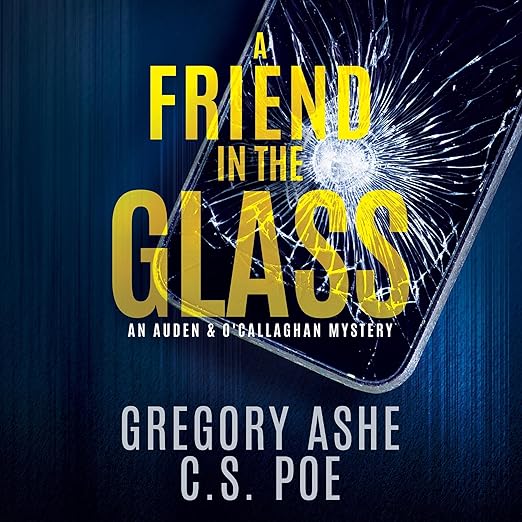
Before You Press Play
- Narration: Garrett Kiesel takes the whole six hours and forty minutes alone, holding two alternating leads without a second voice.
- Themes: military coverup, confidential informants, ex-Army trauma, a relationship tested by a case, winter New York.
- Mood: Tense and airless, with the pressure rarely letting up.
- Verdict: A strong third entry for readers already invested, and a poor place for anyone to start the series.
Winter in New York, and the people who know about Project Stonefish are starting to die. This audiobook is the third of the Auden and O'Callaghan mysteries, six hours and forty minutes of conspiracy, cold streets and a new relationship put under more pressure than it can comfortably take. It is also the installment where the operation that drove Sam Auden out of the Army finally comes looking for him, which means the couple at the center spend the book investigating the worst thing that ever happened to one of them.
Sam's Fixation on Stonefish Serves No One
Rufus O'Callaghan is still working as a confidential informant and still has Sam Auden, the ex-Army drifter who has now moved into his apartment and is failing to settle into city life. A woman calls Sam offering to sell information about Project Stonefish, the training operation that drove him out of the Army and killed somebody he cared about. Before anything can be arranged she dies of a suspicious overdose, having already contacted somebody else.
One November 2024 five-star lays out the machinery neatly: Sam swamped by the noise and congestion of the city, Rufus still feeding information to Erik, his contact on the force, bodies beginning to accumulate, and the growing suspicion that Sam fixing on one villain from Stonefish serves nobody's interest, least of all his own. That last point is the plot's real hinge, and it is a relationship problem before it becomes a case problem. Poe handles that kind of complication well, letting the danger and the domestic friction feed each other instead of taking turns.
The series has always run those two tracks together, and this installment tightens the knot. Sam's judgment is compromised on precisely the subject the case turns on, Rufus knows it, and the two of them are trying to build something domestic while one of them chases the thing that broke him. Whether the mystery satisfies you will depend less on the conspiracy than on how much you want these two to survive each other.
Garrett Kiesel Alone Handles Two Alternating Voices
The conspiracy delivers on scale. An October 2025 five-star describes the pair landing in the middle of an enormous military coverup, dragged in rather than volunteering, with Sam determined to reach the bottom of it and Rufus equally determined to help him, surrounded by dirty government officials and the people who do their dirty work. That is the register: institutional rot, personal stakes, and no clean line between the two.
That compact length is a real advantage here. Conspiracy plots bloat easily, and at this length the story cannot afford a slack middle; the reveals arrive close together and the domestic scenes have to earn their place between them. A listener can finish this across two evenings and keep the whole web in mind, which matters for a plot that depends on who contacted whom and in what order. Middle books in a romance series have a habit of padding. This one has no room to.
Garrett Kiesel carries the full recording alone, which is a specific kind of assignment in a genre that often reaches for two performers. This is a dual-lead story with alternating perspectives, one man raised in the city and one who cannot stand it, and holding both apart across nearly seven hours is the central technical demand of the job. The credit line is the only place on the page where the recording is described at all. Alternating first-person narration is the hardest structure to hand to a single reader, since a listener has to locate the point of view within a sentence or two of every switch.
Whoever Cowrote This Goes Uncredited on the Page
Now the byline. A four-star from November 2024 refers to Poe and a collaborator by initials, praises the flawed characters these two authors create, and admires how the mysteries the pair write stay opaque until the authors choose to show their hand. Whoever the second writer is, the listing does not name them, which is a genuine problem for anyone trying to follow this collaboration across its other books and series.
Confusion about who is who has spread to the responses, too. A three-star from January 2025 has the leads reversed throughout, placing Rufus in Sam's apartment, describing Sam as the informant and Rufus as the veteran, and having the caller reach Rufus rather than Sam. The publisher's summary says the opposite in every case. That is worth knowing before you read the responses for guidance, and it hints at how easily the two men blur for a reader arriving mid-series. Both are damaged, both are guarded, and the alternating perspective asks you to keep them apart from the opening chapter onward.
Two more things about the page. All five responses on the page were written before the December 2025 recording appeared, the earliest in November 2024, so all of them describe the printed book and none can speak to the audio edition. And the page classifies this under LGBTQ titles alone, dropping the mystery classification the tag and the series name both carry, which buries a crime novel in a category browsers use for something else.
Worth the Ask for Readers Already Invested
Readers already invested in Rufus and Sam, first. If you have the previous two books behind you, this is the installment where the backstory finally opens up and the relationship gets tested against it. Newcomers should start at the beginning: the emotional weight here rests entirely on history the earlier books established, and the case makes considerably less sense without knowing what Stonefish cost Sam.
Know what you are taking on. A four-star from January 2025 calls the plot convoluted and notes the near-total absence of tension relief, which stretched the reading over six weeks during a difficult period, then still praises the ending and commits to book four. That is a fair warning: this is a tense, grim, claustrophobic entry, and listeners who want their romantic suspense with more air in it should choose a different series.
Six hours and forty minutes is a small ask for the installment that finally opens the Stonefish file, assuming you are still with the series. Come for the couple, tolerate the conspiracy, and accept that the page will tell you almost nothing about the recording you are buying. The one thing the listing genuinely owes you, the second author's name, is the one thing it does not print. Third installments rarely carry this much weight, and this one earns the position it occupies.
Questions Listeners Ask
Can I start this audiobook without reading the first two books?
Not comfortably. This is the third book about Rufus and Sam, and everything here rests on Project Stonefish, the operation that drove Sam out of the Army before the series began. The relationship between the two men is already established as well, and the stakes here assume you watched it form.
Is this audiobook a romance or a crime novel?
Both, braided tightly. The case concerns a military training operation and the people prepared to kill to keep it buried. The emotional line concerns two men trying to build something domestic in one small apartment while one of them pursues the thing that broke him. Neither half works without the other.
How much does the New York winter setting matter?
Quite a lot. Sam has arrived from elsewhere and is struggling with the racket and crush of the place, the apartment the pair share is cramped, and the season closes the whole story down to interiors and cold streets. The setting works as pressure rather than as decoration throughout.
What exactly is Project Stonefish?
The Army training operation Sam Auden left the service over, and the reason somebody he cared about died. A woman offering to sell information about it sets the plot in motion, and whoever wants it buried has the power and the ruthlessness to keep it that way. Earlier books circle it; this one opens the file.