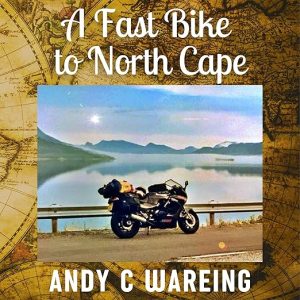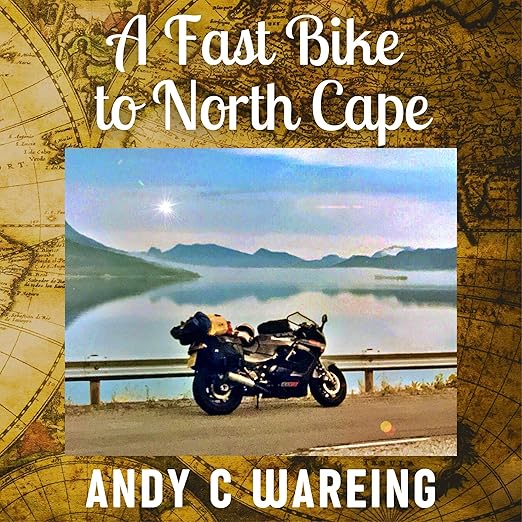
Andy Wareing's account of riding a Kawasaki GPZ1000RX from Britain to North Cape in 1989 is the kind of audiobook that announces its qualities inside the first ten minutes. The opening of A Fast Bike to North Cape, narrated by Wareing himself, establishes the register immediately: this is a man looking back at a younger version of himself with the specific compound emotion of affection and disbelief that only time can produce. He was barely prepared. The weather was biblical. The decisions were catastrophic. The trip was, by any rational measure, inadvisable. The audiobook he has made of it, at 4 hours and 18 minutes, is a genuinely entertaining piece of work that belongs to a particular and underappreciated tradition of British comic travel writing.
The year 1989 is worth taking seriously as context rather than mere nostalgia framing. This was travel without smartphones, without GPS, without the background safety net of instant communication. Wareing navigated with paper maps, described by him as "reading paper maps like pirates on the high seas," and found his way by asking people and by getting comprehensively lost. The friends he made and lost along the roads were real encounters, not filtered through social media or ratings apps. The travelogue captures a kind of contingent, analog adventure that is essentially impossible now, and part of what makes it work as an audiobook is that Wareing is not sentimental about this. He is funny about it, which is the better response.
How A Fast Bike to North Cape Holds Up
The comparisons in the marketing copy to Bill Bryson, Douglas Adams, and David Sedaris are not idle. Wareing's comedy is structural in the way that Bryson's is: the humor emerges from the gap between the narrator's ambitions and what actually happens to him, from the logical conclusions that reality insists on drawing from his choices. A reviewer named Paul Anderson notes that Wareing "shares details, thoughts, feelings, and his own quirks to such a degree, that the lucky reader..." and trails off, but the point is the specificity. This is not a generic adventure yarn. It is a portrait of a particular person making particular choices in a particular moment, and the details are where the comedy and the pathos live in equal measure.
The route itself, crossing fjords, frozen tundra, and high mountain passes to reach the most northern point of Europe, provides natural dramatic geography. Wareing is good at place. The Arctic landscapes register as genuinely alien rather than merely pretty, and the physical difficulty of the journey, the cold, the weather, the mechanical anxiety of pushing a motorcycle through terrain it wasn't designed for, comes through in the narration with enough texture to make you feel the discomfort. R.W. Nilsson's review calls it "a wilder trip, at least weather wise" and confirms that "he suffers for it," which the audiobook delivers honestly rather than romanticizing the hardship.
Why A Fast Bike to North Cape Works as an Audiobook
Wareing's self-narration is the primary reason to choose the audio version over the page. He has the comedian's essential skill of knowing when not to push a joke, letting the absurdity of a situation breathe rather than underlining it. The timing on his comic observations feels natural, not scripted, which is harder to achieve than it sounds, and that naturalness is almost impossible to replicate with a third-party narrator reading someone else's jokes. He also knows how to land the quieter moments without overplaying them. There are passages in A Fast Bike to North Cape that are genuinely touching, encounters with strangers who become briefly important, moments of solitude in landscapes of specific beauty, and Wareing reads those passages with a restraint that makes them more effective than the funny ones. The Petrolhead Travelogues series can be listened to in any order, so there is no prerequisite reading required, and this volume functions as a complete piece in itself.
At 4 hours and 18 minutes, this is also an audiobook that fits conveniently into a long drive or a day of mixed tasks. The compact runtime reflects discipline rather than thinness; there is no padding, no unnecessary recapping, no philosophical detours beyond what the material earns. Each scene earns its place.
Weak Spots in A Fast Bike to North Cape
The "accidentally informative" quality flagged in the synopsis is real and worth attending to. Wareing is not writing a travel guide, but his descriptions of Norwegian geography, of the logistics of crossing into the Arctic Circle in 1989, and of the social textures of the places he passes through, accumulate into something genuinely educational without being intended as such. The characters he meets along the way, a rotating cast of fellow travelers, locals, and one or two people who appear at exactly the wrong moment, are rendered with a journalist's precision for the telling detail. The "interesting characters" the synopsis promises are specific people, not stock types, and Wareing's ear for dialogue is sharp enough that you will remember several of them after the audiobook ends. Also: the motorcycle mechanics are treated with appropriate weight for an audience that includes riders. Wareing doesn't over-explain to non-riders but assumes you understand why a particular mechanical anxiety matters, which is respectful of the genre's established readership.
The Right Listener for A Fast Bike to North Cape
Motorcycle enthusiasts and travel memoir readers who want their adventure writing cut with genuine comedy will find this audiobook exactly suited to their taste. Fans of Bill Bryson or David Sedaris who haven't encountered this corner of the travel-writing world should consider it a strong introduction. Listeners who need their travel books to function also as practical guides will not find what they're looking for here; this is lived experience rather than itinerary. Those who want unbroken action and high stakes at every turn should also look elsewhere, since much of what the book offers is the particular pleasure of watching someone navigate inconvenience with wit. The 4-hour runtime makes it accessible to listeners who aren't ready to commit to a longer memoir, and the self-contained nature of the series means there's no pressure to go further unless you want to.
A Few Questions About A Fast Bike to North Cape
Do you need to be a motorcycle enthusiast to enjoy this audiobook?
No. The motorcycle is the vehicle for the adventure, but the book is fundamentally a piece of comic travel writing in the tradition of Bryson and Sedaris. Non-riders will follow the journey without difficulty, and the humor and human encounters are accessible to any listener who enjoys well-observed personal narrative.
Does A Fast Bike to North Cape audiobook stand alone, or should you listen to other books in the Petrolhead Travelogues series first?
The series is explicitly designed so that each volume can be listened to in any order. This audiobook is a completely self-contained experience. No prior knowledge of Wareing's other travelogues is required.
How long is the audiobook, and is the runtime long enough to make the trip feel substantial?
The audiobook runs 4 hours and 18 minutes. Wareing disciplines the material tightly, so the compact runtime reflects precision rather than a thin account. The journey to North Cape feels complete within that length because he keeps the narrative moving and wastes no time on padding or unnecessary reflection.
Andy Wareing narrates his own audiobook. Does that self-narration work for listeners who prefer professional voice actors?
Wareing is a natural narrator with strong comic timing, and the self-narration is particularly effective for the book's humor, which depends on the authorial voice reacting to its own past choices. Listeners who strongly prefer trained professional narrators may notice an occasional lack of formal polish, but the authenticity the self-narration brings to the material more than compensates.