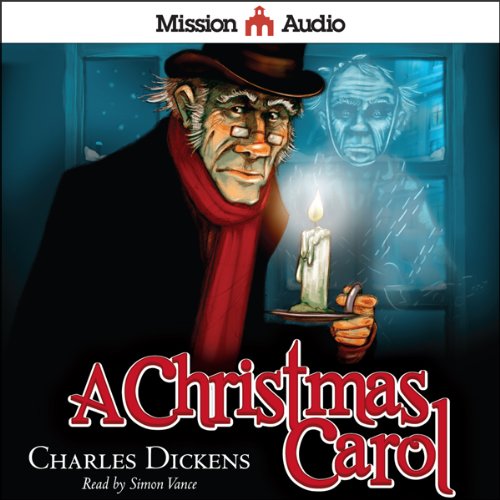
I first listened to A Christmas Carol in Simon Vance's reading on a December afternoon when I had three hours between meetings and needed to sit somewhere quiet. I have encountered the text in various formats, school editions, theatrical adaptations, the Muppet version which I am legally required to mention, and what struck me immediately about Vance's reading was how much of the prose I had simply never properly heard before. Dickens wrote this at speed, in six weeks, but he wrote every sentence as if time were plentiful. Vance gives it back that spaciousness.
The novella was published in 1843 and, as the synopsis notes, arrived at a particular historical moment: Britain was recovering its Christmas traditions after a period of sobriety, and Dickens was both riding and driving that recovery. What tends to disappear in adaptations is the social argument. Scrooge is not simply a miser who needs to learn warmth. He is a figure who has made a coherent philosophical choice to refuse sympathy for the poor, and the three Ghosts dismantle that philosophy through evidence rather than sentiment. It is a more rigorous piece of moral reasoning than holiday readings usually acknowledge.
Our Take on A Christmas Carol (Simon & Schuster Edition)
Vance is among the finest British voice narrators working in the audiobook form, and he brings to this text something rarer than technical skill: he reads as if he genuinely respects the prose. His Scrooge is not a pantomime villain. He is a man who has systematically made himself smaller than he was, and Vance plays the transformation not as a sudden defrost but as an accumulation of cracks. By the final stave, the joy feels earned rather than imposed.
One reviewer described Vance as her favorite narrator combined with her favorite author, which is the kind of reader-performance alignment that makes the best audiobooks. Another framed the experience through his Bible study group's reading of the novella as a specifically Christian text, noting how the Ghost of Christmas Past's role as conscience aligns with certain theological frameworks. Dickens was drawing on a broader tradition of moral reckoning than his secular admirers usually credit.
At two hours and fifty-four minutes, this is a rare audiobook that can be completed in a single sitting that does not feel rushed. The novella's brevity is a feature, not a limitation. Dickens packed more social criticism, more emotional architecture, and more linguistic brilliance into those pages than many novels three times the length manage. Vance's pacing honors that compression.
This edition also benefits from being a straight unabridged reading rather than a theatrical or multi-cast production. There are excellent dramatic versions of A Christmas Carol, but what they offer is interpretation imposed on top of the text. Vance offers the text itself, which turns out to be more than sufficient.
What to Watch For in A Christmas Carol (Simon & Schuster Edition)
Listeners who know only the adaptation versions, film, stage, animated, will encounter passages and even characters that feel unfamiliar. Dickens's Fezziwig section is richer than most adaptations preserve. The novel's explicit commentary on the Poor Law and the workhouse system is present and pointed in a way that sanitized adaptations routinely cut. Vance does not edit it out. The social argument is part of the text he is reading.
The genre categorization as a children's audiobook in some catalogues is misleading. Dickens intended this for adult readers and wrote it as social criticism for people who would understand its economic and political references. It works for family listening, but adults will hear things in it that children, reasonably, will not.
Who Should Listen to A Christmas Carol (Simon & Schuster Edition)
Anyone who wants to hear what Dickens actually wrote, as opposed to what we have collectively decided it says, should give this two hours and fifty-four minutes without hesitation. Single-narrator readings done at this level of skill are exactly what the audiobook format was built for.
Listeners who specifically want the theatrical version, the full cast, the musical score, the dramatic sound design, should seek one of the many produced adaptations. This is literature read well, not a performance staged around literature.
- Narrator: Simon Vance's reading is precise, warmly authoritative, and genuinely distinguished. He navigates Scrooge's transformation with dramatic intelligence rather than theatrical excess.
- Subjects: Redemption through confrontation with the past, the moral cost of indifference to poverty, the recuperation of joy
- Tone: Richly atmospheric, moving without sentimentality
- Bottom line: The best single-narrator audio version of Dickens's most beloved novella, completed in under three hours without sacrificing an ounce of the text's emotional power.
Frequently Asked Questions
Is Simon Vance the definitive narrator for this text?
Vance is among the finest British voice performers working in audiobooks, and A Christmas Carol suits his precise, warmly authoritative register exceptionally well. He differentiates Scrooge's arc across the novella with genuine dramatic skill. Listeners who have only encountered celebrity readings of the text will find this one a recalibration.
At under three hours, does this audio version feel complete or abridged?
This is an unabridged reading. The novella itself is short, and two hours and fifty-four minutes represents the full text at Vance's considered pace. It is not a truncated version.