Before You Press Play
- Narration: Olayemi Joel is the sole voice across all twenty-eight sessions, with no listener reviews yet to confirm how the pronunciation and pacing land with a child.
- Themes: everyday spoken vocabulary, repetition-based retention, West African language and heritage
- Mood: Patient and encouraging
- Verdict: Judge this one on its own stated method for now, since no listener proof yet exists for a spoken-Yoruba course built this seriously for kids.
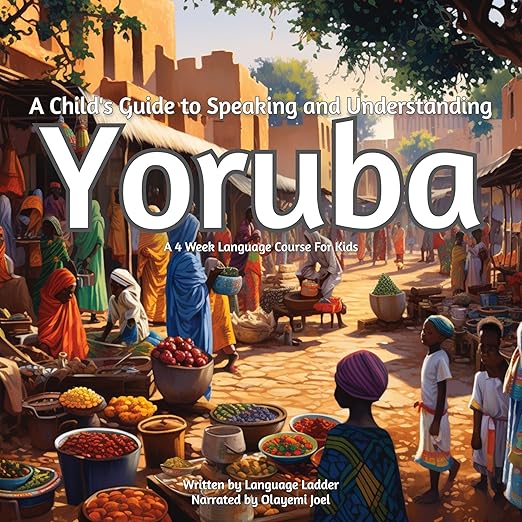
A Child's Guide to Speaking and Understanding Yoruba promises exactly what its title says, and the synopsis backs that promise with real structural detail. This audiobook is built around twenty-eight sessions totaling roughly thirteen hours, organized through what the course calls a frequency-dictionary approach, meaning it teaches the words and phrases a child is statistically most likely to actually use rather than working through a full grammar a young listener would never sit through.
Language Ladder Fills Both the Author and Publisher Fields
One phrase from the synopsis, frequency dictionary, explains the whole design philosophy here. Rather than teaching vocabulary alphabetically or grammatically, the course prioritizes the words and phrases a Yoruba speaker actually reaches for most often in daily life, on the theory that a child gets more usable language, faster, from mastering the fifty most common words than from a scattershot introduction to five hundred equally weighted ones. It is a practical, outcomes-first approach borrowed from adult language pedagogy and applied here to a young audience.
Language Ladder appears in both the author and publisher fields on this listing, which signals a branded course product rather than a single writer's individually authored book. That distinction matters for expectations: this is closer to a structured curriculum built by a team than to one educator's personal teaching voice, and the consistency that implies, thirty-plus themed sections following one repeatable method, is generally a strength for a course meant to be worked through session by session over weeks.
Genuine scope backs that description: more than five hundred words and phrases spread across more than thirty themes, including greetings, quantities, colors, places, emotions, time, food, transport, animals, and basic questions and responses. Layering repetition on top of that breadth, through what the course describes as short daily lessons and a timed repetition method meant to improve retention, is a reasonable design choice for a subject where a child's actual goal is holding a real conversation, not passing a written exam.
No reviews are attached to this listing, so nothing here can confirm how the method actually lands with a real child learner day to day. The rating badge does offer one hard data point: two counted votes total exactly six points out of a possible ten, four points short of a perfect sweep across both raters. That is a plainly stated fact rather than an estimate, and it is worth knowing even though two votes alone cannot say much about how this course performs at scale.
Joel's Delivery Carries Almost the Entire Product
Audio is not a compromise format here the way it can be for other instructional material; it may be the correct one. The synopsis says plainly that grammar is only taught through example and that the course focuses specifically on speaking and oral comprehension, which means the actual skill being built, producing and recognizing spoken Yoruba, is exactly what an audiobook delivers natively. A printed phrasebook would arguably be the compromise format for this particular goal, not the other way around.
Olayemi Joel narrates, and while nothing in the available data confirms performance quality directly, a course built entirely around correct spoken pronunciation puts unusually direct weight on the narrator's delivery compared to a typical children's audiobook. Getting Yoruba's tonal patterns right is not a nice-to-have here; it is close to the entire product, since a child absorbing incorrect pronunciation from thirteen hours of repetition would be learning the exact opposite of what the course promises.
A Promise Rather Than a Confirmed Outcome
Yoruba relies on tone to distinguish words that look identical in plain Latin script, and nothing in this listing's synopsis confirms whether written companion material, showing tone marks or spelling, comes packaged alongside the audio. Families wanting their child to eventually read and write Yoruba, not just speak and understand it, should treat this specifically as an oral-comprehension course and plan to source separate material for literacy, since the synopsis itself frames grammar and presumably writing as secondary to speaking practice throughout.
Honesty matters here too: the complete absence of listener reviews is worth sitting with rather than glossing over. Everything above is drawn from how Language Ladder describes its own course, not from a parent or child who has actually worked through all twenty-eight sessions and reported back on results. That is not a reason to dismiss the course, but it is a reason to treat the structural detail here as a promise rather than a confirmed outcome. The synopsis also mentions dedicated sections in English on strategies for learning new languages generally, plus guidance for continuing study after the course ends, which suggests Language Ladder is thinking past these specific thirteen hours toward a child's longer language-learning habits, even if no listener has yet reported back on whether that guidance actually helps.
Skip It for Literacy or a Faster Pace
This suits families wanting a screen-free introduction to spoken Yoruba for a child, particularly households connected to Nigeria or the wider West African diaspora who want a structured way to pass the language on, along with homeschooling parents looking for a self-contained thirteen-hour course rather than scattered free resources. Yoruba's real-world reach, spoken by roughly thirty million people and rooted in the Niger-Congo language family, makes this a genuinely useful skill rather than a novelty exercise, and a course built around actual conversational frequency respects that real-world use in a way a purely academic grammar course would not.
Skip it if literacy, reading and writing Yoruba script and tone marking, is the actual goal, since the course's own framing centers oral comprehension instead. Skip it too if an older learner needs a faster-paced, less repetition-heavy adult course; the daily-lesson structure and timed repetition described here point clearly toward a younger audience's attention span and learning pace.
A Few Questions About A Child's Guide to Speaking and Understanding Yoruba
Can a child actually learn to speak Yoruba from this audiobook alone?
The course is designed for exactly that, focusing on oral comprehension and speaking practice across twenty-eight sessions and more than five hundred words and phrases. Grammar is only taught through example rather than as a separate subject, so a listener should expect conversational competence as the goal, not formal written fluency.
Does this audiobook include written Yoruba, spelling, or tone marks a child could read?
That is not confirmed in the available synopsis, which emphasizes speaking and oral comprehension specifically. Families wanting their child to also read and write Yoruba, including its tone marking, should plan on sourcing separate material, since this course appears built around listening and speaking rather than literacy.
Why does the rating on this audiobook show such a low score with almost no votes?
Only two people have rated it so far, together landing on a combined six out of a possible ten between them, and neither left a written review to explain the score. That is a genuinely small sample, so the number reflects limited feedback rather than a proven verdict on the course's quality.
Is this Yoruba audiobook better suited to young children or older learners?
The short daily lessons, timed repetition method, and children's framing throughout the synopsis point toward a younger audience specifically. An older learner or adult wanting a faster-paced, less repetitive course focused on the same language would likely be better served by material built for that different pace.