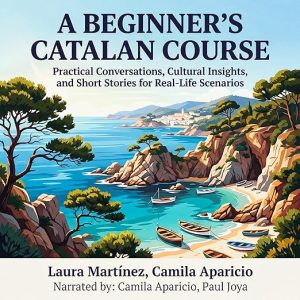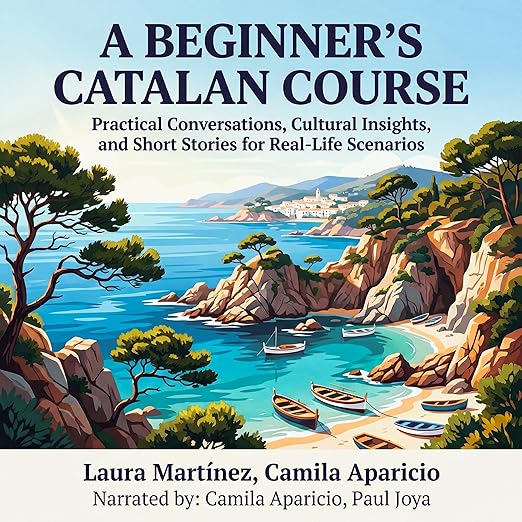
Language courses live or die by the voice in your ear. A Beginner's Catalan Course audiobook gets that part right from the first track: Camila Aparicio, framed throughout as your guide, narrates with the measured clarity of someone who has taught pronunciation to nervous beginners many times before. That combination of warmth and precision sets the tone for what follows, a four-hour course aimed at getting you functional in Catalan before you land in Barcelona or sit down with a Catalan-speaking colleague.
Catalan occupies a fascinating and sometimes undervalued corner of the European language landscape. It is not Spanish, not French, and definitely not a dialect of either, even though it borrows phonetic traits from both. Author Laura Martínez leans into that distinctiveness from the start, framing Catalan not as something exotic to decode but as a living language with its own logic, its own literature, and its own speakers who will respond warmly when you try. That framing matters: too many beginner language courses treat the target language as a problem to solve rather than a culture to enter.
The structure here is practical rather than academic. Each lesson moves from vocabulary clusters into dialogues and then into short contextual stories, a sequence that mirrors the way real language exposure tends to work. You encounter the word for coffee, you hear it used between two people at a café counter, and then you hear it again embedded in a short narrative about someone's morning routine. Repetition through context rather than rote drilling is the method, and for an audio-only format it is the right call. You cannot stare at flashcards while commuting; you can, however, follow a short story.
Pronunciation guidance deserves special mention here. Catalan contains sounds that English speakers rarely encounter, the open and closed varieties of certain vowels, the distinction between voiced and voiceless sibilants, and Aparicio handles these with patience. She does not rush past them with a brief phonetic note; she models them, gives context for where they appear, and returns to them in the practice dialogues. For a language that is widely studied from print, having a live voice demonstrate the musicality of Catalan is a genuine asset of this audio format.
Highlights
The course covers the terrain you would expect: greetings and social pleasantries, numbers and times, food and café vocabulary, shopping, transportation, and navigation around health conversations. What it adds beyond those basics are the cultural notes woven into each unit. When the course covers food vocabulary, you are not just drilling the words for bread and cheese, you are hearing why the Boqueria market in Barcelona operates the way it does, why certain regional dishes carry the pride that they do, and how your attempts to speak Catalan rather than defaulting to Castilian Spanish will be received by locals in Catalonia. These contextual threads are well-judged and never overwhelm the language practice.
The quote embedded in the synopsis, the Catalan proverb that frames language as a way of seeing the world, is actually a useful north star for the course's philosophy. Martínez is not trying to deliver a tourist phrasebook; she is trying to give you the beginnings of a lens. Whether four hours and a handful of dialogues can fully deliver on that ambition is a fair question, but the aspiration lifts the material above the purely transactional.
Weak Spots in A Beginner’s Catalan Course
Realistic expectations are important here. At just over four hours, this course provides a genuine introduction but not fluency. Listeners expecting to emerge from it capable of navigating complex conversations will be disappointed. The grammar explanations, while clear, are necessarily abbreviated, this is audio, after all, and dense grammatical paradigms do not translate well without a printed reference. The course would pair well with a written grammar guide or a PDF companion, though none is mentioned in the material.
Listeners with existing knowledge of Spanish, French, or Italian will find certain vocabulary patterns recognizable, which is an advantage. Those coming to Romance languages cold will need to replay certain segments more than once. The audio-only format means there is no spaced repetition system, no quiz function, and no way to check whether your own pronunciation is accurate without recording yourself. For genuine pronunciation development, supplementing with a language exchange partner or a tool like Forvo for Catalan audio examples would extend what the course can offer.
The rating is low, only three reviews, which makes it hard to triangulate listener consensus. What the synopsis and structure suggest is a carefully assembled beginner resource that understands its audience: travelers preparing for a visit to Catalonia, heritage speakers wanting formal exposure to a language they heard at home, or language enthusiasts drawn to a linguistic path less taken. For all three groups, this course offers something genuinely useful.
Is This One for You?
Pick this up if you are planning a trip to Barcelona or anywhere in Catalonia and want to go beyond survival Spanish. It is also a good fit for language learners who appreciate cultural context alongside vocabulary, and for anyone curious about one of Europe's most distinct regional languages. Skip it if you need grammar depth, a print companion, or a structured progression system, this is a starting point, not a complete curriculum. Anyone who already speaks intermediate Catalan will find the pace too slow. But as a first genuine encounter with the language, narrated by a voice that treats the material with care, it earns its place.
- Voice: Camila Aparicio, the guide named in the course itself, narrates with natural warmth and clear pronunciation, which matters enormously when learning to reproduce sounds you have never heard before.
- Big ideas: Language acquisition, Catalan cultural identity, practical travel communication
- Atmosphere: Encouraging and methodical, with a sense of genuine adventure
- Worth it?: A solid audiobook introduction to Catalan for travelers and language learners who want usable phrases over grammar charts.