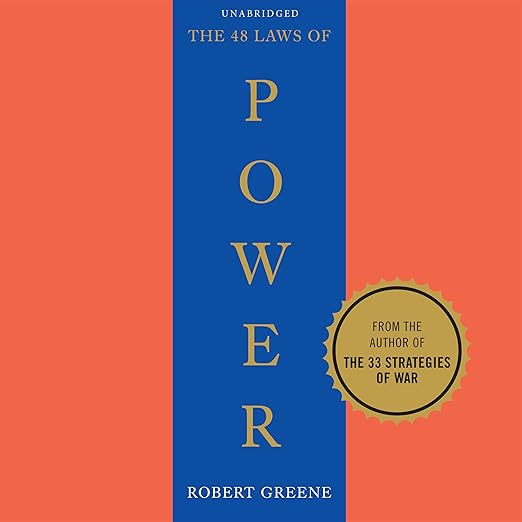
Quick Take
- Narration: Richard Poe’s measured, gravitas-laden delivery suits Greene’s historical register well; his steady pacing sustains well across twenty-three hours.
- Themes: Power dynamics and historical strategy, moral ambiguity in human relations, patterns of influence across cultures
- Mood: Expansive and intellectually provocative, occasionally unsettling
- Verdict: A genuinely useful lens on how power operates through history, best approached as a study of human behavior rather than a practical instruction manual.
I came to The 48 Laws of Power the way most people do, sideways, through a reference in an interview or a quote lifted out of context in a social media caption. I finally sat with the full audiobook on a flight back from a conference, and what surprised me was how much more nuanced the actual text is than its reputation suggests. Greene is not writing a how-to guide for manipulation, though the book is certainly used that way. He is writing a historical study of how power has functioned across three thousand years of human behavior, and the tone is closer to Machiavelli-as-observed-phenomenon than Machiavelli-as-prescription.
The audiobook runs twenty-three hours and six minutes, which is substantial, and the format rewards non-linear listening. Several reviewers mentioned opening the book to a random law rather than progressing sequentially, and the structure fully supports that approach. Each law is self-contained, illustrated with historical examples and a reversal that complicates the initial principle. The unique formatting one reviewer specifically noted is genuinely distinctive: Greene alternates between the law itself, an observance, a transgression, and keys to power, creating a rhythmic argumentative structure that builds on itself across the full runtime.
Our Take on 48 Laws of Power
Greene synthesizes Machiavelli, Sun Tzu, Carl von Clausewitz, and a catalog of less canonical strategists and courtiers into a coherent philosophy of power. The synthesis is the book’s real accomplishment, not any single insight. Reviewers consistently note that some laws feel morally uncomfortable, which is accurate, but that discomfort is part of Greene’s design. He is describing how power actually operates, not how we wish it did, and the gap between those two things is where the book lives. The reviewer who described it as making them think about power dynamics in everyday life captures the book’s lasting effect accurately: once you have listened to it, you notice the patterns Greene names in situations where you previously would not have looked for them.
Why Listen to 48 Laws of Power
Richard Poe’s narration is a strong match for the material. His voice carries natural gravitas without theatrical inflation, and the measured delivery suits the historical register of the examples. At twenty-three hours, the audiobook benefits from a narrator who can sustain tone without monotony, and Poe manages that balance across the full length. The production quality from HighBridge is clean and consistent. One notable external data point: this is a book that has reportedly been rejected by some correctional facilities, a fact one reviewer mentions without irony. That detail alone says something about how seriously some institutions take Greene’s ideas about power and the people they worry might apply them.
What to Watch For in 48 Laws of Power
The book’s weakness is also its strength. Because Greene draws from such a wide historical and cultural range, some examples feel stretched to fit the law being illustrated rather than organically demonstrating it. A few laws are more compelling than others, and the quality of argument is uneven across the forty-eight. Listeners approaching the book as an unimpeachable manual will be disappointed by the contradictions between laws and the frequent reversals Greene himself offers. Those who approach it as a conversation with history, a series of observed patterns rather than absolute rules, will find it considerably more durable and worth returning to.
Who Should Listen to 48 Laws of Power
Students of history, psychology, and organizational behavior will find the most sustained value here. Readers who have enjoyed Greene’s subsequent books like Mastery or The Laws of Human Nature may want to start with 48 Laws to understand the philosophical foundation. Those who are morally uncomfortable with amoral analysis will find the experience difficult regardless of how many caveats Greene includes. At twenty-three hours, the commitment is real; the random-law approach multiple listeners recommend is a genuine solution for those who want the ideas without the linear obligation.
Frequently Asked Questions
Is The 48 Laws of Power actually advocating for manipulation and unethical behavior?
Greene frames the laws descriptively, as patterns observed across history, and includes reversals that complicate each principle. The book describes how power operates rather than simply prescribing behavior, though its applications vary widely depending on the reader.
Does the audiobook work if you listen non-linearly, jumping between laws?
Multiple reviewers recommend this approach and the structure supports it fully. Each law is self-contained with its own historical examples and analysis.
How does Richard Poe’s narration hold up across a 23-hour runtime?
Poe’s measured, authoritative delivery suits the material and sustains well over the long runtime. Listeners accustomed to more animated narration may find his register steady rather than exciting.
Why has this book reportedly been restricted in some correctional facilities?
One reviewer noted this specifically. Some institutions restrict books addressing power, manipulation, and influence on the grounds that they may be disruptive in that environment.