Quick Take
- Narration: Duralde narrates his own book with the easy authority of someone who has spent decades talking about film on podcasts and in print. The delivery is warm, engaged, never overperforming, and matches the conversational intelligence of the text.
- Themes: LGBTQ+ representation and erasure, Hollywood’s institutional closet, the long arc from coded queerness to open storytelling
- Mood: Celebratory and clear-eyed, carried by genuine enthusiasm for the subject
- Verdict: The most complete single-volume history of queer Hollywood available, written and read by someone who has clearly loved every frame of it.
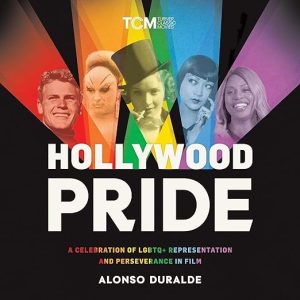
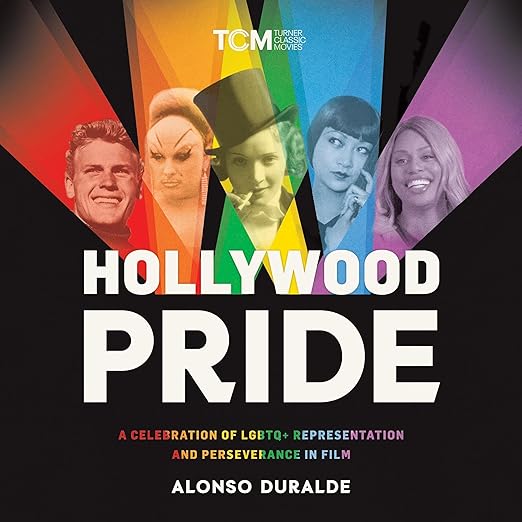
I started Hollywood Pride on a Friday evening with a glass of wine and ended up still listening at midnight, having convinced myself I would just get through the silent era chapter. The problem with a book this generously stocked with names, films, and stories is that every paragraph opens a door you want to walk through. Alonso Duralde has been one of the most trusted film critics working in podcasting and print for years, and this book feels like the culmination of everything he has been preparing to say.
It is published under the Turner Classic Movies banner, and the association fits. This is a book that takes the full sweep of cinema seriously, beginning not with some symbolic moment in the 1960s but with an 1895 Edison laboratory film of two men dancing together. That early positioning tells you everything about Duralde’s approach: queer cinema did not begin when Hollywood decided to acknowledge it. It was there from the start, sometimes visible, often encoded, occasionally erased, but never absent.
The Scholarship Behind the Story
One of the reviewers here describes the book as a reference work that also holds together when read straight through, and that dual function is genuinely difficult to pull off. Duralde manages it by organizing the material chronologically through the evolution of Hollywood’s relationship with LGBTQ+ representation rather than through individual biography. You follow the pansy craze of the 1930s, the long enforcement of the Production Code, the underground films of Kenneth Anger and John Waters in the 1960s and 70s, the eruption of New Queer Cinema in the early 1990s, and the current landscape in which queer storytelling occupies mainstream award contention. Each period is populated with specific people doing specific things, from Alla Nazimova’s all-queer production of Salome in 1923 to the careful career management that kept Rock Hudson and Tab Hunter working through the studio era.
One honest reviewer notes that while the book offers an excellent overview, it does not always go deep on any single figure or film. That is a fair observation and worth flagging. Hollywood Pride covers more than a century of cinema across multiple formats, countries of influence, and categories of workers, from directors and actors to choreographers and art directors. Depth is necessarily traded for breadth. If you arrive hoping for sustained close readings of individual films, you will want to supplement this with more focused studies. If you arrive hoping to finally hold the entire history in your head at once, this delivers that with clarity and intelligence.
The Closet as Industrial System
What Duralde does particularly well is refuse to treat the Hollywood closet as merely a set of personal tragedies. He treats it as a system, something that studios, publicists, gossip columnists, and fan magazines actively constructed and maintained because it served commercial purposes. The sex symbols who lived under threat of exposure, figures like Lizabeth Scott and Greta Garbo, are understood not as simply private people but as individuals navigating an apparatus designed to manage their public personas regardless of the truth. The moral weight of that system, and the courage required to work within it or against it, comes through throughout the book without ever tipping into sentimentality.
Duralde also takes care to chart the parallel tradition of filmmakers who refused to work within Hollywood’s constraints at all. The sections on underground cinema, on Kenneth Anger’s Scorpio Rising and John Waters’ early work, give the book a necessary counterweight. Mainstream Hollywood representation and independent queer filmmaking developed in dialogue with each other, and this book tracks that conversation in a way that fewer histories bother to do.
Why Self-Narration Works Here
Duralde reads his own work, and this is one of those cases where you genuinely cannot imagine it going to someone else. He is well known from podcasting, and that background shows in the smoothness and naturalness of the delivery. He does not perform the text so much as inhabit it. When he gets excited about a particular figure or film, you can hear it without it becoming theatrical. The book was described by one reviewer as a labor of love, and that quality survives the recording process intact. Listening to someone who clearly cares deeply about their subject is different from listening to a hired narrator working from a transcript, and that difference is real and consistent across eight and a half hours.
Who Should Listen and Who Should Skip
This is an ideal listen for anyone curious about how Hollywood got to where it is now regarding LGBTQ+ representation, but who lacks the time or inclination to read a stack of more specialized histories. It is also genuinely useful for anyone already familiar with the broad strokes who wants a reliable single source to fill in gaps. Film enthusiasts who already know their New Queer Cinema deeply, or who have read extensively on any single period covered here, may find stretches where the overview feel is limiting. For those listeners, this works best as a foundation or a companion rather than a primary text. For everyone else, it is nine hours well spent.
Frequently Asked Questions
Does Alonso Duralde’s background as a film critic and podcaster come through in the narration?
Clearly and consistently. Duralde has spent years discussing film in conversational formats, and the narration reflects that. He moves through complex material with ease, and the enthusiasm he brings to particular figures and moments is audible without becoming performative.
Does the book cover films and filmmakers outside the acting profession, or is it mainly about stars?
Duralde deliberately widens the frame to include writers, directors, producers, cinematographers, art directors, and choreographers. The book argues that LGBTQ+ workers shaped American cinema at every level, not just on screen, and it follows through on that argument with specific examples throughout.
How recent does the coverage go, and does it address contemporary streaming-era representation?
The book runs from the dawn of cinema through to contemporary Hollywood, including the shift brought about by streaming platforms and the current generation of openly queer figures in film. It is not a book that stops at any particular decade and treats what follows as too recent to discuss.
Is this connected to a Turner Classic Movies series, and does that affect the content?
Hollywood Pride is published under the TCM imprint, which suggests a certain level of curatorial seriousness about cinema history. The TCM association shapes the book’s comprehensive, reference-quality approach, but Duralde’s critical voice is clearly his own and operates independently of any institutional promotional agenda.