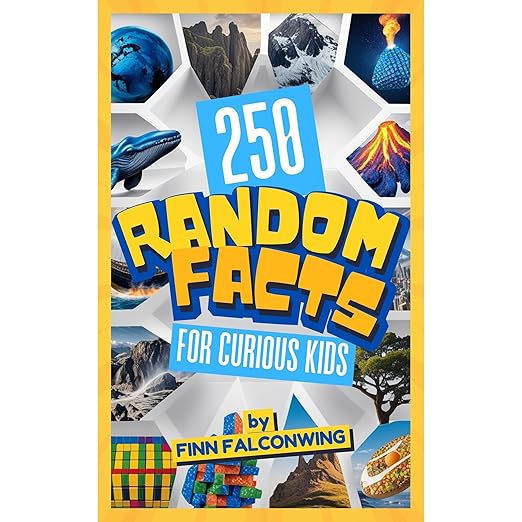
Finn Falconwing's 250 Random Facts for Curious Kids is a fact-collection audiobook narrated by Virtual Voice that runs just under two hours, covering territory from ancient history (Cleopatra lived closer to the invention of the iPhone than to the building of the Great Pyramid) to biology (a turtle that breathes through its butt) to food records (the world's largest pizza exceeded 131 feet in diameter). The structure is exactly what the title describes: 250 individual facts, organized by theme, delivered in rapid succession. For the right child, this format is genuinely addictive. For the wrong one, it can feel like a long quiz-prep session without the quiz. Understanding which kind of listener you have is the most important variable before purchasing this audiobook.
The Butt-Breathing Turtle Meets Flat Enthusiasm
The craft decision that defines this audiobook is the embrace of range over depth. Each fact is self-contained, designed to be memorable and shareable rather than to build toward any sustained argument or narrative. That is a deliberate choice, and it reflects a real understanding of how many children actually engage with information. Reviewer Arnaud noted that the book includes a quiz section to test memory, which transforms it from pure passive listening into something interactive. That feature alone puts it ahead of comparable fact collections that simply list and move on, because it creates a reason to retain the material rather than let it wash over you.
The facts themselves are well-selected across categories. The space section will likely produce the most jaw-dropped moments, a planet made of diamonds is among the entries, while the history facts tend toward the counterintuitive rather than the commemorative. The Cleopatra comparison is a good example of the book's approach: it reframes familiar information to produce surprise rather than presenting information that is straightforwardly new. That technique is pedagogically sound. It tells children that history they already think they know is actually stranger than they realized, which is a better hook for curiosity than pure novelty. Reviewer Kareen described not being able to stop flipping through, which in audio translates to maintaining the forward momentum that keeps a two-hour fact collection from feeling like a slog.
The Virtual Voice narration is the book's real limitation. It is clear and paced appropriately, but it delivers each fact with the same flat enthusiasm, which means the material that is inherently funnier or more startling does not get auditory reinforcement. A human narrator with comic timing could make the butt-breathing turtle land very differently than the orbital speed of Neptune. Both reviewers and the book's own descriptions emphasize how the facts make learning fun, and that promise is delivered through content quality rather than performance quality.
Built for Half-Attentive, On-the-Go Listening
The audiobook format works for this kind of book because children often consume factual content while doing something else, and Falconwing's material is designed for exactly that kind of half-attentive, curious listening. The nearly two-hour runtime is better served by breaking it into fifteen-to-twenty-minute sessions where facts can be talked about, tested, and applied rather than absorbed in a single long stretch. Reviewer kunal roy captures the book's central premise accurately: children are already full of questions, and this audiobook feeds that curiosity systematically across multiple domains. Animals, space, history, the human body, science, sports: the range means that every listener will find something that connects to an existing interest, and then get pulled into adjacent territory they did not know they cared about.
The cross-domain curiosity-building is where the book does its best work. A child who is initially drawn in by the animal facts may find herself genuinely interested in the historical facts because the book's approach to both is the same, lead with the surprising, challenge what the listener assumed they already knew, and deliver the new information with enough specificity to make it memorable. That consistent method across categories gives the audiobook a coherence that a purely random collection would not have, despite the word random in the title.
A Child Becomes the Ultimate Fact Master
The quiz section, which reviewers flag as a highlight, functions best as a pause point in a longer session rather than a final assessment. Listeners who treat the audiobook as background material and then get tested on it will find the retention lower than those who engage actively by trying to repeat or rephrase each fact before moving on. The book's own promotional framing calls this an activity for boosting memory and problem-solving, and that framing is accurate if the listening is active. Passive listening will produce entertainment but less durable learning. Parents who listen alongside children and pause to discuss individual facts will produce significantly better outcomes than those who use the audiobook as unattended background.
Watch also for the moments where the facts are clearly intended to be shared. Several of the book's best entries are designed to be quoted at a dinner table or in front of friends, and those moments are the clearest evidence of what Falconwing is actually building: a child who becomes the ultimate fact master in social contexts. The social application of the material is baked into the selection, which is smarter curation than it might initially appear from a book whose primary selling point seems to be sheer volume.
Curious, Fact-Hungry Kids Are the Real Audience
Children aged seven to twelve who enjoy trivia and tend to absorb information through audio are the primary audience. The book works well for car journeys, as a gentle listen for children who need something interesting rather than narrative-driven, and as a companion for children who love documentaries and nature programs. Parents looking for something educational to play during screen-free time will find the content appropriate and genuinely interesting. Listeners expecting narrative structure, character, or dramatic development will not find any of those things here. The Virtual Voice narration will disappoint anyone who values expressive performance, but the content quality is consistent enough to carry the experience for curious, fact-hungry young listeners.
Before You Listen
Is the Virtual Voice narration in this audiobook clear enough for younger listeners?
The synthetic narration is clear and well-paced, and younger listeners who are comfortable with virtual voice narrators will follow it without difficulty. It lacks expressiveness and comic timing, so facts that are genuinely funny do not get the vocal emphasis a human narrator would provide, which is a real limitation for this kind of content.
How is this audiobook structured, and can children listen to it in sections?
The book consists of 250 individual facts organized by theme, followed by a quiz section. It is designed to work in short sessions. Listening in fifteen-to-twenty-minute blocks, with pauses to discuss or test individual facts, will produce better engagement and retention than a single two-hour sitting.
Is this audiobook suitable for adults who enjoy trivia, or is it strictly for children?
Several reviewers note that the facts are surprising and shareable for adults as well as children. The presentation and vocabulary are aimed at a younger audience, but the content itself crosses age groups. Adults who enjoy pub trivia or general knowledge programs will find legitimate value in the selection.
Does this audiobook work well as a family listen?
Yes, particularly for families where children are in the seven-to-twelve age range. The short, self-contained format of each fact makes it easy to pause, react, and discuss. The quiz section at the end adds a game element that works naturally in a group context.