Borrowing the Atomic Habits Framework for Myths
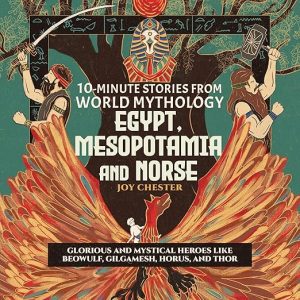
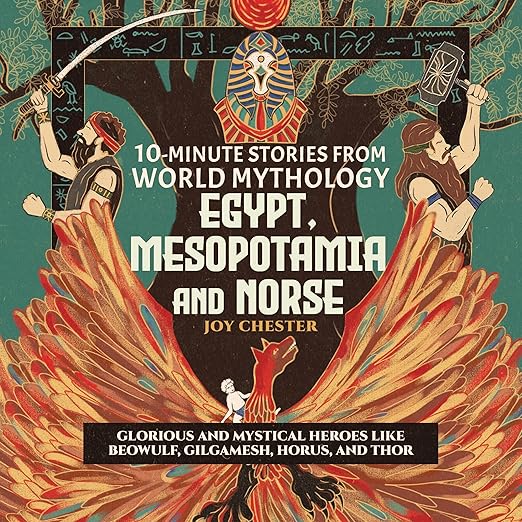
Dave Millican narrates Joy Chester's collection of twenty ancient myths adapted into ten-minute segments, and the format that might sound like a compromise in theory works surprisingly well in practice. At just under four hours total, this audiobook covers Egyptian gods, the Epic of Gilgamesh, Norse heroes, Beowulf, and three creation myths from across these civilizations, all adapted for young listeners without losing what one reviewer called the original 'magical charm.' For families looking for car trip content, bedtime listening, or a way to introduce children to the world's oldest stories, this delivers with consistent quality.
The editorial logic here is borrowed from the 'atomic habits' framework that Chester cites explicitly: short, consistent exposure builds lasting knowledge more effectively than occasional long sessions. Whether that behavioral science fully applies to mythology appreciation is perhaps debatable, but the practical result is a collection that works well in the specific contexts where young listeners actually consume audio content. Ten minutes is long enough to tell a complete story with narrative shape; short enough that a child's attention holds through the ending.
Millican Can Reset the Register, Story to Story
The three mythological traditions represented here are not equally familiar to most young Western listeners. Norse mythology has achieved mainstream visibility through popular culture in ways that Egyptian and Mesopotamian traditions have not. Chester's decision to pair the more familiar Norse stories with the much older Egyptian and Mesopotamian material, including what she calls 'some of the world's oldest, most epic tales,' gives the collection genuine educational range. Children who know Thor and Odin from film will encounter Gilgamesh and Enkidu, Osiris and Isis, for perhaps the first time here.
Millican's narration maintains the storytelling energy that this kind of anthology requires. Twenty stories across twenty different cultural contexts demand a narrator who can reset the register between entries without losing the forward momentum of the collection. He does this effectively, bringing enough vocal variation to distinguish the Egyptian, Mesopotamian, and Norse sections while keeping a consistent energy that suits the young audience. One reviewer described the result as 'bite-sized legends' that are 'the perfect way to spark a great conversation,' and the narration supports that conversational, accessible quality throughout.
The adaptation quality holds across the collection. Chester maintains fidelity to the narrative structures of the original myths, including the features that make them structurally interesting: the pride of Gilgamesh, the cunning of Loki, the persistence of Osiris's resurrection. Some 'gruesome or brutal details' have been set aside for the kid-friendly adaptation, but the essential drama and moral architecture of each myth survives the process. This is a meaningful achievement; many mythology adaptations for children reduce the material to adventure stories stripped of their cultural and religious context, and Chester avoids that flattening.
Twenty Stories as a Deliberate Editorial Argument
The ten-minute format means that each story is necessarily compressed. Listeners who want the full complexity of the Epic of Gilgamesh or the Prose Edda will not find it here; this is an introduction to each tradition rather than a sustained engagement with any one of them. Parents who want to use these stories as a gateway to deeper reading have a genuine opportunity here, but should plan to point older or more curious children toward fuller versions once the appetite has been established.
One reviewer noted a content caveat: some stories may feel incomplete compared to their full versions. That is accurate and inevitable given the format. The adaptation choices Chester makes are generally well-judged, but the compression occasionally leaves narrative threads that a longer treatment would resolve more fully. For young children encountering these stories for the first time, this does not matter; for older listeners who already know the source material, the brevity may occasionally feel abrupt.
The three-civilization scope creates a slight imbalance in depth. Norse mythology receives somewhat fuller treatment in popular awareness than Mesopotamian material, and the Gilgamesh sections are doing harder work to establish the necessary cultural context for unfamiliar listeners. Chester handles this capably, but listeners who come in already knowing Norse mythology well may find the Egyptian and Mesopotamian sections more novel and rewarding.
The selection of twenty stories across three traditions is itself an editorial argument. Chester is not simply anthologizing the most famous myths; she is selecting for narrative drama and accessibility while including material like Gilgamesh and Mesopotamian creation stories that rarely appear in children's mythology collections. That curatorial ambition is worth recognizing. Most mythology collections for children default to Greek and Roman material with Norse mythology as a distant second. The Egyptian and Mesopotamian emphasis here reflects a genuine interest in giving children access to the world's oldest surviving narrative traditions rather than simply the most familiar ones.
Pitched Below What Adults Need Alone
The primary audience is children approximately six to eleven, with parental co-listening adding value for younger ages. This audiobook suits car trips, bedtime, or any situation where a complete story is wanted in a short window. Parents who want to build their children's awareness of non-Western mythological traditions alongside the more commonly encountered Greek, Roman, and Norse material will find the Egyptian and Mesopotamian coverage particularly valuable.
Adults looking for an introduction to world mythology for their own benefit will find the adaptation level pitched below what they need. But as a shared listening experience between adults and children, or as a conversation starter about where different cultures' stories come from, this audiobook earns its high ratings and its reviewers' enthusiasm. Millican's narration and Chester's careful adaptation make it a reliable choice for families who want mythology that respects the original material.