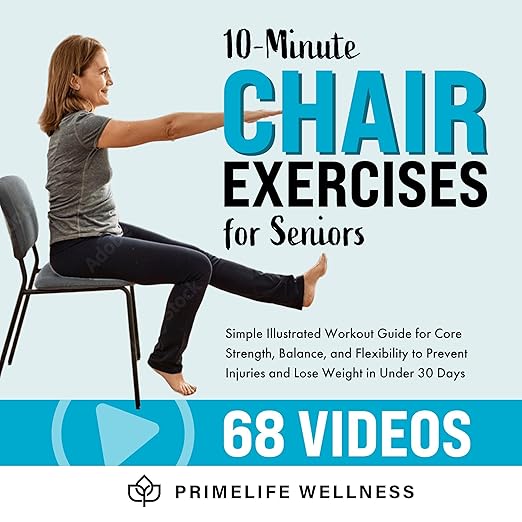
For seniors who have been told to move more and given no practical guidance on how to do that safely at home, 10-Minute Chair Exercises for Seniors delivers a concrete answer. Published by PrimeLife Wellness and narrated by Jeff Bower, this audiobook covers sixty-eight chair-based exercises and two complete twenty-eight-day programs: one focused on strength and mobility, one focused specifically on fall prevention. The listening experience is instructional rather than narrative, which means the value proposition is entirely about whether the content is accurate, well-organized, and delivered in a way that seniors can follow in real time. On all three counts, this title delivers what it promises.
Physiotherapist-Aligned Chair Exercises Set Honest Expectations
Chair-based exercise programs for seniors have expanded significantly in recent years as fitness research has accumulated evidence for seated movement as a legitimate and effective alternative to floor-based or standing exercise. The PrimeLife Wellness approach is grounded in that research: the exercises are physiotherapist-aligned, progressing logically from gentle mobility work to more demanding strength exercises that preserve joint safety throughout the progression. The ten-minute framing is honest: these are short sessions designed for daily or near-daily practice rather than extended workouts, which sets realistic expectations and creates a commitment that most seniors can actually maintain over weeks and months rather than abandoning after a few days of overreach.
Bower's Calm Delivery Anchors Two 28-Day Programs
Jeff Bower's narration is the element that determines whether this content functions in audio format, and he's well-suited to the job. He reads with a measured pace that gives listeners time to set up each position before the description of the movement begins. He doesn't rush, he doesn't condescend, and he avoids the relentlessly upbeat encouragement that makes some fitness audio feel like a performance rather than practical guidance. The result is a narration that feels like instruction from someone competent and calm, which is precisely what a senior attempting a new exercise routine at home needs from the format.
The program structure is what separates this audiobook from more loosely assembled senior fitness content. Two twenty-eight-day programs with distinct goals give listeners a clear path rather than an arbitrary menu of exercises to pick from without direction. That structure also supports the kind of progressive adaptation that makes exercise routines sustainable over months.
Fall Prevention Gets Real Clinical Specificity Here
Fall prevention is where this audiobook earns its most meaningful clinical ground. Fall-related injuries are the leading cause of injury-related death among seniors, and exercises that build the specific balance and muscle strength that reduce fall risk have real evidence behind them. The PrimeLife Wellness fall prevention program is built around those specific muscle groups and balance mechanisms rather than offering general fitness content labeled as fall prevention. That precision gives the program more focused utility than titles that use the phrase as a marketing descriptor rather than a structural organizing principle.
The sixty-eight exercises allow for genuine variation across a twenty-eight-day program without repetition becoming monotonous. The organizational structure makes navigation straightforward: listeners who want to preview a session before doing it, or return to a specific exercise description on subsequent days, can do so without difficulty. Bower's consistent narration style means individual exercises are identifiable within the audio structure, which matters more for a program users will revisit repeatedly than for a narrative audiobook they'll hear once.
The ten-minute session length is also a meaningful design choice rather than an arbitrary marketing figure. Research on exercise adherence consistently shows that shorter daily sessions produce better long-term results than longer sessions attempted less frequently, because the shorter commitment is easier to fit into existing routines. PrimeLife Wellness is working with that evidence rather than against it.
Chair Exercises Need a Visual Reference Too
Audio format has a fundamental limitation for physical instruction: it can describe but cannot show. Chair exercises that involve specific hand positions, angles of movement, or subtle postural adjustments are harder to convey in audio than in video or illustrated print. Bower handles this limitation with careful, precise description, but some listeners will find that a visual reference: the printed companion guide, or a brief review of exercise images before each session: makes the audio narration significantly more effective. This is not a criticism of the audiobook specifically; it's an inherent constraint of the format for physical instruction content. Using audio alone is workable; using audio with visual support is better.
The instructional tone means this isn't passive listening material. The audiobook is designed to be used in real time while sitting and ready to move. Listening while commuting or lying down and following along later reduces the program's effectiveness considerably. The ten-minute commitment during the session is the actual time investment, and that investment requires being in position and engaged rather than absorbing the content abstractly.
Home Fitness for Seniors Recovering From Surgery
The primary audience is adults sixty-five and older who want a structured, safe, home-based fitness program that doesn't require floor work, equipment, or prior fitness experience. The chair format makes it accessible for seniors recovering from surgery, managing arthritis or limited mobility, or starting exercise after a long sedentary period. Both the strength program and the fall prevention program have immediate, meaningful applications for that population, and the ten-minute session format makes daily practice a realistic rather than aspirational commitment.
Adult caregivers who want to set up a supported exercise routine for an elderly parent or patient will also find this audiobook useful as a structured guide the senior can follow independently. The program's organization and Bower's consistent narration style support independent use without requiring supervision for each session. Pair with the visual companion materials for best results, and consider starting with the fall prevention program if balance and mobility are the primary concerns: the specificity of that program's design is where this audiobook makes its strongest case.
Does the 10-Minute Chair Exercises for Seniors audiobook work as a standalone audio experience, or does it require the companion guide?
It works as a standalone, but Jeff Bower's narration describes physical positions and movements that some listeners will find easier to execute with a visual reference alongside. The printed companion guide or exercise images are a meaningful supplement, particularly for exercises with specific postural requirements. Using both together produces better results than either alone.
How many exercises are in this audiobook, and how are the two twenty-eight-day programs organized?
The audiobook covers sixty-eight exercises. The first twenty-eight-day program focuses on strength and mobility for general fitness; the second focuses specifically on fall prevention, targeting the balance and muscle groups most critical for reducing fall risk. Both programs are structured for daily practice at around ten minutes per session.
Is the exercise content in this audiobook physiotherapist-reviewed, or is it general wellness advice?
The content is physiotherapist-aligned, with exercises progressing from gentle mobility work to more demanding strength training within the seated format. The fall prevention program in particular is built around muscle groups and balance mechanisms with clinical backing rather than general wellness framing.
Can this audiobook be listened to passively, or does it require active participation during playback?
Active participation during playback is how the audiobook is designed to be used. The instructional format means Bower guides listeners through each session in real time: it works best when you're seated and ready to move. Passive listening and following along later significantly reduces the program's effectiveness.