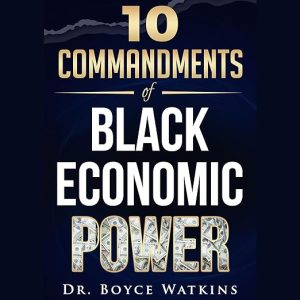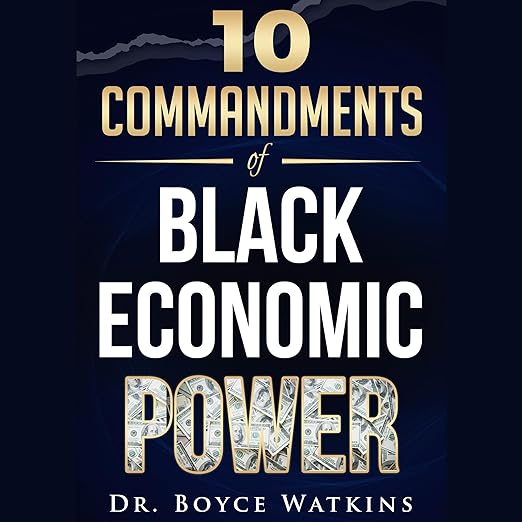
Dr. Boyce Watkins opens the audiobook 10 Commandments of Black Economic Power with an unusual and direct statement of intent: this is not a book for everyone. Watkins, an economist and financial educator, wrote it explicitly for Black Americans, and he says so at the outset, framing the work as a response to centuries of discriminatory policy and the ongoing extraction of wealth from Black communities. Thomas A. Penny narrates, and at four hours and thirty-six minutes, the audiobook moves with the focused energy of a lecture series rather than a meditation, making its ten-part structure feel purposeful rather than a mechanical device for organizing loosely connected advice.
The Black Family as a Multimillion-Dollar Institution
The conceptual move Watkins makes early on is worth noting. He positions this alongside Claude Anderson's Powernomics as part of a continuing conversation about community economics rather than individual wealth accumulation. One reviewer specifically referenced Powernomics, describing Watkins as a student of Anderson who has articulated what they had been wanting to say themselves. That lineage matters for contextualizing the argument. This is not personal finance in the Dave Ramsey mode; it is collective economic strategy rooted in a specific historical analysis of how trillions in Black wealth have been lost through what Watkins frames as a combination of structural exclusion and cultural habits that work against intergenerational accumulation.
The argument rests on a foundational claim: the Black family is, in its potential, a multimillion-dollar institution. That reframing orients the entire discussion away from the individualism that dominates most personal finance content. Rather than positioning Black economic uplift as a matter of individual discipline or navigating white-controlled financial systems more cleverly, Watkins argues for building parallel structures rooted in community investment, collective ownership, and wealth transfer across generations. The commandments structure keeps the material organized and makes each chapter feel like a discrete, actionable unit rather than a vague exhortation. Listeners report coming away "more informed than ever" and finding the book provides genuine "groundwork for wealth acquisition" rather than inspirational noise with no load-bearing architecture beneath it.
Thomas Penny's Restraint Lets the Argument Persuade
Thomas A. Penny's narration is measured and authoritative without becoming stiff. He gives the material the weight it asks for without over-performing the urgency. In a book whose argument depends heavily on the credibility of its reasoning, an overheated narrator would undermine the very precision Watkins is working toward. Penny's restraint serves the text well, allowing the content to do the persuading rather than the delivery. The audiobook format also works for this material because the commandments structure lends itself to incremental listening: you can absorb each chapter as a unit, step away to think about it, and return without losing the thread.
At under five hours, this audiobook is compact for the scope of its ambition. Watkins is covering macroeconomic history, cultural analysis, and practical strategic frameworks simultaneously, and he does so without losing momentum or resorting to repetition to fill time. Listeners who have encountered his work through his online platform, the Black Business School, will find the recording captures the directness and pace of his spoken style. For those meeting his framework for the first time, the compression helps rather than hurts: Watkins does not pad, and the absence of filler means the argument lands with cumulative force that builds across the ten chapters rather than dissipating in generalities.
Watkins Critiques Both Sides, Skipping Intersectionality
The book's willingness to name uncomfortable truths about internal cultural patterns within the Black community generates the most friction for some listeners. Watkins is not exempting his own community from criticism while critiquing systemic racism; he does both simultaneously, which some listeners find bracing and others find uncomfortable for different reasons. That dual critique is arguably the book's most distinctive characteristic and the thing most likely to produce strong reactions in either direction. It is worth going in with awareness of that tension rather than being surprised by it partway through.
The framework also does not engage deeply with intersectional considerations of class, gender, or geography within Black communities. The argument operates at a level of generality that is rhetorically powerful but occasionally smooths over important distinctions in experience and circumstance. Listeners wanting more granular discussion of how the commandments apply across different economic circumstances and regional realities may need to supplement this audiobook with additional reading. The book announces its scope clearly and then executes on it; the limitation is in what it chose not to attempt rather than in any failure to deliver what it promised.
Collective Wealth Building Beats Individual Portfolio Tips
This audiobook speaks most directly to Black Americans interested in community economics, collective wealth building, and the historical context behind current financial disparities. It is a strong choice for listeners who have engaged with Claude Anderson's related work and want to encounter a complementary framework from a different analytical angle, or who are coming to community economics fresh and want a clear, organized entry point. General audiences interested in economic equity and the mechanics of systemic wealth extraction will find it illuminating even if the prescriptive sections address a more specific listener. Those seeking conventional personal finance advice about investment accounts or market strategies should know this operates on a different level entirely, culture and community structure rather than individual portfolio management, and solidarity economics rather than optimization of personal returns. For a book written for a specific audience, it rewards a broader readership willing to engage on its own terms.
A Few Questions About 10 Commandments of Black Economic Power
Who did Dr. Boyce Watkins write this audiobook for?
Watkins is explicit that he wrote this for Black Americans. The book's framing, arguments, and prescriptions are directed at that audience specifically, as a response to centuries of wealth extraction from Black communities. Non-Black listeners can and do find the material valuable, but the author's stated intent is to address a particular community's specific economic situation.
Is this audiobook worth listening to if you have already watched Dr. Watkins' material through the Black Business School?
Listeners familiar with Watkins' online platform will recognize his directness and speed of delivery in this audiobook, and some of the framework will feel familiar. However, the ten-commandments structure provides a more organized and cumulative presentation than individual videos, and the concentrated format makes the overall argument land with more force than scattered content tends to achieve.