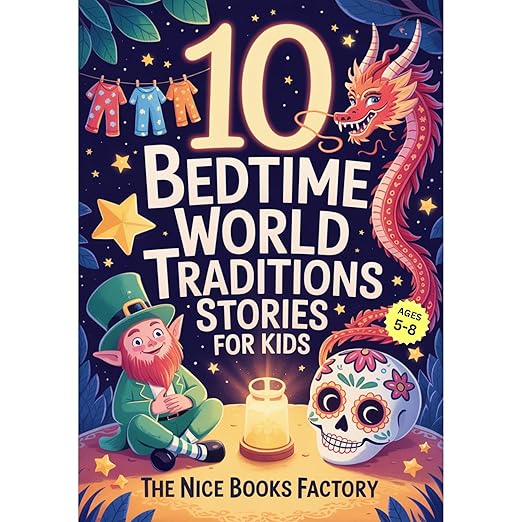
Ten short bedtime stories drawn from cultural traditions across the globe make up this audiobook from The Nice Books Factory, 10 Bedtime World Traditions Stories for Kids (Ages 5-8), rendered in Virtual Voice narration and running just over an hour. The format is designed for a specific parental problem: finding consistently calming bedtime content that does not require much hunting. Each story runs four to six minutes, which makes one story per night the natural unit, and the collection covers celebrations and observances including Chinese New Year, Juneteenth, Day of the Dead, and Ramadan alongside a story featuring a leprechaun and the meaning of luck. The structure is simple and it works: ten nights, ten cultures, ten gentle endings.
The Virtual Voice narration is worth naming directly. This is AI-generated audio rather than a human performance, which affects the listening experience in ways that matter more for young children than for adult audiences. The delivery is consistent and clear but lacks the warmth modulation and timing intuition that a skilled children's narrator brings to material designed for falling asleep. Parents who regularly read aloud to their children may find themselves supplementing rather than fully replacing that practice. The collection's value is in its content structure and cultural breadth rather than in the audio production itself, and understanding that distinction before buying saves disappointment.
Ofrenda Scenes Favor Feelings and Imagination
The collection makes a genuine attempt to differentiate itself from the crowded bedtime-story market by focusing on specific celebrations rather than generic cultural backgrounds. A reviewer noted that the stories are not traditional tales from their countries of origin but rather snapshots of children doing recognizable things inside those traditions, which is a meaningful distinction. The Mexican story, for instance, shows children preparing an ofrenda for Day of the Dead rather than retelling a traditional narrative. This approach makes the stories more immediately accessible to young listeners who can locate themselves in the actions being depicted, even if they are unfamiliar with the cultural context.
The content orientation toward feelings and imagination rather than explicit lessons is evident in how the stories are structured. The Ramadan story focuses on what patience under the moon feels like rather than providing a religious education summary. The Chinese New Year story centers on the visual and sensory experience of lanterns. This approach is pedagogically sound for the five-to-eight age range, where emotional resonance tends to produce more durable learning than factual instruction. A reviewer noted the stories sparked conversation and reflection, which suggests the content structure does its job even where the audio production is limited by the absence of a human narrator.
Ten Self-Contained Stories Fit a Five-to-Seven Sweet Spot
The practical appeal is in the format: one hour of content divided into ten self-contained stories, each short enough to complete before a child falls asleep, with calm and reassuring endings. For families building a nightly routine, the ten-night structure provides predictability without requiring repeated playback of the same story. The cultural variety also makes this more interesting across a ten-night span than a single-subject collection would be, because the settings and characters change enough to sustain a child's attention without stimulating it to the point of disruption.
For parents concerned about representation, the specific traditions included cover significant cultural observances with some geographic range, though the collection focuses primarily on Western-facing celebrations. Reviewers with younger children in the five-to-six range found it well-calibrated; those with children closer to eight found the content slightly simpler than their kids expected. The title's age range of five to eight represents the outer limit rather than the sweet spot, with five to seven being the more realistic primary audience. A child who regularly reads chapter books will likely find the stories too brief and simple for sustained engagement.
Virtual Voice Narration Lacks Natural Prosody
The Virtual Voice narration is the most significant practical variable in this audiobook. Parents auditioning this for use in an established bedtime routine should be aware that the performance lacks the natural prosody of human narration, which can reduce its effectiveness as a sleep-onset tool for children accustomed to being read to in person. The stories work better as audiobook content that parents and children listen to together rather than as a fully independent replacement for human bedtime reading. The content itself is gentle and well-structured; the delivery is functional rather than immersive.
The collection's commercial framing in the synopsis is enthusiastic to the point of overstatement, with language around urgency and gifting that parents should simply set aside. The actual stories, as reviewers describe them, are genuinely calm and well-sized for their purpose. The gap between the marketing language and the product is wider here than in most children's audiobooks, but the product underneath the marketing holds up for its intended audience and age range. One reviewer summed it up well: a fun way to go around the world with your children, which is accurate if also modest.
Not the Sole Sleep Aid for Sensitive Ears
This audiobook is best for parents of five-to-seven-year-olds looking for a consistent, culturally varied bedtime routine without screen involvement. Families who regularly read aloud may find the Virtual Voice narration a limitation, but the content structure offers genuine variety across ten nights. Not recommended as a sole sleep aid for children who are sensitive to non-human vocal production, or for older children in the eight-plus range who will find the content too simple. For the target demographic under those conditions, it delivers what it promises.
A Few Questions About 10 Bedtime World Traditions Stories for Kids (Ages 5-8)
Is this audiobook narrated by a human voice or AI?
The narration is Virtual Voice, meaning AI-generated audio. This affects warmth and vocal timing in ways that may matter for very young children or families using it as a primary sleep-onset tool. It is functional and clear, but lacks the expressive range of a human children's narrator.
What age within the stated five-to-eight range benefits most from this audiobook?
Reviewer feedback suggests the content is best calibrated for ages five to seven. Children closer to eight found the stories somewhat simple. The emotional framing and story length are well-matched to early elementary listeners.
Can children listen to this audiobook independently, or is parent involvement recommended?
Given the Virtual Voice narration, the audiobook works best when parents and children listen together, at least initially. The content is entirely appropriate for independent listening by the target age group, but the narration lacks the warmth modulation that typically makes bedtime audio most effective as a sleep-onset support.