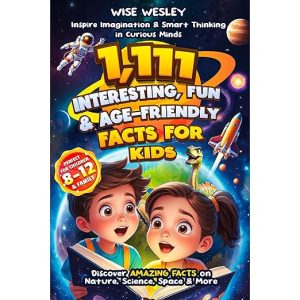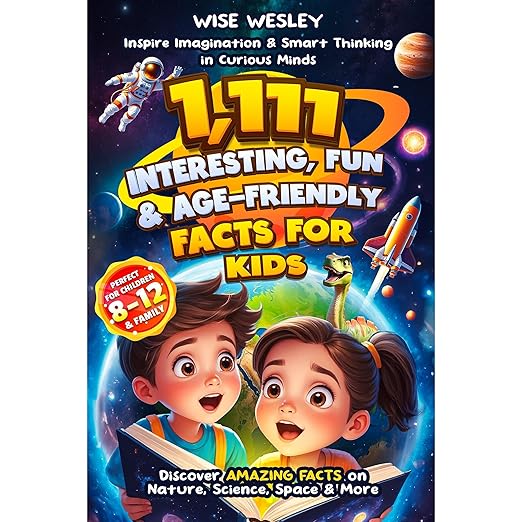
Scroll up, choose Kindle or Paperback, and ignite your child's next learning adventure today. That is the closing line of the description attached to this audiobook, and it is an instruction for a page this file is not on. Read the rest of the copy with that in mind and it resolves into a print listing: a durable 200-page paperback, classroom packs billed as instant bell-ringers, puzzles and riddles, quick-fire quizzes, DIY challenges that turn facts into mini experiments or art projects. Wise Wesley's book is genuinely good at the thing it sets out to do. The question worth settling before you buy is which parts of it survive the trip into a 4 hour and 11 minute file, and the honest answer is roughly half.
Facts Sized to Repeat at the Dinner Table
Six categories carry the facts: space and astronomy, animals, history, technology, extreme weather and geology, and the human body. The examples the copy chooses are a fair sample of the writing's instincts. Lava-tube moons and record-breaking rockets for space. See-through frogs, shape-shifting octopuses and jet-propelled squids for the animal chapters. A 38-minute war, ancient emojis and secret spy pigeons for history. Singing sand dunes, storms that never stop and million-ton clouds for the planet. That is a well-picked set, because every item has a hook a child can repeat at a dinner table without adult help. Facts that need a paragraph of setup do not travel. Facts that fit in one sentence and sound impossible are the whole currency of this genre, and these mostly qualify.
Four hours and eleven minutes of consecutive trivia is a peculiar listening object, though, and it wants managing. Nobody takes 1,111 of anything in order, and a file has no index, no dip-in structure and no way to skip the octopuses to reach the rockets except by scrubbing. Handled as a linear listen, the density starts working against the material somewhere in the second hour, when one astonishing thing follows another with no shape between them. Handled in fifteen-minute portions with someone to interrupt it, the same density is the point. The book was designed for a browsing eye, and the file rewards an adult willing to impose the browsing by hand.
Built for the Car and the Dead Half Hour
Written responses here keep describing the same use case, and it is not a child listening alone. A five-star from May 2024 quotes its favorite entry, the one explaining that stars do not actually twinkle and that the shimmer belongs to everything floating in the atmosphere between us and them, and describes going through the facts with a son and discussing them afterward. Another response reports children who cannot wait to test the parent who bought the book, and adds that the parent failed several of the questions. Both are describing a shared activity rather than a solo one, and that is exactly the shape audio supports best in a car, at a table, over a meal.
Format also fits the writing. These sentences are short, concrete and free of subordinate clauses, which is what makes them work by ear at the age band the copy names, eight to twelve. A listener does not have to hold anything in memory from one fact to the next, so a child who drifts for thirty seconds loses thirty seconds and nothing else. Compare that with any narrative nonfiction for the same age, where a lapse in attention costs the thread. For long journeys, doctor waiting rooms and the dead half hour before dinner, the low commitment per unit is the feature.
Virtual Voice Meets 1,111 Proper Nouns
Half the product does not make the crossing. The copy sells quick-fire quizzes at the end of every chapter, brain-boosting puzzles and riddles, DIY challenges and art projects, and one written response confirms what a listener cannot use, mentioning an area to color alongside the quizzes and the end-of-chapter questions. A riddle read aloud with its answer read three seconds later is not a riddle. A coloring page has no audio equivalent at all, and the sheets designed to be written on cannot travel either. None of that is a fault in the writing, but the classroom and homeschool pitch in the description rests on printable apparatus, and a family buying the file for enrichment activities will get the facts and none of the activities.
Smaller matters belong on this page and are missing. The description claims a 4.8-star average from more than 90 reviewers, while the listing itself displays 4.7 across 100 ratings, and the copy's figure is a print-edition number carried over unchanged. The narrator field reads Virtual Voice, the label for a synthesized reading rather than a hired performer, which matters more here than in a novel: 1,111 numbered items, proper nouns from six subject areas, and no human deciding where the emphasis lands in a sentence built on a surprise. Audition a sample before committing a long trip to it.
Plain Sentences Are Harder Than Clever Ones
Buy it for the eight to twelve band the copy targets, especially for households that already play the quiz game and want ammunition. It suits car journeys, siblings of slightly different ages, and any adult happy to pause every few minutes and argue about whether an octopus really does that. A four-star response makes the case for the writing more precisely than the marketing does, noting that the facts are interesting and written in a simple manner, and calling the simplicity the important part. That is right. Plain sentences are harder to write than clever ones and they are what makes this listenable.
Skip it for a classroom, where the bell-ringers and early-finisher sheets are the reason to buy and none of them are in the file. Skip it for a child who wants to color, cut out or fill in. And skip it if a synthesized voice reading four hours of trivia sounds like a hard sell in your house, because nothing on the page suggests otherwise. The paperback keeps the crayons; the file keeps the facts.
Good to Know
Do the puzzles, quizzes and coloring activities work in the audiobook?
Not really. Quizzes and riddles can be read aloud, but the answer follows within seconds and no page comes with the file to write on. The coloring space and the DIY sheets have no audio equivalent, and one written response describes using exactly those features in print. The facts transfer; the workbook does not.
Is this audiobook read by a person?
No. The narrator field reads Virtual Voice, which is the label for a synthesized reading rather than a credited human performer. For a title made of 1,111 short items with proper nouns from six subject areas, that is worth sampling before a long journey, since emphasis and timing carry most of the humor in a one-line fact.