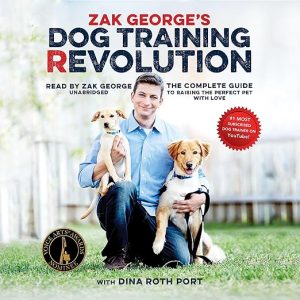
I don't usually review dog training books on this site, but Zak George's Dog Training Revolution came up in my queue because someone I trust told me to listen to it before adopting a second dog, and I ended up thinking about it more than I expected to. The audiobook format creates an interesting constraint for a practical training guide: you can't demonstrate anything. George's solution is to narrate the book as an entry point to his YouTube channel, where the visual demonstrations live. It's an honest acknowledgment of the medium's limitation, and it works.
George is a YouTube phenomenon before he's an author, hundreds of training videos, millions of subscribers, and an Animal Planet presence that predates this book's 2016 release. The book distills that video library into a single organized framework: from selecting a dog and preparing your home, through the core training issues most owners face, potty training, play biting, leash pulling, barking, jumping, to addressing behaviors that have already become entrenched.
What Zak George Delivers
George narrates his own book, and his YouTube energy translates directly to audio. He's enthusiastic, clear, and genuinely optimistic about what positive reinforcement can accomplish, sometimes aggressively so. One reviewer notes that the book takes an unnecessarily hard line against any use of negative feedback in training, and that observation is accurate. George is writing in conscious opposition to dominance-based training methods, and that polemic occasionally tips from principled to absolutist.
Set against that, his practical advice is consistently sound. The emphasis on treating the root causes of behavior rather than the symptoms, the attention to breed-specific differences, the patience required to train a dog who has already developed problem behaviors, these are the right things to emphasize, and George emphasizes them clearly. The audiobook version loses some of the nuance that visual demonstration would provide, but the conceptual framework translates well.
What Zak George Gets Right
The six-hour-and-forty-four-minute runtime is appropriate for the material. This is a complete guide, from before you get the dog to after you've had it for months and something has gone wrong, and the coverage is thorough without being academic. George writes for people who want to do this right and are willing to invest the time in positive reinforcement, not for people who need a quick fix.
Multiple reviewers with shelter and rescue experience call it comprehensive and accurate. One shelter volunteer who had also read Cesar Milan notes the philosophical difference clearly: Milan's dominance model positions the owner as alpha; George's relationship model positions the owner as parent. Both approaches have advocates; George argues his case clearly and with reference to current animal behavior science.
Where Zak George Loses Some Ground
The YouTube companion channel is not optional, it's integral. The book repeatedly refers listeners to specific videos for visual demonstrations of techniques that don't translate fully to audio description. Listening to the audiobook without accessing the channel means receiving about seventy percent of what the resource is designed to deliver. This is an unusual dependency for an audiobook, and it's worth knowing before you start.
Listeners with older dogs who have established problem behaviors should know that George addresses this directly but with appropriate honesty: it takes longer, it requires more consistency, and some entrenched behaviors are genuinely difficult to modify. He doesn't oversell what positive reinforcement can accomplish in difficult cases, which is the right approach.
Who Should Pick Up Zak George’s Dog Training Revolution
Best suited for first-time dog owners who want to establish good foundations from the beginning, or for owners who have recently adopted a dog and want to understand what's driving problem behaviors before they try to address them. The book's strength is its developmental framing, it treats training as an ongoing relationship rather than a series of commands to install, and that framing is most valuable when you're starting from scratch.
Experienced owners who already use positive reinforcement methods may find the book covers familiar territory with less depth than specialist resources. The YouTube channel is where George's real depth lives; the book is the organized framework that makes the channel navigable. Used together, they're a genuinely useful resource. Used separately, each is less complete than the other implies.