Quick Take
- Read by: Shawn Dougherty reads in person, so the instructions arrive from the practitioner rather than from a hired professional working off a script.
- At its heart: Grass-fed dairy, low-input homesteading on poor land, closed-loop fertility, food independence
- Vibe: Practical and unhurried, the pace of a long conversation over a fence
- Short version: The most useful six hours you can spend before buying a milk cow, and largely wasted on anyone who never will.
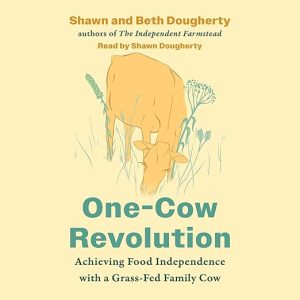
Buy this one only if a dairy cow is a genuine possibility in your life, or if you want to understand why some people organize an entire homestead around a single animal. That narrowness is the audiobook's strength. Shawn Dougherty reads it aloud in person, Chelsea Green released the recording in November 2025, and every minute of it goes to one cow and what that cow makes possible: milk, meat, calves, pigs, compost, and a way of farming poor ground cheaply.
One Solar-Powered Cow, Bought in the Right Order
Marginal land is the starting condition here, not an afterthought. Shawn and Beth Dougherty spent more than three decades working out frugal methods for a small farmstead on ground that would never support a conventional operation, and everything in the book grows out of that constraint. Low input, low cost, one cow at the center. The claim is not that this is easier than industrial agriculture. The claim is that it works on land nobody else wanted.
The sequence is the most valuable thing on offer. Find a reliable dairy cow. Move her to the homestead. Settle her in. Then comes the daily round: managing grazing patterns, monitoring pasture health, milking, and handling the milk once you have it. Beginners rarely fail at the concept. They fail at the order of operations, and a book that opens with acquisition rather than technique is aimed precisely at the person who has not bought the animal yet. Choosing badly at that first step is the expensive mistake, and it is the one a manual organized by subject rather than by sequence never quite warns you about.
Solar-powered cow is the phrase the Doughertys use, and it explains the ambition. The animal turns grass into milk and meat for the family, feed for calves and pigs, and manure that becomes compost for garden soil, which converts one purchase into the hub of a diversified farmstead instead of a line item inside it. That systems view is what separates this from a livestock manual. It is a book about what a cow makes the rest of your land capable of doing.
Dougherty Reads Thirty Years of His Own Work
Hearing a farmer read a farming book is not a small thing. Shawn Dougherty is credited as the reader as well as the writer, which puts the instructions in the voice of someone who has done the work for thirty years rather than a professional working from a script. Author-read nonfiction is always a trade between polish and authority, and on practical instruction that trade usually favors authority. Sample it before committing anyway, since the preference is a personal one.
An accompanying PDF ships alongside the audio, and the listing says so explicitly. On a how-to title that detail is close to essential: any chart, diagram or checklist from the printed book has somewhere to live, and you are not left rebuilding a grazing rotation from memory. Instructional recordings without a companion document ask you to hold everything in your head at once. This one does not, and on a practical subject the difference is substantial.
Philosophy frames the whole thing, quite deliberately. An introduction and a conclusion lay out what the Doughertys mean by calling themselves cow people, and argue for what happens in communities where small, food-independent farmsteads take root as models of sustainable land use. You can hear that as the part to skip or as the reason the book exists at all. My own view is that the argument earns its keep, because nobody keeps a milk cow for purely economic reasons.
One Byline for Two Authors, and Unteachable Hands
Two people wrote this book. The listing names one. The description states it plainly: Shawn and Beth Dougherty honed the methods together, they share the wisdom, the Doughertys begin at the beginning. The byline carries a single name and so does the reading credit, so a book about a partnership reaches you in one voice with the other collaborator present only in the third person. It flattens a two-person body of work into a single author page.
Nine ratings, every one of them five stars, and a single written review that says nothing about the contents. The lone comment reports buying it as a Christmas present and reports that the recipient loves it, which is a pleasant thing to read and useless for deciding whether the grazing material holds up. Treat the score as an early signal from a small, self-selecting audience. Nobody has yet written down what they learned, or what they wish the book had covered.
Milking is a physical skill, and no recording teaches a physical skill by itself. The audio can give you the order of operations, what to do with the milk after it leaves the cow, and why an unvarying routine matters more than elegant technique. It cannot correct your hands. Pair this with somebody local who milks, or plan on the companion document plus a good deal of trial, because the gap between hearing and doing is unusually wide here.
Honest Arithmetic for Homesteaders Still Dreaming
Homesteaders who already have land and are weighing whether a cow belongs on it are the exact audience, and the description names the other half: people who have just moved back to the land, or who are still planning and dreaming. Anyone in the dreaming stage gets the most honest version of the arithmetic here, because a book written from marginal ground has no incentive whatsoever to pretend the work is light. Small dairy operations, cheesemakers and anyone raising pigs on surplus milk will also recognize a good deal of their own problem set in the daily round.
Nobody with a suburban lot and a passing interest in self-sufficiency needs this, and the book makes no attempt to pretend otherwise. Readers wanting a broad homesteading survey will come away short too, since pigs, calves, other livestock and the garden all appear strictly in relation to the cow. And anyone hoping for a rural memoir will find the philosophy confined to the opening and closing chapters, with the long middle given over to chores.
Practical books written out of thirty years of doing the thing are rare, and rarer still when the person who did it also reads them aloud. What you are buying here is three decades of someone else's mistakes, delivered in the voice that made them, with the diagrams attached in a separate file. What you are not buying is a way around the labor. The ratings cannot tell you much yet, but the description is unusually honest about who this is for.
Common Questions
Is the accompanying PDF necessary, or can I follow the audiobook alone?
The audio stands up on its own for the reasoning and the sequence of decisions. Download the PDF anyway. Anything the print edition presents as a table or a diagram lives there, and a grazing plan or a checklist is far easier to consult on a screen than to reconstruct from memory halfway through a milking.
Do I need The Independent Farmstead first?
No. The description identifies the Doughertys as the authors of that earlier book, but this one starts from the beginning: finding a cow, moving her, settling her in. Reading the earlier title gives you the wider homestead context, though nothing here depends on having done so.
What ground does it cover, and how much time does it take?
Six hours and thirty-three minutes, released in November 2025. That covers acquisition, daily chores, grazing management, pasture health, milking, milk handling, and the way a single cow feeds calves, pigs, the family and the compost heap. The opening and closing sections carry the philosophy.
Is the audiobook only about the cow itself?
The cow is the hub, not the whole subject. Pasture health, grazing rotation, compost quality and garden soil all get attention, because the argument is that one grass-fed animal makes a diversified farmstead viable. Anyone wanting equal coverage of poultry or vegetables should look at a general homesteading title.