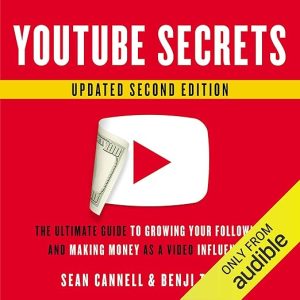
Creator advice ages faster than almost any other kind of nonfiction, which makes the date on a channel-growth guide the first thing to check. This audiobook runs five hours and twenty-nine minutes and carries a release date of March 28, 2019, while the copy above it announces a new edition, fully revised and updated with new content and strategies. Sean Cannell reads it. The byline carries that one name, though the description and the publisher line both name a second author.
Five Graded Reviews Under a Counter of Three
Benji Travis is the missing name, and the omission is not a trivial one. The description introduces the book as the work of Sean Cannell and Benji Travis together, the publisher line lists both, and two of the five reports credit the pair by name. Only the author byline has dropped one of them. Search under both names, or under the wrong one, and this page will not help you.
Numbers on the page do not survive a second look. The listing reports three ratings at a 4.6 average while displaying five reports that each carry a grade, four at five stars and one at four. Five graded opinions cannot sit beneath a counter reading three. Three whole-star votes cannot average 4.6 either, since the nearest values three votes can reach are 4.3 and 4.7.
Frameworks are what the book is selling, and the copy is specific about the shape of them. A seven-ingredient recipe for building a channel heads the promised contents, followed by a list the description abandons in the middle of a word. What survives of that list is enough to place the book: a step-by-step method for somebody with no channel yet, or with one that has stopped moving.
Priced Within Reach of Those Skipping Courses
Beginners are where it works, and the earliest response on the page demonstrates that neatly. An October 2018 report, five stars, was left by somebody who had just started a travel channel and credits the book with tips that were already growing an audience and praises the way it explains the basics without overselling anything. That response is dated nearly six months before the listed release, which means it is grading an earlier printing.
Access is the argument the book makes for itself, and one response states it better than the marketing does. One report from April 2023 values it specifically for being within reach of people who cannot pay for online courses, and names the two channels behind the authors, BenjiManTV and Think Media, as the credential that matters. Paid creator education is expensive. A short book at a fixed price is a genuinely different proposition.
Short is the right length for this material, and a recording that ends inside a single afternoon is short. Platform advice has a shelf life measured in months rather than decades, so material you can absorb across two sittings and act on immediately is worth more than a comprehensive volume nobody finishes. The structure supports that: a recipe, a framework and a sequence of steps rather than a survey of the whole subject.
Hearing Only One Voice of a Partnership
Dates are the problem this listing cannot talk its way out of. The description announces a new edition, fully revised and updated. The release date reads March 2019. The page's only four-star verdict, dated January 2021, calls the book a little outdated on the grounds that it is from 2018, and points at platform policy changes it no longer covers. The earliest response predates the listed release outright. Which text you are buying is genuinely unclear.
Reading credits repeat the byline problem in a second place. Sean Cannell is the only voice listed on a book the description presents as a partnership, written by two people whose separate channels form part of the sales argument. The page never says whether the second author appears at any point. For a guide resting on the credibility of two working creators, hearing one of them is a real if modest loss.
Depth is the last reservation, and it comes from the page itself. That same January 2021 report comes from somebody who had worked through several books on the same subject, and it calls this a good option for core fundamentals that never goes far into any one topic while covering almost all the general areas. That is exactly what a fundamentals guide does, and exactly what somebody past the fundamentals will resent.
Useful as a Sequence, Weak on Current Rules
Aspiring creators with no channel yet are the clean fit, and the page bears that out. An August 22, 2025 report at five stars calls the book informative, concise and very practical, and recommends it to anyone planning to make videos, which describes a starting guide rather than a growth manual. If you have never uploaded anything in your life, this was written with you in mind.
Business owners and small teams are the second audience the copy names, alongside digital entrepreneurs and influencers, and the framing suits them: video treated as a route to a community that produces revenue rather than as a creative pursuit. Nothing in the book requires an existing audience or a production budget. What it does require is a willingness to follow a sequence instead of experimenting.
Do not buy it for current platform mechanics, because the newest thing anybody on this page vouches for is several years old and the revision claim in the copy sits unhappily beside a 2019 date. Do not buy it if you already run a channel with traction, since fundamentals are the whole offer. Buy it as a starting sequence and take your rule changes from a source that can be updated weekly.
Which category does the audiobook sit in, and will the right people find it?
Under computers and technology, with a Content Creation and Social Media tag. That is accurate as far as it goes, though nothing places the book on a business or marketing shelf, which is where the copy's own stated audience of business owners and digital entrepreneurs is most likely to be browsing for it.
What does the book promise about making money?
The copy says the framework builds a community that brings in revenue, with video as the mechanism. It promises no figure, no timeline and no sponsorship rate anywhere in the description. Expect an argument about audience first and monetization as a consequence of it, which is the more honest way around.
Is this audiobook enough on its own to start a channel?
For the very beginning, close to it. The August 31, 2025 report, five stars, records learning a great deal with everything explained in easy terms, and recommends it to anyone starting out as a content creator. What it cannot supply is current equipment guidance or anything reliable about the platform's present rules.
What does the copy mean by a leap of faith?
The description tells you to stop trying to work it out alone, convert your vision into a channel and build a community around it, and calls that first move a leap of faith. In practice it means publishing before you feel ready. The whole sequence in the book assumes you have already made that decision.