- Performance: Quentin Hudspeth reads analytical design prose with no narrative spine and a great many conditional clauses to hold together
- What it covers: Game design as a learnable craft, what makes play satisfying, the limits of designer instinct
- Feel: Discursive and argumentative, like a long conversation at a convention bar
- Our call: Strong for anyone with a prototype in progress, weaker as a passive listen you never take notes on
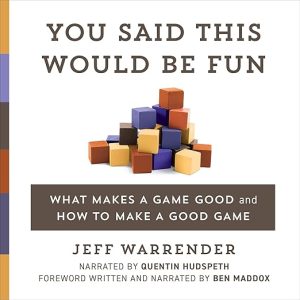
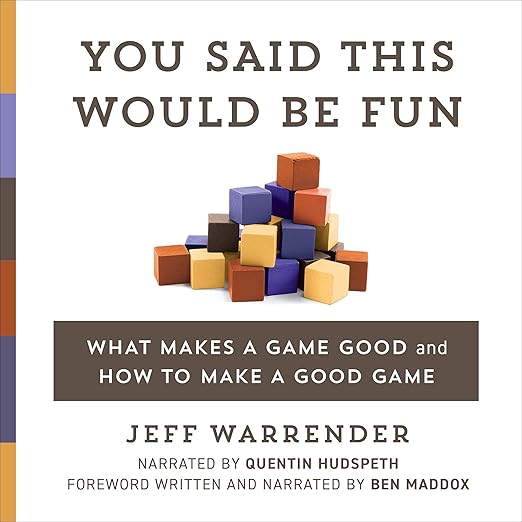
Board game design is one of those crafts that developed its own literature almost by accident, written by practitioners for practitioners, and mostly circulated in blog posts and convention talks. Jeff Warrender wrote a proper book about it, and the You Said This Would Be Fun audiobook gives that book nine hours and thirteen minutes of speaking time. What follows is a genuine attempt to say what makes a game good, which is a harder question than it sounds and one the field mostly answers with a shrug.
Filed Under Home and Garden, About Board Games
Shelving is the first oddity you will hit. This listing files the title under home and garden, with a crafts and hobbies tag attached, and nothing in the description supports either. The subject is strategy board game design, start to finish. If you found the page by browsing a category, the category is wrong, and if you are searching for game design material, you may never have found the page at all.
Warrender frames design as a craft with transferable skills, "acquired through study and practice", rather than as a talent people either have or lack. The structure follows from that. Good games, the argument runs, "exhibit qualities that designers of all experience levels can strive to emulate", and the book works through those qualities one at a time. Three audiences are named in the description: the first-time designer with an idea, the experienced designer hunting new approaches, and the enthusiast who simply wants to understand how games work.
Axioms are the delivery mechanism, and that word comes from a reader rather than from me. Jeffrey LaFlam describes the practical use he made of the book: "I actually wrote every axiom that the book presented down on a big sheet of paper and now I treat it like a checklist when I'm designing". John W Arnold reports something similar, having "read and re-read this book while designing a game". Both are describing a reference text rather than a book you finish and shelve.
Hudspeth Narrates the Wild West of Design
Jeffrey LaFlam also supplies the strongest endorsement in the pool, and it is a comparative one: "I've read several game design books and this one is definitely worth the read". JonnyPac, writing at length, sets the scene for why such a book was needed, describing a field that "in a lot of ways it's still like the Wild West, where designers live or die by their instincts". A craft running on instinct is a craft that benefits enormously from someone writing the instincts down.
Quentin Hudspeth reads the edition, and the material puts an unusual demand on any reading. This is analytical prose about systems, full of hypothetical game states and conditional clauses about what a player might do if a rule worked one way rather than another. Nothing here is narrative. Holding a listener through a conditional chain that would occupy three lines on a page, without the reader being able to scan back, is the whole difficulty, and it recurs on every topic the book covers.
Nine hours is generous for a subject this specific, and the generosity shows up as worked examples rather than as padding. Ian B., who came away persuaded, argues the reach is wider than the cover suggests, writing that "video game designers would do well to read this too, since video games more often fail in providing the type of thinking-man's fun found in the best strategy games". That is a real argument for anyone designing interactive systems of any kind.
M. Rolfe Doubts Warrender's Design Chops
Qualification is the sharpest objection on the listing, and it comes from the one dissenting notice. Twenty-eight ratings sit behind the 4.4 average, and the most useful of the five written comments is the three-star one. M. Rolfe grants that the writing is engaging, then asks the awkward question directly: whether Warrender has "the design chops to say what does or doesnt work", noting that "his nearest hit is under the 5000 mark on bgg". Take that as a caution about authority rather than about content.
Ian B. adds a scope limit worth knowing before you buy. The book is "not as appropriate for makers of rpgs and puzzles", in that reading, and the author "has a bias for interactivity", which Ian B. shares but flags anyway as a lens rather than a law. If you are designing a solitaire puzzle game or a role-playing system, expect to translate a good deal, and expect some of the axioms not to survive translation.
Checklists do not transfer well to listening, and that is the honest format warning here. The single most enthusiastic use anyone reports involved copying every axiom onto a sheet of paper. You cannot do that at the kitchen sink. Anyone who wants the book as a working tool should plan on a notes app, repeated passes, or a print copy alongside the audio, because a list-driven reference is the hardest kind of nonfiction to keep in your head.
First-Time Designers With a Prototype on the Table
First-time designers with a prototype on the table are the obvious core audience, and the description says so outright. If you have a game half-built and cannot work out why playtesters keep drifting off, this offers vocabulary for the problem, which is usually the step before solving it. John W Arnold recommends it for beginners without qualification. Warrender pitches the whole book at people mid-journey rather than at graduates, which is why the tone stays collegial even when the judgments get firm.
Video game developers, systems designers and anyone building rules that people have to enjoy obeying make up the second group, on Ian B.'s argument rather than the publisher's. Board game design forces its questions into the open because nothing can hide behind graphics or sound, which makes it a useful place to study fun as an engineering problem. Strip away the art and the soundtrack and what remains is a set of decisions a person either enjoys making or does not, which is the only question this book cares about.
Pass on it if you want a business guide to publishing and selling a game, or a set of templates you can apply without thinking. This is opinionated craft writing, and one reviewer here objects to the opinions on principle. The pleasure of it lies in the arguing, so it rewards listeners who want to disagree with a book rather than obey one.