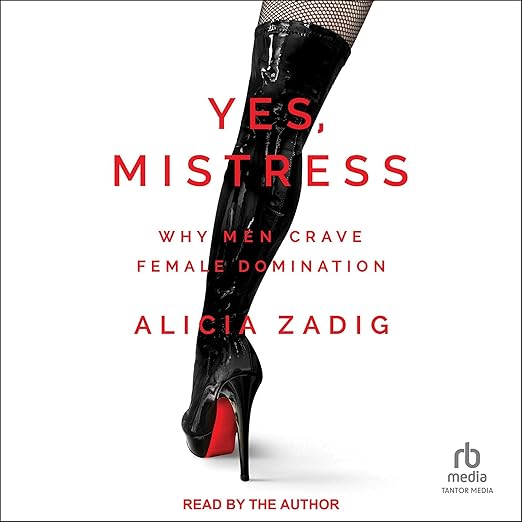
Quick Take
- Narration: Alicia Zadig self-narrates with the authority of someone who has spent years discussing this material professionally, the insider voice is load-bearing for this content.
- Themes: Female domination and male submission, psychology of power exchange, BDSM in cultural and historical context
- Mood: Curious and analytical, with the energy of someone genuinely interested in explaining rather than sensationalizing
- Verdict: A well-researched exploration of female domination and male submission that works equally for those within the dynamic and those trying to understand it from outside.
I was somewhere in the middle of Yes, Mistress when I realized Alicia Zadig was doing something genuinely difficult: she was writing about a subject that almost everyone has strong reactions to, male submission to dominant women, and treating it as a topic worthy of the same careful inquiry as any other aspect of human psychology. Not sensationalized, not pathologized, not defended in the particular exhausted way that people who’ve spent years being misunderstood sometimes write. Just examined, with curiosity and access.
Zadig is a working dominatrix with years of professional experience, and that position gives her a form of evidence that academic research typically can’t access. She has spoken directly with the men who seek this dynamic, heard the things they say when they’re not performing, observed what actually happens in the space between their stated desires and their lived experience. Yes, Mistress draws heavily on this firsthand knowledge while framing it through psychology, cultural history, and media analysis. The combination is what makes it work.
The Question at the Center
The book’s central question, why do men crave surrendering to a dominant woman?, sounds tabloid-simple, but Zadig takes it seriously as a genuine inquiry into desire, gender, and power. The dominant cultural narrative about masculinity in most Western societies is one of control, agency, and authority. Male submission inverts all of that deliberately. Why? What does the surrender provide that the performance of dominance doesn’t? What is the relationship between everyday social power and erotic submission to female authority?
Zadig works through multiple frameworks to approach these questions: psychological (the relief of releasing control for people who hold significant responsibility), cultural (the historical oscillation in attitudes toward powerful women), and personal (the specific testimonies of the men she profiles). The combination gives the book a layered quality that a purely clinical account would lack. When she quotes the men themselves, their attempts to articulate desire that society gives them no language for, those passages have a genuine human weight.
The Historical and Cultural Context
One of the book’s more distinctive contributions is its historical excavation of female dominance across cultures and periods. The dominatrix is often positioned as a thoroughly modern figure, a product of post-sexual revolution culture or internet pornography. Zadig pushes back against this significantly, tracing representations of powerful, dominant women and the men who submitted to them across much older cultural traditions. This isn’t mere antiquarian interest, it serves the book’s argument that male submission is not pathological deviation but a recurring pattern in human sexuality with deep roots.
The media analysis chapters examine how female domination has been depicted in film, television, and literature, and how those depictions have shaped what people understand about the dynamic. This section will feel familiar to readers who have engaged with cultural studies approaches to sexuality, but it adds value for general readers who haven’t thought about where their assumptions about dominatrixes come from.
Self-Narration as Professional Signal
Zadig reading her own work adds something specific that a hired narrator couldn’t replicate. Her voice carries the ease of someone who has spent years talking about these topics in professional contexts, and the effect is of a guide who is neither embarrassed by the material nor performing transgression for effect. Reviewers consistently note how “well-researched” and “easy” the book is to engage with, and the narration contributes to both qualities. At nine and a half hours, the runtime is appropriate for the depth of material covered.
The 4.3 rating from 134 reviews is solidly positive for a book in this specific niche. Reviewers from different perspectives, those inside the dynamic, those simply curious, report finding it useful and enlightening. One called it “a good introduction to the community from an insider’s view,” which is accurate. Another praised the psychological and historical framework. The range of positive responses suggests it works across multiple entry points.
Who Should Listen, Who Should Skip
This works for people who are in or curious about female domination dynamics, for partners of submissive men who want to understand the psychology, and for general readers interested in how gender and power intersect in erotic life. It also functions as a good introduction to BDSM scholarship more broadly for people who want a readable, narrative-driven starting point rather than an academic text.
It’s not explicit in the way erotica is, the content is analytical and ethnographic rather than arousing by design. Readers looking for explicit fiction or fantasy will find the wrong register here.
Frequently Asked Questions
Is Yes, Mistress written as a guide for dominatrixes, or is it more of an explanatory and analytical text?
It’s primarily analytical and explanatory rather than instructional. Zadig explores the psychology, history, and cultural context of female domination and male submission rather than providing a how-to guide for practitioners. Those looking for practical instruction would find playing guides or D/s practice books more directly applicable.
Does the book address the experience of amateur couples who explore female domination, or is it focused on professional dominatrix-client relationships?
The book covers both professional and personal dynamics. While Zadig’s professional experience is her primary evidence base, the psychological and relational material she discusses applies to couples exploring power exchange in private relationships as well. Several reviewers found it applicable to their personal situations.
How does Zadig handle the question of consent and the difference between healthy power exchange and potentially harmful dynamics?
The book takes consent as foundational throughout. Zadig’s professional background includes extensive engagement with the ethical frameworks of the BDSM community, and the distinction between consensual submission and coercive dynamics is treated as important rather than glossed over.
Is this book appropriate for someone who has a partner exploring submissiveness and wants to understand it better?
This is one of the book’s most practical applications. Partners who don’t share the submissive orientation but want to understand it are likely to find Zadig’s explanatory approach and the first-person testimony from the men she profiles genuinely illuminating about dynamics they’re observing but may not intuitively grasp.