Quick Take
- Narration: Callie Beaulieu reads Schaub’s self-deprecating voice with warmth and good comic timing that makes the memoir format feel genuinely personal rather than performed.
- Themes: Object attachment and identity, the psychology of keeping versus discarding, family history as physical accumulation
- Mood: Warm, frequently funny, and occasionally unexpectedly moving about the weight of personal history
- Verdict: A more psychologically interesting clutter memoir than the category usually delivers, at its best when Schaub stops organizing and starts asking why she cannot.
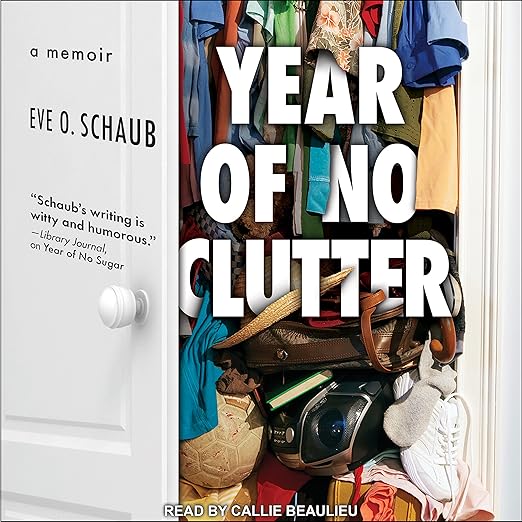
There is a specific breed of home organization book that uses the promise of a tidier house to deliver something more unsettling: a reckoning with all the reasons you accumulated the mess in the first place. Year of No Clutter, Eve O. Schaub’s account of tackling the hell room in her Vermont farmhouse, belongs firmly to that second category, even if it arrives dressed as the first. I finished it on a Saturday afternoon when I had been meaning to sort out my own overstuffed storage closet and never quite started, which felt appropriately on-theme.
Schaub approaches the problem of her hell room, a catch-all space where every unkillable object in the house eventually ended up, as both a practical project and a philosophical inquiry. She knows, and says directly, that the room is not really about old vinyl raincoats or fifth-grade report cards. It is about what those objects represent, which is time, identity, and the anxiety that throwing something away is a form of self-erasure. That is a genuinely interesting premise for a memoir, and when Schaub is honest about it, the book delivers something the decluttering genre rarely does. It asks the question underneath the question: not how do we get rid of things, but why do we keep them in the first place, and what does the answer reveal about who we think we are.
The Hell Room as Family Portrait
What distinguishes Schaub’s approach from standard decluttering guides is that she lets her family into the narrative in a way that complicates the project from every direction. Her children have opinions about what should stay. Her husband has a different relationship to object-keeping than she does. The hell room is not just her accumulated past; it is the physical record of a household’s overlapping histories and everyone’s competing claims on what counts as worth preserving. When she unpacks an object, she is often unpacking a story about someone else’s attachment to it as much as her own.
This family dimension is where Callie Beaulieu’s narration earns its place most fully. Beaulieu reads the comedic passages with enough lightness to make the book feel like a conversation rather than a confessional, and the warmth she brings to the family scenes keeps the memoir from tipping into a personal essay about anxiety and avoidance. The humor is genuine throughout, as reviewer C. Brown noted: information, humor, and honesty of being a little crazy, all working together. Beaulieu does not oversell the comedy or underplay the moments when the material gets genuinely heavy. That balance is harder to maintain than it looks.
Where the Book Gets More Interesting Than Expected
The section of the book that caught me most off guard was Schaub’s extended meditation on why we keep things at all, and what the compulsion to hold on says about how we understand identity and time. She is not making a clinical argument here. She is thinking through her own experience and arriving at something that feels genuinely true: that objects are not just objects but tiny reference points in a self-narrative, and that discarding them can feel like editing the record of who you were. Our things, she argues, represent our memories, our history, a million tiny reference points in our lives. If we throw our stuff in the trash, where does that leave us.
This is closer to an essay in the tradition of Adam Gopnik or Anne Fadiman than to the decluttering advice category. Listeners who come looking for Marie Kondo-style actionable guidance will find the book frustratingly indirect. Listeners who want to understand their own resistance to decluttering, rather than overcome it through an organizational system, will find Schaub unusually honest company. The book does not tell you how to clean out your hell room; it tells you why you have not already done it, which is the more interesting question.
A Note on Reviews and What This Book Is Actually About
Some reviews visible for this title appear to address Schaub’s earlier book, Year of No Sugar, rather than Year of No Clutter. The two books share an author, a self-experimental format, and similar critical reception, which has created some confusion in the review ecosystem. This review addresses Year of No Clutter specifically, and the distinction matters because the two books have genuinely different emphases. Year of No Sugar is more high-concept, externally focused, and practically demonstrable. Year of No Clutter is more introspective, more psychologically nuanced, and more interested in the interior life of a person who cannot let things go than in the mechanics of letting them go.
Who Should Listen and Who Will Want Something Else
This audiobook works well for listeners who find the decluttering-memoir genre interesting but want something with more psychological texture than most of its peers deliver. Beaulieu’s narration suits the confessional and comedic tone in equal measure, and the 8-hour 58-minute runtime does not overstay its welcome. The book is funny without being fluffy, and honest without being relentlessly heavy. If you want a practical system for organizing your house, look elsewhere. If you want a thoughtful, frequently hilarious examination of why you keep everything you keep, and what that habit says about your relationship to your own history, Schaub earns her time. Reviewer Sedonia Guillone’s description of the writing style as funny, honest, and reading like a long blog of a project more of an odyssey, is accurate in the best sense: you are along for a specific journey, with a specific person, working through something that turns out to be more complicated than she expected.
Frequently Asked Questions
Is Year of No Clutter practical in the same way as The Life-Changing Magic of Tidying Up?
No. Schaub’s book is a memoir and personal essay first. It does not provide an organizing system or step-by-step decluttering method. It explores the psychology of clutter rather than offering a practical cure for it. Readers who want actionable frameworks should look elsewhere; readers who want to understand their own resistance to decluttering will find Schaub unusually useful.
Is this the same book as Year of No Sugar?
No. Schaub wrote both books using a similar self-experimental framework, which has caused some confusion in reviews. Year of No Sugar documents her family’s attempt to live without added sugar for a year. Year of No Clutter documents her attempt to address the hell room in her farmhouse. They are companion works but entirely distinct.
How does Callie Beaulieu’s narration suit the book’s blend of humor and introspection?
Beaulieu reads Schaub’s self-deprecating voice with good comic timing and consistent warmth. The humor lands without the narration becoming performative, and she handles the moments of genuine emotional weight without over-dramatizing them. The balance suits the memoir’s conversational register throughout.
Will listeners who have never struggled seriously with clutter or hoarding find this relatable?
Yes. Schaub’s central argument is that everyone has a hell room in some form, and the psychological patterns she identifies around object attachment and identity are broadly human rather than specific to hoarders. The scale of her particular situation may be unusual; the underlying impulses she examines are not.