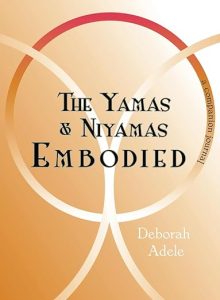
Deborah Adele has spent years teaching the Yamas and Niyamas as the ethical bedrock of yoga practice, and her companion journal audiobook arrives as something genuinely uncommon in the wellness space: a guide that does not simply describe transformation but attempts to facilitate it in real time. I came to this audiobook at the tail end of a stretch that had felt busy in the wrong ways, full of obligation and empty of reflection. The idea of spending time with a practice-based exploration of yoga's ten ethical principles sounded, honestly, like relief. What I found was something more demanding than I expected, and more rewarding for it.
At four hours and eighteen minutes, this audiobook occupies its own temporal pocket. It is not background listening. Adele makes that clear from the outset. The format blends short-form journaling prompts, author-led meditations, and invitations to specific yoga poses. The listening experience is designed to interrupt itself. You pause. You draw. You sit. That rhythm takes adjustment if you are accustomed to consuming audiobooks while doing something else, but once you surrender to it, the pacing feels exactly right.
How Yamas & Niyamas Holds Up
What distinguishes Adele's approach from the flood of mindfulness titles released in any given year is her commitment to the body as a site of knowledge. She does not treat the Yamas and Niyamas as abstract philosophical concepts to be intellectually absorbed. Instead, each principle, from Ahimsa (nonviolence) through Ishvara Pranidhana (surrender to the divine), is approached through somatic engagement: attention to sensation, opposite-hand drawing as a way of bypassing habitual thought, and yoga poses selected not for fitness but for what they surface emotionally. The effect is that ideas which might read as lofty in a lecture become grounded and personal in a way that feels earned.
Adele's framing of the healing dimension is specific and honest. She explicitly addresses the work of shedding biases and generational harm, framing the body as something that has been shaped by forces beyond our choosing and that can, with practice, be heard rather than overridden. That is a more sophisticated model of wellness than what most self-help audio content offers, and it earns the format's demand for active participation.
Why Yamas & Niyamas Works as an Audiobook
Laura Jennings's narration is well-matched to the material. Her delivery is calm without being soporific, and she navigates the meditative passages with genuine attentiveness. There are moments in guided meditation recordings where a narrator's voice simply performs relaxation rather than embodying it, and Jennings largely avoids that trap. She reads the journaling prompts with the same evenness as the expository sections, which prevents the audiobook from breaking its tone when it shifts modes. For listeners who respond to audio-guided practice, her presence makes the meditations feel guided rather than merely read.
The companion journal aspect also means the audiobook has a different relationship to replay than most. Listener Stacey Luikaart described the experience as giving space to really dive in on the yamas and niyamas while helping her understand, digest the information, and then incorporate it into her life. That is precisely the design. Individual chapters can be returned to during different seasons of practice, and the self-observation exercises will surface different things depending on where you are in your life when you engage with them. Repeated listening is built into the architecture.
Weak Spots in Yamas & Niyamas
Adele works through all ten principles in sequence, and not all of them will carry equal weight for every listener at any given moment. Some chapters will land as immediately clarifying; others may feel more distant until the right circumstances bring them into focus. That unevenness is not a flaw so much as a feature of the material. The Niyamas, the internal observances, tend to carry more friction than the Yamas for many practitioners, and Adele does not soften that. Her treatment of Tapas (discipline) and Svadhyaya (self-study) is particularly clear-eyed about how these principles can be misused as tools of self-punishment before they become tools of self-knowledge.
The multisensory approach, combining audio-led meditation, movement, and drawing, does ask something of the listener that purely text-based or lecture-based formats do not. You need to be in a physical space where you can practice. Attempting this audiobook on a commute or while cooking will strip out most of what gives it its particular value. That is a genuine logistical consideration, not a criticism of the content. It is, however, worth knowing before you begin.
The Right Listener for Yamas & Niyamas
This audiobook is well-suited for yoga practitioners at any level who want to move beyond the physical postures and into the philosophical and ethical dimensions of the practice. It will resonate particularly with those drawn to introspective work, listeners who respond to guided meditation formats, and anyone who feels that wellness media often stays too theoretical to actually shift anything. It complements Adele's earlier book on the same subject rather than replacing it, so readers who have engaged with that text will find additional depth and new entry points here.
Listeners who need audiobooks to work as background media, or who find guided pauses in audio frustrating, will likely find the format at odds with their habits. The same goes for those looking for a secular mindfulness framework stripped of yogic tradition. Adele grounds everything in the practice's actual lineage, and that context is integral to the work, not decorative. The yoga philosophy tradition the book inhabits is present throughout, not as background color, but as the actual substance of what is being taught.
A Few Questions About Yamas & Niyamas
Is the narration by Laura Jennings effective for the meditation sections of this audiobook?
Jennings brings a measured calm to the meditative passages that works well. She avoids performing relaxation artificially, which is a common pitfall in guided meditation recordings. Her delivery stays consistent across expository, contemplative, and practice-prompt sections.
Does the audiobook cover all ten Yamas and Niyamas, or focus on selected ones?
All ten principles are covered in sequence. Each receives dedicated attention through the layered format of embodied practice, self-observation, and journaling. Some will resonate more than others depending on where you are in your own practice, and the design supports returning to individual chapters over time.