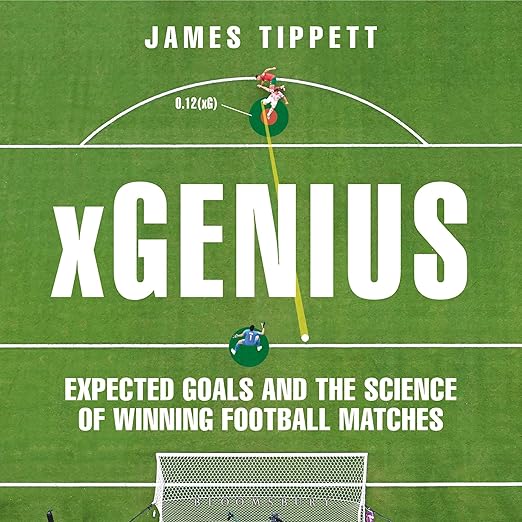
xGenius asks a deceptively simple question: if Expected Goals has been mainstream football discourse for years, why do so many people still explain it badly? James Tippett's audiobook, narrated by Simon Darwen, attempts to answer that question by doing what the metric's popularizers often failed to do: explaining not just what xG measures but what it means for how matches are actually won, how players are valued in transfer markets, and how clubs like Brighton, Brentford, and Liverpool have turned analytical rigor into sustainable competitive advantage at a fraction of the spending of their peers. This is a nine-hour audiobook about football data, and it does not assume you enjoyed statistics at school or have any prior exposure to the analytical literature.
xG Doubles as a Recruitment and Tactical Tool
The central argument Tippett makes is that Expected Goals is not primarily a commentary metric: it's not just a more sophisticated way to say whether a team was fortunate or unfortunate on a given Saturday afternoon. It's a planning tool, a recruitment filter, and a tactical framework, and the clubs that understood this earliest extracted disproportionate value from the insight before it became widely distributed knowledge. The xG model, properly applied, predicts with reasonable reliability which teams are sustainably good and which are performing above or below their structural ceiling. Tippett's contribution is to make this concrete rather than abstract, using match data, specific transfer decisions, and tactical analyses that show the model operating in the real world rather than in controlled analytical conditions.
Darwen's narration handles the statistical material by treating it the way good sports journalism treats statistics: as tools for telling stories rather than as technical content requiring separate explanation. The chapters on Brighton's recruitment under Graham Potter and Brentford's approach under Matthew Benham are among the audiobook's strongest, because they show the xG framework generating specific, legible decisions with visible and verifiable consequences. When Tippett explains why Brentford bought certain players in the way they did, or why Brighton's style of play is structurally incompatible with certain opposition defensive setups, the xG model becomes more than a number on a broadcast graphic. It becomes a decision-making framework that produced observable outcomes.
Jamie Carragher's endorsement reflects something genuine about the audiobook's unusual positioning. Carragher is not a data evangelist: he's a former professional who explains football through what he saw on the pitch: and his endorsement suggests that xGenius works as a bridge between the analytical world and the practitioner world, which is precisely what most football data books fail to achieve.
Arsenal Explains Regression to the Mean
The Arsenal passages are worth particular attention. Tippett uses Arsenal's xG history over several seasons as a case study in how a club can perform consistently well against the metric for extended periods before the underlying quality finally emerges in results. It's one of the clearer explanations available in audio or print of what "regression to the mean" actually means in football terms, expressed through a team that most English-speaking football listeners will have opinions about and can therefore evaluate against their own watching experience. That combination of analytical explanation and personal reference point is what makes the method effective throughout the book.
For listeners who have been following the broader data revolution in football: Moneyball comparisons, StatsBomb, the analytics departments that now exist at essentially every top-flight club: xGenius provides the most accessible single entry point into understanding what that revolution actually changed about how football decisions get made. It's not about the tools or the technology; it's about the decisions, and Tippett keeps that distinction clear throughout the nine hours.
Darwen sustains his energy and clarity across the full runtime, which matters more for an analytical text than for narrative fiction. The middle sections, where Tippett develops the theoretical foundations of xG in more technical detail, require more active listening than the case study chapters, but Darwen's pacing holds the material together without losing the momentum the opening chapters build.
Nine Hours That Reward Active Engagement
At nine hours, xGenius demands a real commitment, and some listeners will find the more technical chapters in the middle sections require more concentration than the narrative case studies. This is not background listening: it rewards active engagement, and listeners who try to absorb it passively will find the analytical content sliding past without landing. Darwen's narration is clear and energetic enough to help, but the material itself requires attention in ways that narrative audiobooks don't.
The book was written at a specific point in the development of football analytics, and some of the examples involving specific managers, clubs, or players may have shifted in relevance since publication. Brighton's approach, for instance, evolved significantly after the period Tippett documents most fully. The principles are durable; the specific case studies will feel more or less current depending on how much the clubs in question have changed. This is an inherent limitation of sports journalism and analytics writing rather than a specific criticism of this title, but it's worth knowing when calibrating expectations for specific examples.
How the Data Revolution Changed Club Behavior
Football supporters who have been hearing about Expected Goals for years and want a coherent explanation of what the model actually means for how the game is played and managed will find xGenius the most accessible audiobook in this space. Prior statistical knowledge is not required: Tippett builds the concepts from the ground up and consistently grounds them in match and transfer examples that make the technical content concrete and evaluable against real events. Darwen's narration makes the nine hours more accessible than the same content in print would be for many listeners.
Those who already work in or closely follow football analytics will find the introductory material familiar, but the case study chapters on Brighton, Brentford, Liverpool, and Arsenal offer enough specificity to hold interest. This is one of the better audiobooks available for understanding how the data revolution in football actually changed club behavior and decision-making rather than merely changing the vocabulary of post-match commentary: and that's a more interesting and more useful story than the vocabulary change alone would be.