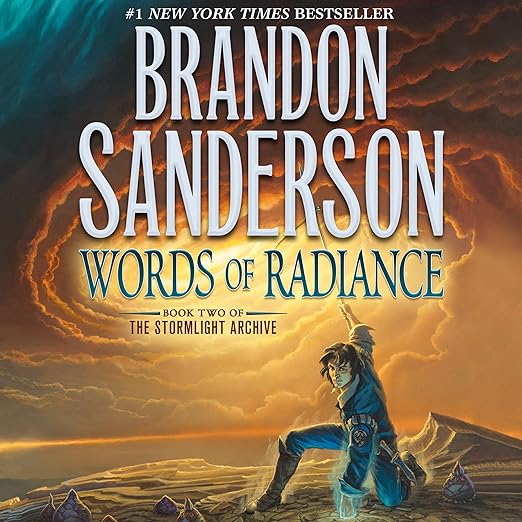
Nobody buys a forty-eight-hour audiobook casually, and Macmillan Audio is not pretending otherwise. Words of Radiance arrived in March 2014 as volume two of the Stormlight Archive, forty-eight hours and fifteen minutes of it, with one reader credited on the file. Brandon Sanderson has never apologized for length, and this is the length in question. Two full working weeks of daily listening, a month of dog walks, or one very committed run of weekends. What that time buys, and what it costs the person spending it, is the whole question worth asking here.
From Admiring the First Book to Loving This One
Three storylines run in parallel, and the description sets them pulling against each other from the first page. Kaladin, expected by his enemies to die as a military slave and instead handed command of the royal bodyguards, a controversial first for a low-status darkeyes, has to shield the king and Dalinar while secretly learning to use powers tied to his honorspren, Syl. Szeth, the Assassin, is killing rulers across Roshar with abilities nobody can counter, and Dalinar sits high on his list. Shallan, called brilliant and troubled and broken in ways she refuses to acknowledge, is trying to reach the Shattered Plains and discovering that arriving is harder than she imagined.
The single most useful thing a prospective listener can hear about this volume arrived in April 2014, five stars, and it is a conversion story. That reader came to the book having admired The Way of Kings without ever being caught by it, and left calling this one a possible new favorite. The trajectory recurs often enough around this series to be worth planning for. Volume one does an enormous amount of construction; volume two gets to spend the material that construction bought. Anyone who finished the first book respecting it more than enjoying it should read that as an argument for continuing rather than a reason to stop.
Eighty-Nine Grades and Not One Mentions Kramer
One reader is credited for all forty-eight hours, and the written column has nothing whatever to say about the performance. Eighty-nine grades sit on the file, five people have written full responses, and not one mentions Michael Kramer, the pacing, or the voices. On a book this long that gap genuinely matters, because the distance between a good reader and a merely adequate one compounds across two working weeks in a way it never does across six hours. Sample a Shallan chapter and a Kaladin chapter rather than the opening. Multi-viewpoint epics succeed or fail on whether a switch feels like a change of camera instead of a change of subject.
What the book does uncommonly well is manage deliberate disorientation, and the reader who filed five stars in November 2015 puts a finger on the mechanism: being dropped into the middle of a world and its rules with no explanation offered, which normally provokes irritation and here does not. That is a specific compliment and a hard trick to pull off in audio, where a puzzled listener cannot flip back forty pages to check something. The rules of Roshar arrive by demonstration rather than instruction, which suits a format that punishes exposition and rewards accumulation over long stretches.
One Listing's Ratings Are Not the Whole Story
Eighty-nine ratings. That is the population sitting at the top of a listing for volume two of a series the description itself introduces as the work of a number one New York Times best-selling author, and it is obviously not this book's reception. It is one listing's slice of it, the residue of editions splitting, formats splitting, and a catalog filing the same story in several places at once. The 4.8 average is real and means something. The population behind it measures nothing about how widely the book has been read, and a buyer using that counter to judge whether the series is worth beginning will reach a badly wrong answer.
The written column is not quite what it appears either. Of the five responses, one is written entirely in German on an English-language listing, engaging seriously with the structure while measuring Sanderson's turnaround time against Robert Jordan's. Responses under any listing are pooled across markets, and somebody scanning fast for a verdict may skip the most substantive paragraph on the page purely because of the language it arrived in. The genre fields file this under literature and fiction as well as science fiction and fantasy, with an Action and Adventure tag that is accurate and still undersells how much of these forty-eight hours goes to politics, grief and argument.
Stop Wondering Whether Book One Pays Off
Readers who finished The Way of Kings and are still wondering whether the series pays off should stop wondering and start this. The case for continuing is strongest precisely for anyone who found the first volume impressive rather than compulsive. Listeners with long solitary hours available, long shifts, long training runs, extract more value per dollar from a book this size than from nearly anything else on the shelf, and the multi-strand construction suits a format you dip into daily over weeks rather than consume in one push.
Starting here is a mistake, and not a recoverable one. The description opens by naming The Way of Kings as the book this continues, and all three plot lines depend on positions established there. Listeners who dislike multi-viewpoint structure, or who lose patience when a chapter cuts away from the character they came for, should weigh that carefully too, since the Parshendi material and Eshonai's decision claim real space at moments when other threads are tightening. Forty-eight hours is an expensive way to discover the structure is not for you.
- Performance: A single credited reader carries a multi-viewpoint epic across two working weeks of listening, which is an endurance assignment as much as a performance.
- What it covers: Honor as a practical problem, slaves and highprinces on one battlefield, an enemy deciding what to become
- Feel: Immense, patient and steadily tightening
- Our call: The volume where the series stops building and starts spending, and the worst possible place to meet it first.
Common Questions
Can the Stormlight Archive be started with this audiobook?
No. The description introduces this as audiobook two, continuing the epic that The Way of Kings began, and every thread depends on positions established there: Kaladin's command of the bodyguards, Dalinar's standing, Shallan's burden, the long war at the Shattered Plains. Beginning here means meeting consequences with none of their causes.
Who are the Parshendi, and why does the description give them a paragraph of their own?
They are the people the Alethi have been attacking for years, and the copy says their numbers keep shrinking. Their war leader Eshonai persuades them to gamble on the supernatural forces they once fled, with consequences framed as dangerous for humans and Parshendi alike. That decision is a third plot line rather than a subplot.
How should a listener pace an audiobook this long?
Daily sessions spread over a couple of weeks, give or take. Because three separate storylines run in parallel before converging, long gaps between sessions cost more here than they would in a single-thread novel. An hour most days keeps the threads live; an occasional listener will lose track of who is where and why.