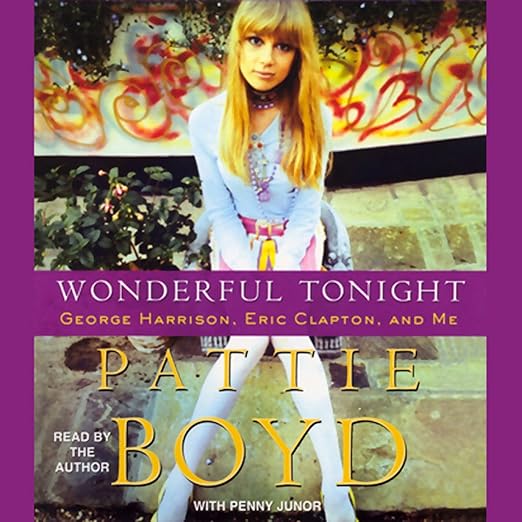
Under two hours is the first thing to notice on this listing, and it does not match the book being described. Pattie Boyd's memoir covers 1964 onward: the Beatles, a marriage to George Harrison, a second marriage to Eric Clapton, and a forty-year silence finally broken. Random House Audio released this audiobook in August 2007 with Boyd reading, and nothing on the page explains how a life of that size has been fitted into a single sitting.
The Voice Belongs to the Person It Happened To
Random House Audio credits Pattie Boyd as the reader, which on a memoir this personal is the strongest argument the page makes. The voice describing a film set in 1964 belongs to the person it happened to, and no hired performer can manufacture that. Whether the recording preserves the whole book is a separate question, and it is precisely the one this listing declines to answer anywhere in its copy.
Pattie Boyd was twenty when George Harrison proposed, ten days after they met on the set of A Hard Day's Night, and the description's framing of everything after that is unusually blunt: two of the most addictive and promiscuous musical geniuses of the century, and the most famous muse in the history of rock and roll. A response posted in the first week of January 2026 praises the book for holding nothing back about the good, the bad, and the ugly of both relationships.
George Harrison's circle is the early subject, and the names arrive fast: Mick Jagger, Ron Wood, Jeff Beck, Paul and Linda, Cynthia and John, Ringo and Maureen. Boyd was inside the group's daily life rather than standing next to it, and the description promises the dynamics, the friendships, the tensions, and the music-making. This is what most people come for, and a memoir was always going to deliver it most easily.
Boyd Inspired Both Something and Layla
Memoirs read by their authors carry a particular risk and a particular reward, and one response here accidentally illustrates both. A three-star review from March 2008 praises a wonderful British accent that sounded distinguished and clever, except that the writer is describing a television interview caught one morning rather than this recording. The distinction is worth holding onto, because that is the nearest thing on the page to a remark about how Boyd sounds reading her own work.
Candor is the selling point, and the description refuses to hide behind euphemism. A letter beginning dearest l., a phone call from Eric Clapton, and the end of a marriage are all laid out in the product copy. Boyd inspired Something and Layla, which is a strange biographical fact for anybody to carry, and the book exists partly to explain what it cost to be the subject of songs other people cherish.
Layla is the obvious hook and the least interesting thing on offer. What actually distinguishes the memoir is ordinary texture: a twenty-year-old model absorbed into a circle with no precedent, watching four musicians turn into an institution while the marriages around them came apart under the pressure. Hearing that from the woman who lived it changes its weight, and that is the entire case for choosing this edition over the printed one.
No Abridgement Notice for an Impossible Length
Length is the problem nobody on the page addresses. One hour and fifty-seven minutes cannot hold a memoir running from 1964 to the present through two marriages and a broken silence, and no abridgement notice appears anywhere on this listing. Either a condensed edition is being sold without the label, or the stated duration is simply wrong, and a buyer deserves to know which before paying. Check the sample and check the chapter count.
One of the five written responses is not in English. It was left on the Japan storefront in December 2021 and is written in Japanese, which means an English-speaking buyer can neither read it nor treat it as evidence about this edition. That leaves four usable responses beneath the score at the top of the page, and one of those four sits at three stars, which is a thin foundation for any purchase.
Addiction and its consequences run through the later material, and one response is unusually direct about it. A four-star review from late January 2026 describes the years with Clapton as appalling, calls Boyd an abused woman, and rejects the memoir's own language of passion for a relationship conducted with somebody drunk around the clock. Whether you accept that reading or not, it is a useful signal about what the closing chapters contain.
Sample It First, the Reviewer's Own Advice
Beatles listeners are the obvious audience and will get exactly what they came for, because Boyd was inside the circle rather than reporting on it from outside. A February 2026 response thanks her for explaining why she left George and how she could then leave a man who wrote so well about her, and describes spending an afternoon living inside that world. That is the register here: gossip transformed into something much closer to sympathy.
Completists should establish what they are buying before they buy it. If this is a condensed edition, the names in the description, Jagger, Beck, Wood, the Harrison and Clapton households, will arrive as summary rather than as scene, and the pleasure of a memoir like this lives entirely in the scenes. Anyone after the complete account should compare the print edition against what is actually on offer here.
Sample it first, which is advice I would give about very few memoirs and give about this one without hesitation. The story is remarkable, the person telling it was there for all of it, and the voice is unarguably the right voice. What the listing has not told you is how much of that story is actually on the recording, and at this length that is the only question that matters.
- Narrator: Boyd reads her own memoir for Random House Audio, one voice, no cast, and no abridgement notice anywhere on the credits.
- Subjects: The Beatles from inside the circle, two marriages to famous musicians, addiction, life as the subject of other people's songs
- Tone: Intimate, glamorous, and steadily sadder
- Bottom line: The right voice telling a remarkable story, on a listing whose running time raises a question it never answers.
Is this audiobook abridged?
The page carries no abridgement notice anywhere, which is the whole problem. What the description promises and what the duration allows do not match, and no line on the listing reconciles them. Compare the chapter list and the sample against a print edition before committing, because the gap is not a small one.
Does Pattie Boyd read the audiobook herself?
She does, and that is the strongest reason to choose this over the printed edition. Boyd was twenty when the events of the opening chapters took place, and hearing them recounted in her own voice four decades later gives the memoir a doubled quality that nothing else supplies. Treat the sample as your guide to whether the delivery suits you.