
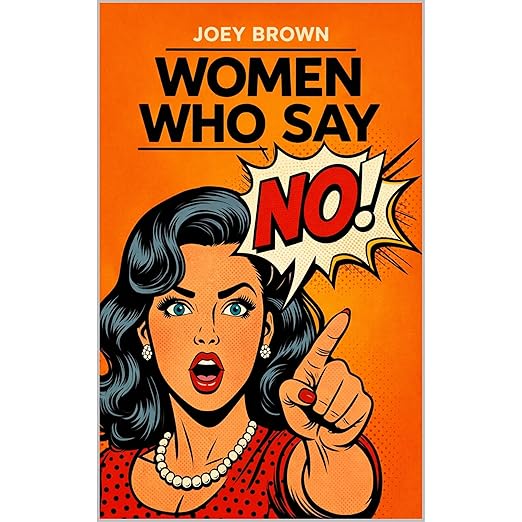
Key Details
- Themes: saying no without apology, boundaries with family and friends, burnout and reclaimed time
- Mood: Blunt and exhortatory, short by design
- Verdict: Take the push if you want it, but expect assertion rather than proof.
Eighty-four minutes is the whole of this audiobook, and the description promises five separate campaigns inside it: the guilty yes, boundaries with partners and children and relatives, the myth of the multitasking woman, the internal judge, and what the copy calls healthy selfishness. Divide the running time and each of those gets roughly a quarter of an hour. Short is not automatically thin. Blunt books about boundaries exist because long ones get abandoned on page forty. It does set the expectation at the right height before you start.
The Whole Book Rests on Seventeen Minutes
Joey Brown addressed a book to women about the price of the automatic yes, and the description refuses to bury the thing most likely to decide whether you want it. Brown writes, in the copy's own words, as an outside observer, a man who analyzes, studies and witnesses the daily dynamics of power and submission. That sentence is doing heavy work. It anticipates the obvious objection and answers it by claiming distance as a qualification rather than a limitation, which is a position you either accept in the first minute or spend eighty-three minutes resisting.
Castle imagery opens the pitch: a life built for everyone but you. From there the register stays in the second person and mostly in the imperative, promising a direct, impactful and strategic guide rather than what the copy dismisses as sugar-coated psychology. Nothing in the description names a study, an interview, a client or a case history. The argument runs on observation, and the observation is presented as coming from outside the experience being described.
Anatomy of the guilty yes is the copy's name for the opening stretch, which is the most promising item on the list, because it is the only one that promises a mechanism rather than a target. Understanding why refusal is difficult, and where the conditioning came from, is the piece a listener can actually apply to a conversation happening that evening. The four sections after it are applications of whatever that first one establishes, so the whole book rests on roughly seventeen minutes of groundwork.
Society Celebrates Your Exhaustion, the Copy Says
Boundaries in the social battlefield is the most concrete promise on the page, and it is the one worth buying for. Partners, children, relatives and friends who have grown accustomed to total availability are a harder problem than a demanding manager, because the relationship survives the negotiation and has to keep working afterward. Books that stop at the workplace script are easy to write. A book that starts with the people you cannot resign from is at least aiming at the difficult half.
Multitasking gets the sharpest formulation in the copy: society celebrates your exhaustion. Whether or not the chapter behind that line delivers, the sentence names the mechanism it wants you to notice, and a listener can carry it out of the file and use it the same afternoon. Compact nonfiction lives or dies on whether it leaves you with a usable phrase, and this one has at least identified which phrases it is aiming for.
Selfishness, in the copy's healthy formulation, closes the argument by tying rest and ambition to legacy: prioritizing yourself as the only route to something that is actually yours. The final lines drop the analysis altogether and become instruction. Stop asking for permission to exist. Reclaim your power. Learn to say no so your yes can finally be true. Those are the last words on the page, and they tell you exactly what kind of listening experience this intends to be.
An Instruction to Reclaim Power Lands as a Notification
Nobody has rated this. Five months after a March 2026 release, the rating field is empty and not one written response has appeared, which means every claim on the page is the author's own and any buyer is effectively the test case. That is a different situation from a book with mixed reviews. You cannot check the tone against a stranger's reaction, you cannot find out whether the promised battlefield chapter is specific or generic, and the pitch is the only evidence in the room.
Synthetic speech is what the credit field describes. Virtual Voice means machine-generated narration rather than a person in a booth, and that matters more here than it would on a reference title, because the closing third of this book is exhortation. Imperatives need conviction behind them. Delivered by a generated voice, an instruction to reclaim your power lands closer to a notification than to a challenge, and nothing recorded by a person exists on this record to compare it with.
Independently published is the imprint line, so no editorial house stands behind the manuscript, and the description never gestures at a research base. Combined with the empty column, a buyer has nothing external to lean on: no publisher's reputation, no reader reaction, no cited source. That does not make the argument wrong. It does mean the eighty-four minutes have to earn their keep entirely on their own, with no institution vouching for a word of it.
Machine Narration for an Hour and a Half
Permission is what this book thinks its reader is waiting for, and if that description fits, the format works in your favor. A single sitting gets you through the whole argument, which suits anyone who has stalled halfway through longer books on the same subject and wants the push without the framework. The direct address, the short span and the imperative ending are all designed for someone who already knows the diagnosis and wants the instruction.
Manifesto is the copy's own word for what it built, and manifestos are a poor fit for some listeners. Anyone who wants evidence, citations or case studies should look elsewhere, since the description offers none. Anyone who wants this subject handled from inside the experience will keep bumping into the standpoint the copy declares up front. And listeners who cannot settle into machine narration for an hour and a half should let that decide it here, because the material spends most of its length talking directly at you.







