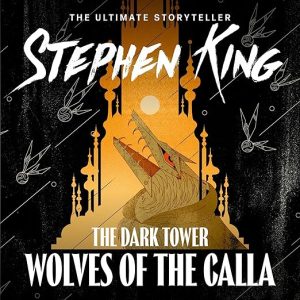
Roland of Gilead rides toward Calla Bryn Sturgis with three companions beside him, warned that the wolves are coming again. This audiobook, the fifth novel in Stephen King's Dark Tower series, finds the farming settlements of the Calla under threat from raiders who steal one child from every set of twins, leaving the sibling alive but permanently damaged, a horror the synopsis describes plainly as wolves who prey on twins. Roland's ka-tet, Susannah Dean, Eddie Dean, and Jake Chambers, arrives to help the Calla defend itself, all while Roland's real quest, the Dark Tower itself, keeps pulling at him from somewhere further down the path.
George Guidall narrates this installment, and that casting carries real series history worth knowing before you press play. Guidall took over the Dark Tower audiobooks starting with this fifth novel, after Frank Muller, who had narrated the first four books, was severely injured in a 2001 motorcycle accident that ended his career. Listeners moving from Muller's earlier recordings into Wolves of the Calla will notice the voice change immediately, and it helps to know going in that this is a deliberate, well-documented handoff rather than a licensing inconsistency.
The setup borrows its structural DNA from the classic Western tradition of hired guns defending a farming settlement from raiders, a lineage King has acknowledged drawing on directly, and that genre framework gives Wolves of the Calla a clearer three-act shape than some of the more loosely structured entries in the series. The Calla's own farmers are not passive victims waiting to be saved either; the town has to debate and vote on whether to accept Roland's help at all, adding real political texture to what could have been a straightforward defense narrative.
Mid-World itself, the series' term for its own changed, broken version of reality, operates on the famous in-world principle that the world has moved on, a phrase King uses throughout the series to explain why magic, technology, and history all coexist in half-functioning, contradictory forms. Wolves of the Calla leans into that decayed-world texture more than some other installments, giving the Calla's isolated farming community a specific, lived-in strangeness beyond generic fantasy setting-building.
Why Wolves of the Calla Works as an Audiobook
Jenny's review calls this the best series she has ever read, praising how the book re-acquaints listeners with characters pulled from several genres blended into one continuous story. T-Rex 5's review calls it a masterpiece and the best of the first five books specifically, citing the time and space dilation elements and the wolves-and-twins horror as standout material. At 4.7 across 11 ratings, the consensus among listeners who have stuck with the series this far is that book five ranks among the strongest entries.
Guidall's long experience with procedural thriller series, built over decades narrating Mitch Rapp and similar franchises, suits the Calla sections' slow-building dread and the increasingly layered plotting King introduces here, stacking the town's defense against the wolves on top of Roland's ka-tet's own fracturing loyalties and buried secrets.
King fans who enjoy the way he blends genres inside a single series will find that instinct fully on display here: horror-tinged child abduction, western-style hired-gun plotting, and the series' ongoing mythology about parallel worlds and the Dark Tower itself all operate simultaneously without any one register crowding out the others, which is part of why T-Rex 5's review calls the book's genre range one of its strongest features.
The 2017 film referenced in the synopsis drew loosely and controversially from multiple books across the series rather than adapting Wolves of the Calla specifically, and it was not well received by longtime readers, which makes the audiobook series, especially entries like this one, the more faithful way to actually experience King's original structure and pacing.
Weak Spots in Wolves of the Calla
Jana Perskie's four-star review calls this a slightly flawed continuation, and specifically references Susannah Dean's history as the duo-personality Odetta Holmes and Detta Walker, along with Eddie Dean's past as a heroin mule out of New York City, background listeners need already established from earlier books for the full emotional impact to land. This is not a jumping-on point: arriving at book five without the first four leaves the ka-tet's relationships almost entirely inert.
At 25 hours and 46 minutes, this is a substantial commitment even by Dark Tower standards, and the structure interweaves the Calla's immediate threat with slower mythology-building that pays off later in the series rather than resolving fully within this single volume.
Guidall has to differentiate a large ensemble of Calla farmers and townsfolk from Roland's four-person ka-tet without letting either group blur together, a real technical demand across nearly 26 hours, and he manages it by keeping the farmers' voices grounded and plain against the ka-tet's more varied, individually distinct registers built up across the previous four books.
Even within a single 26-hour volume, King interleaves multiple narrative threads, the Calla's defense preparations, Father Callahan's own troubled history, and Susannah's private physical crisis, without fully resolving all of them by the book's end, consistent with a series built to reward patient, long-haul listening over quick payoff.
Susannah's own condition, introduced gradually across earlier books and complicated further here, adds a layer of urgency to the ka-tet's mission beyond the external threat from the wolves, reminding listeners that Roland's companions are carrying their own unresolved crises even while risking everything for a community that is not their own.
The Right Listener for Wolves of the Calla
This suits existing Dark Tower listeners current through book four, Stephen King fans who enjoy his genre-blending of horror, western, and fantasy elements, and anyone ready for a long, patient listen that rewards series investment.
Skip it if you are new to the series; start with The Gunslinger instead. Listeners deeply attached to Frank Muller's narration of the earlier books should also know that Guidall's voice, while excellent on its own terms, is a genuine change from what came before.
The Short Version
- Narration: George Guidall took over Dark Tower narration starting with this fifth novel, after Frank Muller's career-ending accident, and his procedural-thriller pedigree suits the Calla's slow-building dread.
- Themes: Found family under threat, a quest that keeps deferring its own resolution, sacrifice for a community that does not fully trust its saviors
- Mood: Sprawling, tense, genre-blending epic
- Verdict: Essential listening for anyone current through book four, a poor entry point for anyone new to the series.
Why does the narrator sound different from earlier Dark Tower audiobooks?
Frank Muller narrated the first four Dark Tower novels before a 2001 motorcycle accident ended his career. George Guidall took over starting with this fifth book, a well-documented series handoff rather than an error.
Does this audiobook connect to the Dark Tower film adaptation?
The synopsis references the 2017 film starring Idris Elba and Matthew McConaughey as promotional context, but the film draws loosely from the series overall rather than adapting this specific novel directly.